

How Often to Lubricate Your Garage Door: Best Tips
Tips, Insights, and News from the Garage Door Experts

Why Knowing How Often to Lubricate Your Garage Door Saves You Time and Money
How often to lubricate your garage door depends on how much you use it and where you live — but for most Maryland homeowners, twice a year is the right starting point. Skip this simple task and you’ll likely end up with squeaky, grinding, or sluggish door movement that puts extra strain on every component in the system.
Quick Answer: Garage Door Lubrication Frequency
| Usage Level | Recommended Frequency |
|---|---|
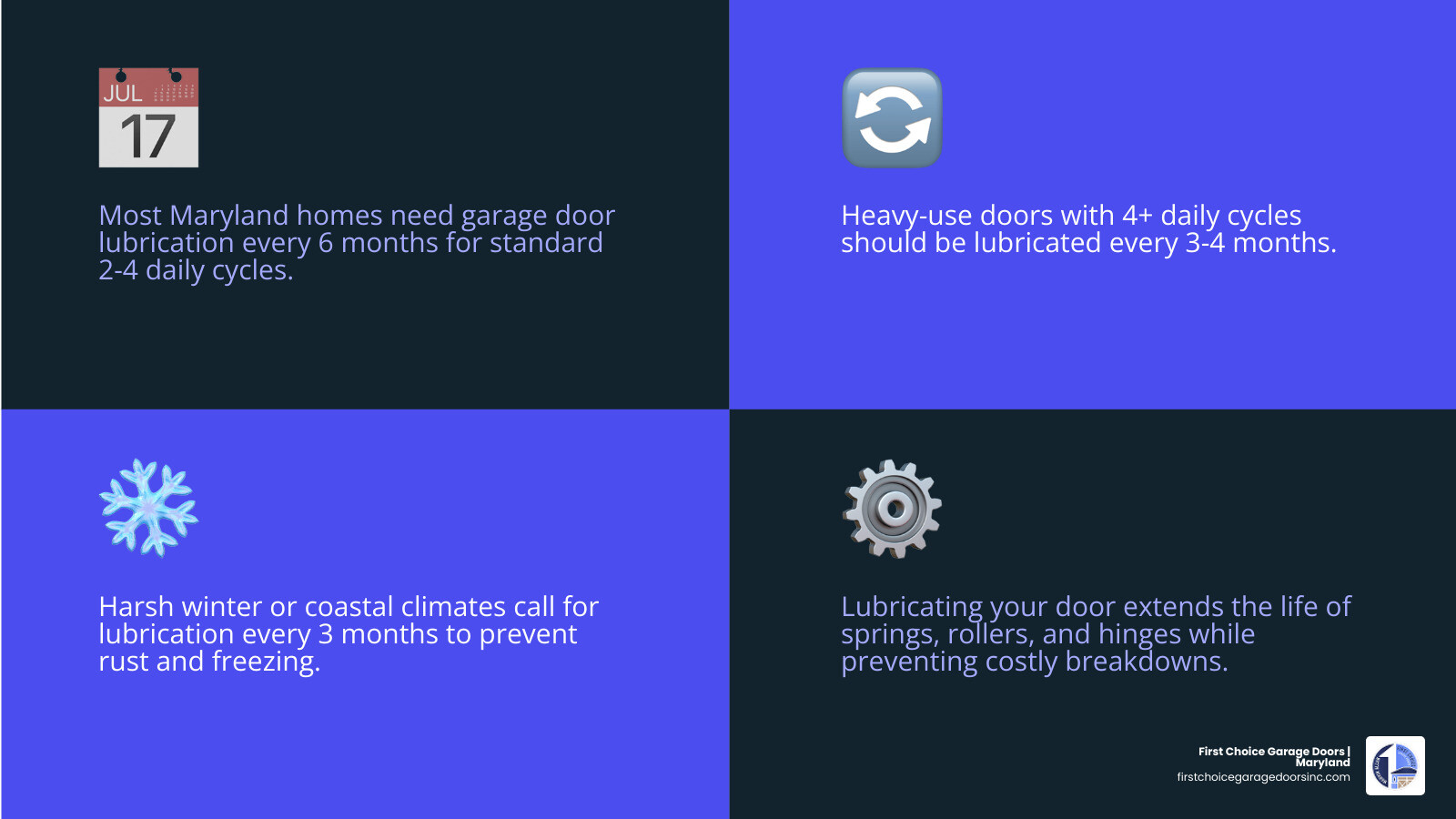
| Standard use (2-4 cycles/day) | Every 6 months (spring and fall) |
| Heavy use (4+ cycles/day) | Every 3-4 months |
| Harsh or coastal climates | Every 3 months |
| Older equipment | Every 4 months |
| After noisy or jerky operation | Immediately |
Your garage door is the largest moving object in your home. It lifts hundreds of pounds of metal dozens of times each week. Without proper lubrication, metal parts grind against each other, wear down faster, and can eventually fail — sometimes at the worst possible moment.
The good news? Lubricating your garage door takes about 15-20 minutes and costs very little. Done on the right schedule with the right product, it can extend the life of your springs, rollers, and hinges by years.
How Often to Lubricate Your Garage Door
If you are wondering exactly how often to lubricate your garage door, the general industry benchmark is every three to six months. In a perfect world, setting a recurring reminder on your calendar twice a year — once in the spring and once in the fall — is the easiest way to stay on track.
This twice-yearly maintenance routine aligns with the natural transition of the seasons. By lubricating your system in the spring, you clear away any salt, grit, and moisture left behind by harsh winter storms. By lubricating again in the fall, you prepare the metal components to withstand the upcoming freezing temperatures, which can cause metal to contract and lubricants to thicken.
Regularly applying a light coat of high-quality lubricant acts as a protective barrier against friction, rust, and premature wear. When you Keep It Greasy With Regular Garage Door Lubrication, you ensure that the load is distributed evenly across the hardware. This simple habit keeps your daily departures and arrivals whisper-quiet and prevents unexpected mechanical breakdowns.
Determining How Often to Lubricate Your Garage Door Based on Climate
In Maryland, our weather is anything but static. Homeowners from Columbia to Easton and up to Frederick experience a full range of seasonal shifts. We have hot, humid summers that feel like a swamp, and freezing winters that bring ice and snow. These climate fluctuations directly impact how your garage door components behave.
During our freezing winters, metal components contract. This contraction increases the friction between moving parts. Furthermore, standard grease can harden in extreme cold, making it much harder for your garage door opener to lift the door. Applying a cold-weather-resistant lubricant in late autumn is a crucial step. You can read more about keeping your system running smoothly through the chilly months in our guide on Garage Door Maintenance Tips for Winter.
Conversely, our humid summers introduce a different set of challenges. High humidity levels accelerate rust and corrosion on exposed steel components, especially torsion springs and hinges. In coastal or high-humidity areas like Easton, the salt air and moisture can quickly corrode metal hardware. To combat this, you should inspect your door and apply a fresh layer of moisture-displacing lubricant every three months. For more summer-specific advice, check out our Garage Door Maintenance Tips for Summer.
Adjusting How Often to Lubricate Your Garage Door for High-Use Systems
Not every household uses their garage door the same way. If your garage serves as the primary entryway for your home, your door likely experiences heavy daily use.
To determine your ideal schedule, consider your daily cycle count. A “cycle” consists of the door opening once and closing once.
- Standard Use (2 to 4 cycles per day): This is typical for a household where the door is opened in the morning to leave for work, closed, and then opened and closed once more in the evening. For this level of activity, lubricating every six months is perfectly adequate.
- Heavy Use (4 or more cycles per day): If you have teenagers driving, run a home business, or frequently use your garage for hobbies and yard work, your door may open and close eight to ten times a day. This frequent movement accelerates wear. For high-use systems, we recommend lubricating every three to four months.
- Older Equipment: As garage door systems age, the bearings, rollers, and hinges naturally develop slight play and wear. Older equipment is more prone to friction and alignment issues. If your door has been in service for several years, shortening your lubrication interval to every four months will help cushion these aging components and extend their operational lifespan.
To make the process as straightforward as possible, you can follow our simple How Often to Lubricate Your Garage Door: 5 Easy Steps guide to establish a consistent, efficient home maintenance routine.
Best Lubricants for Garage Doors
Using the right product is just as important as knowing how often to lubricate your garage door. Grab the wrong can from your workbench, and you could end up attracting dirt, gumming up the bearings, or stripping away the protective oils that were applied during manufacturing.
For garage doors, you should always use a high-quality aerosol spray designed specifically for garage doors or general mechanical hardware. These sprays are formulated to penetrate tight spaces, dry quickly, and leave behind a durable, dust-resistant protective film.
To help you choose the correct product, we have put together The Ultimate Guide to Best Lubricant for Garage Door Tracks and Rollers, which details what products perform best under different operational loads.
Silicone Spray vs. White Lithium Grease
The two most popular and effective lubricants for residential garage doors are silicone-based sprays and white lithium grease. Both have unique properties that make them suitable for different parts of your door.
| Feature | Silicone-Based Spray | White Lithium Grease |
|---|---|---|
| Primary Use | Rollers, hinges, springs, locks | Metal-on-metal pivot points, screw drives, chains |
| Viscosity | Thin, highly penetrating | Thick, stays in place |
| Temperature Range | Excellent (often rated from -20°F to 250°F) | Good, but can thicken in extreme cold |
| Dust Resistance | High (dries tack-free) | Moderate (can attract light debris over time) |
| Moisture Resistance | Excellent (repels water) | High (provides a thick barrier) |
Silicone spray is incredibly slippery, quick-drying, and does not attract dust or grime. Because it maintains its viscosity across a wide temperature range (even down to extreme cold), it is the premier choice for Maryland winters. It is also safe to use near nylon rollers, as it will not degrade plastic or rubber parts.
White lithium grease is a thicker, soap-based lubricant designed for heavy metal-on-metal contact. It clings to vertical surfaces without dripping and provides an excellent cushion against high-pressure friction. However, because it remains wet and tacky, it should be used sparingly in areas exposed to heavy dust or windblown debris.
Why You Should Avoid WD-40
It is the classic homeowner instinct: a hinge squeaks, so you reach for the blue-and-yellow can of standard WD-40 Multi-Use Product.
Please, put the can down.
While WD-40 is a fantastic product for many household tasks, it is not a long-term lubricant for garage doors. WD-40 is primarily a solvent and a water displacer. When you spray it onto a squeaking garage door hinge, it will provide temporary relief because it is wet. However, within a week, the solvent will evaporate, leaving behind only a microscopic layer of light mineral oil.
Even worse, because WD-40 is a solvent, it actually breaks down and strips away any high-quality grease or silicone that was already protecting your hardware. It leaves the metal drier and more vulnerable to friction than it was before. Additionally, the sticky residue left behind by evaporating solvents acts like a magnet for dirt, dust, and pet hair, creating an abrasive paste that grinds down your bearings over time.
What Parts of Your Garage Door Need Lubrication?
To keep your door running smoothly, you need to target the specific pivot points, bearings, and springs that experience the most physical stress. Spraying the entire face of the door or soaking every piece of metal in sight is a waste of product and will create a messy cleanup.
Springs, Hinges, and Rollers
The weight-bearing and moving components of your door require the most attention:
- Torsion Springs: Located on a metal shaft above your closed garage door, these springs are under immense tension. They do the heavy lifting for your door. Because they contract and expand tightly, the individual coils rub against one another. Lightly spray the entire length of the torsion spring with a silicone or garage-specific lubricant to prevent friction and rust.
- Hinges: Your door is made of several horizontal panels connected by metal hinges. Spray the pivot points of these hinges (where the metal bends) rather than the flat plates. If you have plastic hinges, do not lubricate them.
- Roller Bearings: Rollers guide your door up and down the tracks. If you have steel rollers with exposed bearings, spray a small amount of lubricant directly into the center ball bearings. If you have nylon rollers, only lubricate the metal stem and the inner bearings; do not spray the nylon wheel itself, as this can cause the wheel to slide and wear down flat.
Taking care of these core components is the secret to a quiet garage. Learn more about maintaining these parts in our guide to Lubrication and Adjustments for a Happier Annapolis Garage.
Why You Should Never Lubricate Garage Door Tracks
One of the most common DIY maintenance mistakes is spraying lubricant directly inside the garage door tracks. It seems logical: the rollers move through the tracks, so lubricating the tracks should make them move faster, right?
Actually, the opposite is true.
Your garage door rollers are designed to roll, not slide, along the metal tracks. If you coat the inside of the tracks with grease or spray, the rollers will lose traction and begin to slide. This sliding action causes the rollers to wear down unevenly, creating flat spots that will make your door bumpy, jerky, and incredibly noisy.
Furthermore, grease inside the tracks will quickly collect dirt, dust, and bugs. Over time, this mixture solidifies into a thick, sticky gunk that jams the rollers, strains your garage door opener, and can even cause the door to slip out of its tracks entirely.
Instead of lubricating your tracks, simply wipe them clean with a damp rag or use a mild degreaser to remove any built-up grime. Keep them clean, dry, and completely free of oil.
Step-by-Step Guide to Lubricating Your Garage Door
Before you begin, safety must be your top priority. A garage door is a heavy piece of machinery under high spring tension. Follow these steps carefully to ensure a safe, clean, and highly effective maintenance session.
To see how our team handles these steps during a comprehensive safety check, take a look at A Peek Inside the Professional Garage Door Maintenance Checklist.
Prep and Clean
- Disconnect the Power: Unplug your automatic garage door opener from the ceiling outlet. Pull the red emergency release cord to disconnect the door from the opener carriage. This ensures the door cannot be activated accidentally while your hands are near the moving parts.
- Close the Door: Always perform lubrication with the garage door fully closed. This keeps the springs under safe, predictable tension and gives you easy access to all the hinges and rollers.
- Clean the Tracks: Take a damp microfiber cloth or rag and thoroughly wipe down the inside of both vertical and curved tracks. Remove any accumulated dirt, grease, or debris.
- Wipe the Hardware: Use a dry cloth to wipe away old, dirty lubricant from the hinges, roller stems, and spring coils. Applying fresh lubricant over dirty grease is far less effective.
Apply and Test
- Lubricate the Hinges: Use the precision straw attachment on your spray can. Apply a small splash of silicone spray or white lithium grease to the pivot points of each metal hinge.
- Lubricate the Rollers: Spray a tiny amount of lubricant directly into the center bearings of each roller. Do not spray the outside of the wheels, especially if they are nylon. Wipe off any overspray immediately.
- Lubricate the Springs: Spray a light, even coat of lubricant across the entire length of the torsion springs. You do not need to soak them; a thin layer is plenty to keep the coils from grinding. If you have extension springs (which run along the upper tracks), lubricate the pulleys at the ends of the springs rather than the coils themselves.
- Lubricate the Opener Rail and Lock: If you have a chain-drive or screw-drive opener, apply a small amount of white lithium grease to the top of the opener rail where the trolley travels. Note: If you have a belt-drive opener, never lubricate the belt, as this will cause it to slip and ruin the drive mechanism.
- Test and Wipe: Re-engage the garage door opener carriage. Plug the motor back in and operate the door manually or automatically through two or three complete cycles. This distributes the lubricant evenly throughout all the moving parts. Finally, take a clean rag and wipe away any excess lubricant that drips from the hinges or rollers to keep your garage floor clean.
Frequently Asked Questions About Garage Door Maintenance
What are the signs that my garage door needs lubrication?
Your garage door will usually tell you when it is thirsty for lubrication. The most common warning signs include:
- Squeaking or Grinding Noises: A high-pitched screech from the hinges or a harsh grinding sound from the rollers indicates metal-on-metal friction.
- Jerky or Stuttering Movement: If the door hesitates, shakes, or moves in a jerky fashion as it opens or closes, dry components are likely catching.
- Opener Motor Strain: If your opener sounds like it is working twice as hard as usual, or if the door reverses safety direction halfway through its cycle, dry parts may be creating excessive resistance.
Can I use regular household oil on my garage door?
No. You should never use standard motor oil, WD-40, cooking sprays (like PAM), or heavy automotive grease on your garage door. Motor oil is too thin and will drip onto your car and garage floor, while also attracting heavy dust. Cooking sprays will quickly go rancid, gum up the bearings, and attract pests. Stick to dedicated silicone-based sprays or white lithium grease.
How long does it take to lubricate a garage door?
A basic DIY garage door lubrication takes about 15 to 20 minutes. It is a quick, low-cost chore that pays massive dividends. If you perform this simple checkup twice a year, you will keep your system running smoothly and catch minor hardware issues before they turn into expensive, emergency repairs.
Conclusion
Knowing how often to lubricate your garage door and using the correct techniques is one of the best ways to protect your home’s largest moving asset. By spending just 15 minutes twice a year, you can keep your garage door operating safely, quietly, and reliably through every Maryland season.
While DIY lubrication is highly effective, some maintenance tasks are best left to the experts. If your door is still making unusual noises after lubrication, or if you suspect your torsion springs are losing their tension, it is time to call in the professionals.
At First Choice Garage Doors, we provide expert garage door repair, installation, and preventative maintenance across Columbia, MD, Easton, MD, and Frederick, MD. Our experienced technicians are dedicated to delivering prompt, high-quality service with a focus on safety and customer satisfaction.
Don’t let a squeaky door turn into a major breakdown. Schedule professional garage door maintenance in Maryland with us today, and let our team perform a comprehensive safety inspection and tune-up to keep your home running smoothly!
{"@context": "https://schema.org", "@graph": [{"@type": "Article", "headline": "How Often to Lubricate Your Garage Door | First Choice", "description": "Learn how often to lubricate your garage door in Maryland, what parts need care, and when to service it. Read First Choice's maintenance tips.", "author": {"@type": "Person", "name": "First Choice Garage Doors | Maryland"}, "publisher": {"@type": "Organization", "name": "First Choice Garage Doors | Maryland", "logo": {"@type": "ImageObject", "url": "/wp-content/uploads/2025/07/fcgd-schema-logo.jpg"}}, "datePublished": "2026-06-10T02:46:55+00:00", "dateModified": "2026-06-10T06:47:16.922728", "mainEntityOfPage": {"@type": "WebPage", "@id": "/blog/garage-door-lubrication-guide-2026/"}, "image": "/wp-content/uploads/2023/08/First-Choice-Garage-Doors-maintenance-2-300x219.jpg"}, {"@type": "FAQPage", "mainEntity": [{"@type": "Question", "name": "How often should you lubricate your garage door?", "acceptedAnswer": {"@type": "Answer", "text": "For most Maryland homeowners with standard use, lubricating the garage door every 6 months, ideally in spring and fall, is recommended. The general industry benchmark is every 3 to 6 months depending on use and conditions."}}, {"@type": "Question", "name": "How often should a heavily used garage door be lubricated?", "acceptedAnswer": {"@type": "Answer", "text": "A garage door used more than 4 cycles per day should be lubricated every 3 to 4 months. More frequent lubrication helps reduce friction and wear on moving parts."}}, {"@type": "Question", "name": "When should you lubricate a noisy or jerky garage door?", "acceptedAnswer": {"@type": "Answer", "text": "If your garage door becomes noisy, squeaky, grinding, sluggish, or jerky, it should be lubricated immediately. These symptoms can indicate extra strain on the door’s components."}}, {"@type": "Question", "name": "Why is garage door lubrication important?", "acceptedAnswer": {"@type": "Answer", "text": "Lubrication reduces friction between metal parts, helps prevent rust and premature wear, and can extend the life of springs, rollers, and hinges. Skipping lubrication can lead to noisy operation, sluggish movement, and possible component failure."}}, {"@type": "Question", "name": "How long does it take to lubricate a garage door?", "acceptedAnswer": {"@type": "Answer", "text": "Lubricating a garage door typically takes about 15 to 20 minutes and costs very little. When done on the right schedule with a high-quality lubricant, it can help prevent expensive mechanical problems."}}]}]}First Choice Garage Doors Team
Garage Door Experts
Our team brings years of hands-on garage door repair, installation, and maintenance experience across Maryland, Virginia, Pennsylvania, Delaware, and Eastern North Carolina.
Connect on LinkedIn
Ready for Expert Service?
Contact us today.
Whether you need repair tips or installation advice, our expert team is here to help you make the right choice for your garage door needs.