
Why Knowing How Often Should I Lubricate My Garage Door Saves You Time and Money
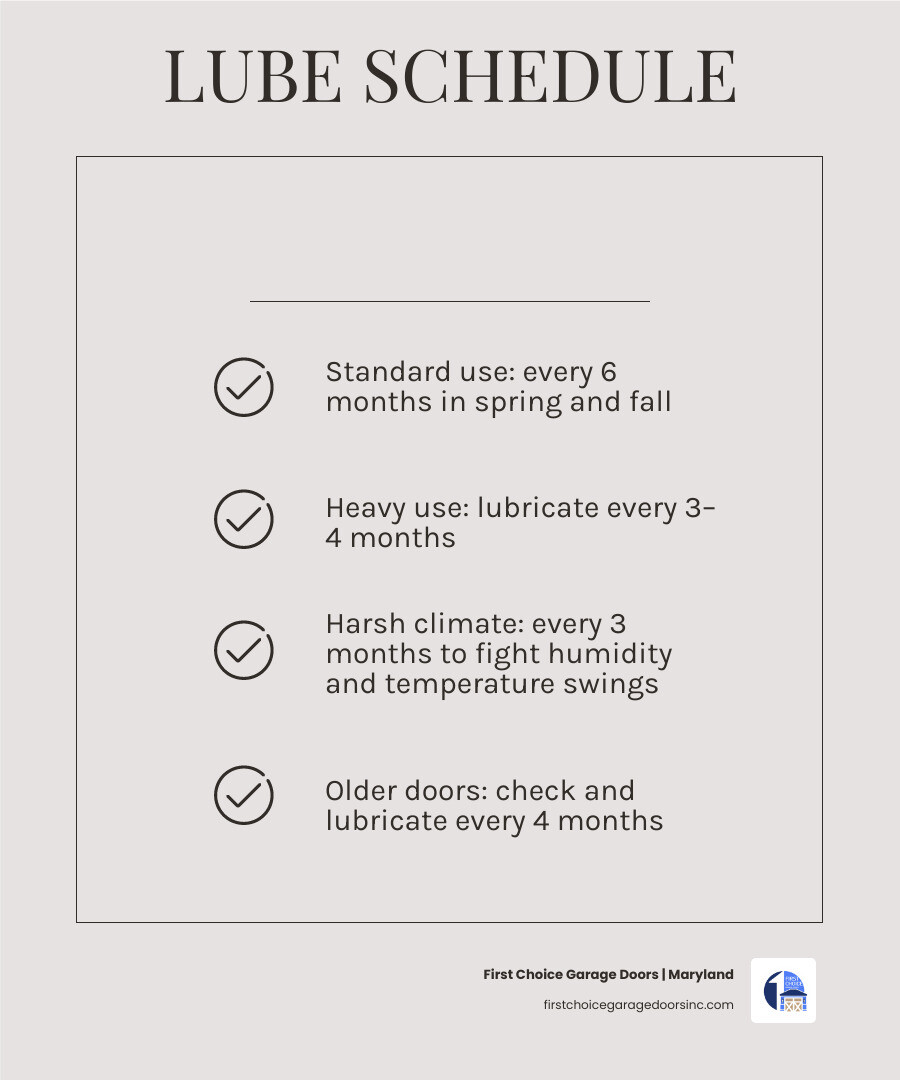
How often should I lubricate my garage door? For most homeowners in Maryland, the answer is simple: at least twice a year — once in spring and once in fall. If your door sees heavy use or deals with extreme weather, bump that up to every 3–4 months.
Here’s a quick reference:
| Situation | Recommended Frequency |
|---|---|
| Standard use (2–4 cycles/day) | Every 6 months (spring & fall) |
| Heavy use (4+ cycles/day) | Every 3–4 months |
| Harsh or coastal climate | Every 3 months (quarterly) |
| Older equipment | Every 4 months |
Your garage door is the largest moving object in your home. It lifts hundreds of pounds of metal, dozens of times a week, through every season Maryland throws at it — humid summers, freezing winters, and everything in between. Without regular lubrication, all those moving parts — hinges, rollers, springs, and bearings — grind against each other, wear down faster, and eventually fail.
The good news? A proper lubrication takes about 15–20 minutes and can add years to the life of your door and opener.
How Often Should I Lubricate My Garage Door?
While the quick answer is twice a year, the reality is that your garage door is a hardworking mechanical system, not a “set-it-and-forget-it” appliance. Think of it like changing the oil in your car. If you drive a normal commute, you stick to the standard schedule. If you are constantly idling in traffic or driving through dusty construction zones, you change it more often.
For your home’s garage door, the standard routine is a thorough lubrication every six months. We highly recommend scheduling this task as part of your seasonal home prep: once in the spring to recover from the freezing winter, and once in the fall to prepare for the cold months ahead. This simple habit keeps your door operating quietly and prevents the metal-on-metal friction that damages expensive parts. To learn more about building this habit, check out our guide on how to Keep It Greasy with Regular Garage Door Lubrication.
However, several external factors can shift this timeline. Let’s look at how local weather patterns and daily usage cycles dictate your maintenance schedule.
Determining how often should i lubricate my garage door based on climate
In Maryland, we get a front-row seat to all four seasons. From the snowy winter mornings in Frederick to the humid, salty air near Easton, our regional climate plays a massive role in how quickly your garage door lubricant breaks down.
- Extreme Winter Cold: When temperatures drop below freezing, standard lubricants can thicken, become gummy, and increase friction rather than reduce it. Metal components also contract slightly in the cold, which puts extra strain on your system. Applying a high-quality, cold-weather-rated lubricant in October or November is essential to prevent your door from binding or freezing shut. For a deeper dive into protecting your system during the coldest months, read our Garage Door Maintenance Tips for Winter.
- Summer Heat and Humidity: High humidity levels in Columbia and coastal moisture in Easton accelerate the oxidation process, leading to rust and corrosion on springs and hinges. When metal parts rust, they become abrasive, grinding down your rollers and putting extra stress on your opener motor.
- Coastal Salt Air: If you live close to the water, salt spray can settle on your garage door hardware. Salt is incredibly corrosive. In these environments, we recommend inspecting and lubricating your garage door quarterly (every 3 months) to create a protective barrier against moisture and salt.
Deciding how often should i lubricate my garage door for high-use systems
How many times does your family open and close the garage door every day? If you have teenagers with cars, use your garage as a home gym, or run a home business, your door might open and close eight to ten times a day.
Each complete open-and-close action is called a “cycle.” Standard residential garage door components are rated for a specific number of cycles (typically 10,000 to 15,000 cycles for rollers and springs). If your door runs through four or more cycles per day, the mechanical stress accumulates rapidly. For these high-use systems, we recommend lubricating the moving parts every 3 to 4 months.
This high-frequency wear is even more critical for commercial properties. If you manage a warehouse, auto shop, or commercial facility in Maryland, your doors might cycle dozens of times a day. To prevent costly downtime and ensure employee safety, commercial doors require a rigorous, professional maintenance plan. You can read more about why this matters in our article on Why Maintenance Is So Important for a Commercial Garage Door.
Choosing the Best Lubricant for Your Garage Door
Using the wrong product on your garage door can actually cause more damage than using nothing at all. Many homeowners reach for whatever can is sitting on their workbench, but heavy greases, motor oils, and general household sprays are notorious for attracting dust, dirt, and hair. Over time, this mixture turns into a thick, abrasive paste that grinds down your bearings and jams your rollers.
To keep your system running smoothly, you should only use lubricants specifically designed for garage doors. The two best options are silicone-based sprays and white lithium grease.
- Silicone Spray: This is the absolute best choice for most garage door components, especially in cold climates. Silicone spray goes on thin, dries quickly, and leaves behind a slick, non-greasy film that repels water and doesn’t attract dirt. It also maintains its viscosity in extreme cold, making it perfect for Maryland winters.
- White Lithium Grease: This is a thicker, petroleum-based grease that is ideal for heavy metal-on-metal contact points, such as the opener’s drive chain or screw. It clings to vertical surfaces and resists high friction and pressure.
To help you choose the right product for each part of your door, explore The Ultimate Guide to Best Lubricant for Garage Door Tracks and Rollers.
Here is a quick breakdown of how these two main lubricants compare:
| Feature | Silicone-Based Spray | White Lithium Grease |
|---|---|---|
| Consistency | Thin, light mist | Thick, clinging paste |
| Best Used For | Springs, roller bearings, hinges | Opener chain, screw drive, metal hinges |
| Dust Attraction | Extremely low | Moderate (if over-applied) |
| Water Resistance | Excellent | High |
| Cold Performance | Down to -40°F | May thicken below 0°F |
A quick warning: Never use classic WD-40 as a long-term lubricant. While it is a fantastic product for loosening rusted bolts, WD-40 is primarily a solvent and water displacer, not a lubricant. It will strip away any existing grease, evaporate within a few days, and leave your hardware dry and vulnerable to rapid wear.
How to Lubricate Your Garage Door in 5 Easy Steps
Ready to knock out this quick weekend project? Grab your safety glasses, a clean rag, a can of high-quality silicone spray, and a can of white lithium grease.
Follow these five easy steps to lubricate your garage door like a pro.
Step 1: Clean the Tracks and Prep the Door
Safety first! Before you begin, close the garage door completely and disconnect the automatic opener from the power outlet (or pull the red emergency release cord to operate the door manually). This prevents the door from moving unexpectedly while your hands are near the moving parts.
Next, take a clean, damp rag and wipe down the inside of the metal tracks on both sides of the door. Remove any built-up dirt, dust, old grease, and spiderwebs. Do not apply lubricant to the tracks. Tracks must remain clean and dry to allow the rollers to roll smoothly rather than slide and slip.
Step 2: Lubricate the Hinges and Metal Rollers
Now that the tracks are clean, move on to the hinges and rollers.
- Hinges: Apply a light spray of silicone lubricant to the pivot points of all the metal hinges where the door sections bend.
- Rollers: If you have steel rollers, spray the silicone lubricant directly into the center ball bearings of the roller. If you have nylon rollers with exposed bearings, do the same. However, if you have solid nylon rollers without ball bearings, or if the wheels are plastic, do not spray the outer wheels. Only apply lubricant to the metal stem that slides into the hinge bracket.
Step 3: Apply Lubricant to the Springs and Bearing Plates
Your garage door’s torsion springs do the heavy lifting, and they are under immense tension.
- Torsion Springs: Locate the spring (or springs) mounted on a metal bar above your closed garage door. Spray silicone lubricant along the entire length of the spring coils. You don’t need to drench them; a light, even coat is enough to prevent the individual coils from grinding against each other as they tightly wind and unwind.
- Bearing Plates: Spray the bearing plates located at both outer ends of the spring bar to keep the shaft rotating smoothly.
- Extension Springs: If your door uses extension springs (which run parallel to the tracks on the sides of the door), spray the spring coils and apply a drop of oil or silicone spray to the small pulleys at the ends of the cables.
Step 4: Coat the Opener Rail and Lock Mechanism
The method for lubricating your garage door opener depends on the type of drive system you have:
- Chain-Drive or Screw-Drive Openers: Apply a small amount of white lithium grease along the top of the metal rail where the trolley travels. This keeps the metal-on-metal contact quiet and smooth.
- Belt-Drive Openers: Do not lubricate the belt. Belt-drive systems are designed to run dry. Applying lubricant to a rubber belt will cause it to slip, degrade, and fail prematurely.
- Lock Mechanism: If your door has a manual lock or key cylinder, spray a tiny amount of silicone or graphite-based lubricant into the keyhole and on the sliding latch to prevent sticking.
Step 5: Test the Door and Wipe Excess
Once everything is lubricated, plug the opener back in (or re-engage the manual trolley). Open and close the garage door manually two or three times. This helps distribute the lubricant evenly deep into the bearings, hinges, and spring coils.
Finally, take a clean rag and wipe away any excess lubricant that is dripping or pooling. Excess oil will only attract dust and grime, defeating the purpose of your hard work.
Frequently Asked Questions About Garage Door Lubrication
To help you keep your garage door in top shape, here are answers to some of the most common questions we hear from homeowners in Columbia, Frederick, and Easton.
Can I use standard WD-40 to lubricate my garage door?
No. Standard WD-40 is a solvent and degreaser, not a long-term lubricant. It is designed to clean metal and displace moisture. If you spray it on your garage door components, it will temporarily quiet the squeak by stripping away old grease, but it will quickly evaporate. Within a week, your metal parts will be completely dry, leading to increased friction, accelerated wear, and louder noises. Always use a dedicated silicone spray or white lithium grease instead.
Should I lubricate the garage door tracks?
No, you should never lubricate the vertical or horizontal garage door tracks. Lubricating the tracks causes the rollers to slide and slip rather than roll. This sliding action can wear flat spots onto your roller wheels and cause the door to become misaligned or jump off the tracks entirely. Additionally, wet lubricant inside the tracks acts like a magnet for dirt, hair, and bugs, creating a sticky grime that can jam the door. Keep your tracks clean by wiping them out with a damp cloth, and leave them dry.
What are the signs that my garage door needs lubrication?
If your garage door is crying out for help, it will let you know. Watch out for these common warning signs:
- Squeaking, Screeching, or Grinding Noises: This is the most common sign of dry metal-on-metal contact.
- Jerky or Shaky Movement: If the door stutters, shakes, or hesitates as it moves up or down, dry rollers or hinges could be resisting the movement.
- The Opener is Straining: If your automatic opener sounds like it is working twice as hard as usual, or if the door reverses safety direction because it detects too much resistance, friction is likely the culprit.
- Visible Rust: If you see orange rust forming on your torsion springs or hinges, they need to be cleaned and lubricated immediately to prevent snapping.
For a comprehensive checklist of other maintenance tasks you should perform alongside lubrication, check out our Ten Residential Garage Door Maintenance Tips.
Conclusion
Regularly lubricating your garage door is one of the simplest, most cost-effective ways to protect your home’s entry system. By taking just 15 minutes twice a year to clean your tracks and apply the right silicone spray, you can prevent expensive part failures, protect your opener’s motor, and enjoy a beautifully quiet door.
While DIY lubrication is a great way to handle routine care, some maintenance tasks are best left to the professionals. Your garage door springs and cables are under extreme tension, and attempting to adjust or repair them yourself can be incredibly dangerous.
If your door is still making unusual noises after lubrication, if it feels heavy to lift manually, or if you simply want the peace of mind that comes with an expert inspection, we are here to help. At First Choice Garage Doors, our experienced professionals provide comprehensive garage door tune-ups, repairs, and safety inspections across Maryland, including Easton, Columbia, and Frederick.
Ready to get your door running like new? Explore our Products and Services: Garage Door Maintenance options, or contact us today to schedule your professional tune-up!