
Your Garage Door Gets More Use Than You Think — Here’s What a Maintenance Visit Actually Covers
What does a garage door maintenance visit include is one of the most practical questions a homeowner can ask — and the answer matters more than most people realize.
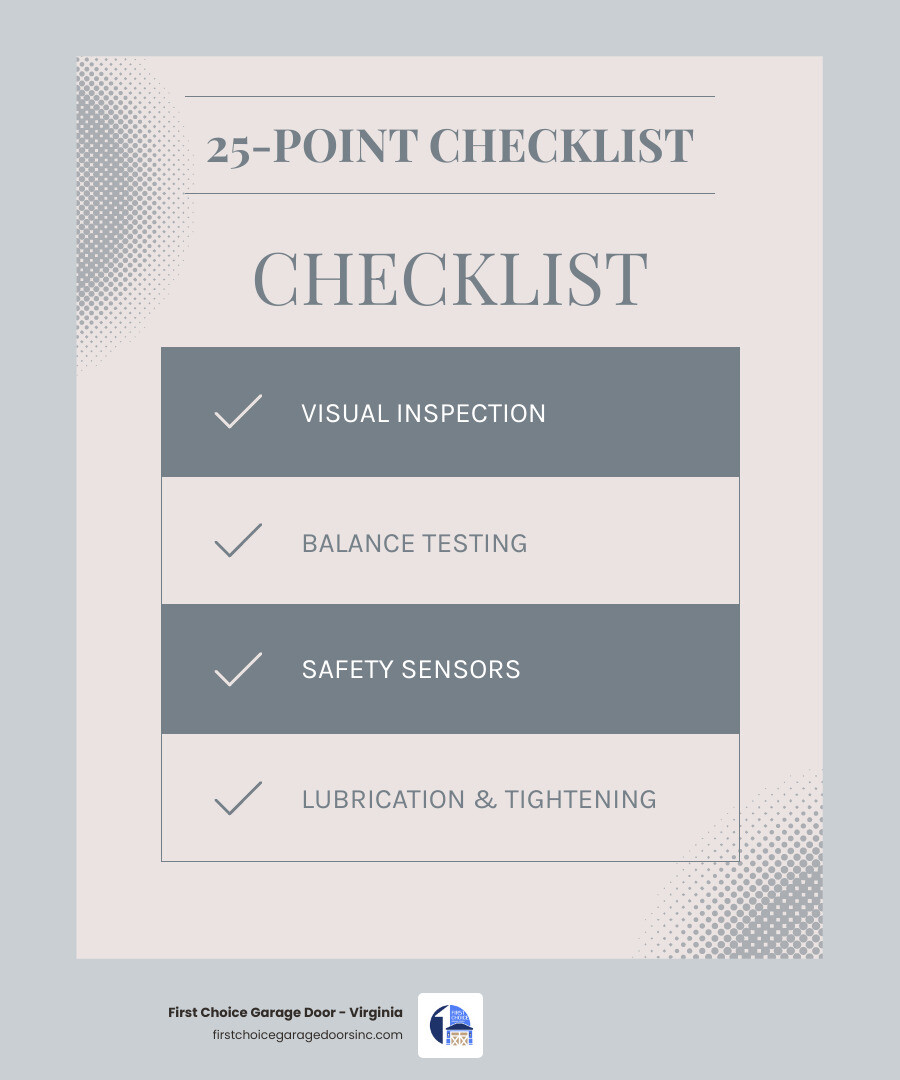
A professional garage door maintenance visit typically covers:
- Visual inspection of panels, tracks, rollers, hinges, springs, and cables
- Balance testing by manually lifting the door and checking if it holds position
- Safety sensor checks — testing photo-eye sensors and the auto-reverse mechanism
- Lubrication of springs, hinges, rollers, and the opener drive system
- Hardware tightening — bolts, brackets, and mounting hardware that loosen over time
- Opener inspection — motor function, travel limits, force settings, and battery backup
- Weatherstripping evaluation for gaps, cracks, or wear
- Spring tension and cable inspection for fraying, rust, or imbalance
Most professional visits follow a 25-point inspection checklist and take between 45 minutes and 1.5 hours.
Here’s why this matters: your garage door opens and closes roughly 1,500 times per year. That’s a lot of mechanical stress on springs, cables, rollers, and an electric motor — all working together every single day. Most homeowners in Northern Virginia don’t think about their garage door until something goes wrong. By then, a small issue has often become a costly repair.
A routine maintenance visit catches those problems early — before a frayed cable snaps, before a worn roller throws the door off track, or before an unbalanced door burns out the opener motor.
Why Regular Maintenance is Essential for Northern Virginia Homeowners
In Northern Virginia, our garage doors face a unique set of challenges. From the humid, heavy air of July to the freezing snaps of January in Manassas, the weather is constantly working against mechanical systems. These temperature fluctuations cause metal components to expand and contract, which can lead to hardware loosening or lubricants drying out faster than expected.
Garage Maintenance isn’t just about keeping things quiet; it’s about operational longevity. A well-maintained garage door can last between 15 and 30 years, whereas a neglected one might fail in half that time. When we visit a home for a tune-up, our primary goal is safety prevention. Garage doors are involved in tens of thousands of injuries annually in the United States, often due to untested safety features or components failing under tension.
Beyond safety, there is the simple joy of a quiet home. If your garage is located under a bedroom or near a living area, regular maintenance ensures that every “open” and “close” doesn’t sound like a freight train passing through your house. By reducing friction and vibration, we extend the life of your opener and keep your morning routine peaceful.
What Does a Garage Door Maintenance Visit Include?
When our technicians arrive at your home in April 2026, we don’t just start spraying oil and hope for the best. We begin with a comprehensive visual inspection to assess the structural integrity of the entire system. We look for the “hidden” signs of trouble that most homeowners might miss during their daily commute.
First, we examine the door panels for any cracks, dents, or signs of rust. Rust is a particular enemy in our region, as it can compromise the strength of the steel. Next, we check the tracks for bends or debris. Even a small pebble or a buildup of “gunk” in the track can cause the rollers to jump or stutter, leading to Garage Repair needs down the line.
We also evaluate the weatherstripping. This rubber seal at the bottom and around the sides of your door does more than just keep out the rain; it prevents pests from entering your home and helps maintain your garage’s temperature, which is vital for energy efficiency if your garage is attached to your living space.
Safety Sensor Testing: What Does a Garage Door Maintenance Visit Include?
The most critical part of any visit is verifying the safety features. Since the early 1990s, federal safety requirements have mandated that garage door openers include a reversal mechanism.
When we ask, what does a garage door maintenance visit include, the answer must always prioritize the “photo-eye” sensors. These are the small infrared sensors located near the floor on either side of the door. We clean the lenses, ensure they are perfectly aligned, and check the wiring for any signs of chewing by local wildlife.
We also perform the “2×4 test.” We place a piece of wood flat on the ground in the door’s path. When the door closes and hits the object, it should immediately reverse. If it doesn’t, it indicates the force settings or the mechanical reversal system is failing, which poses a significant risk to children, pets, and vehicles.
Hardware Tightening: What Does a Garage Door Maintenance Visit Include?
Think about how much a garage door vibrates during those 1,500 annual cycles. Over time, that constant movement acts like a slow-motion earthquake, vibrating nuts and bolts loose.
During a professional visit, we systematically go through the entire system with a socket wrench. We tighten:
- Hinge bolts: These hold the panels together and allow them to pivot.
- Track brackets: These secure the tracks to your garage walls and ceiling.
- Roller stems: We ensure the rollers are securely seated in their brackets.
- Mounting hardware: We check the “back hangs” that support the opener motor.
Ensuring structural stability through hardware tightening prevents the door from becoming misaligned, which is one of the leading causes of doors getting stuck halfway.
The Technical Side: Balance, Lubrication, and Opener Tuning
While homeowners can certainly keep their tracks clean, there are technical aspects of maintenance that require a professional eye and specialized tools. One of the most important is the balance test.
| Feature | Homeowner Visual Check | Professional Technical Adjustment |
|---|---|---|
| Springs | Look for visible gaps or rust | Test and adjust tension for perfect balance |
| Cables | Check for obvious fraying or “fuzz” | Inspect full length and check drum alignment |
| Balance | Observe if the door looks level | Manual lift test at waist height (3-4 feet) |
| Hardware | Look for missing bolts | Torque all fasteners to spec |
| Safety | Wave a hand in front of sensors | Calibrate force settings and travel limits |
A balanced door is essential. To test this, we disconnect the opener and lift the door manually. A perfectly balanced door should stay in place when opened halfway (about waist height). If it slams shut or shoots upward, the torsion springs are improperly tensioned. This puts immense strain on your opener motor, which can lead to a premature burnout. Warning: Never attempt to adjust torsion springs yourself; they are under extreme tension and can cause severe injury.
Lubrication Points and Opener Calibration
We often see homeowners using WD-40 on their garage doors, but this is actually a mistake! WD-40 is a degreaser and cleaner, not a long-term lubricant. It can actually attract dirt and turn into an abrasive paste that wears down your hardware.
In a professional visit, we use high-quality silicone lubricant or white lithium grease. We apply it sparingly to:
- Metal rollers and bearings
- Hinges and pivot points
- The torsion spring (to prevent friction between the coils and reduce “chatter”)
- Opener drive system: Whether you have a chain drive, screw drive, or belt drive, we ensure the rail is clean and the drive mechanism is properly treated.
Finally, we calibrate the opener itself. We check the “travel limits” to ensure the door closes firmly against the floor without crushing the weatherstripping. We also test the battery backup system by unplugging the unit to ensure you won’t be trapped during a Northern Virginia power outage.
Signs Your Home Needs a Professional Tune-Up
How do you know it’s time to call us? Sometimes the signs are subtle, and sometimes they are quite loud. If you notice any of the following, your door is likely overdue for a maintenance visit:
- Grinding or Screeching Noises: This usually means metal-on-metal friction is occurring because the lubrication has failed or a part is misaligned.
- Jerky Movement: If the door “stutters” or hesitates as it moves, it could be a sign of worn rollers or a track that has shifted out of alignment.
- Slow Response: If you press the remote and the motor hums for a second before moving, or if the door moves significantly slower than it used to, the opener is likely struggling with an unbalanced door.
- Frayed Cables: If you see “fuzz” or loose steel strands on the lift cables, they are at risk of snapping. This is an emergency repair waiting to happen.
- Rust Accumulation: Rust on the springs or tracks acts like sandpaper, eating away at the components every time the door moves.
Frequently Asked Questions About Garage Door Servicing
How long does a typical maintenance visit take?
For most standard residential doors in Northern Virginia, a thorough maintenance visit takes between 45 minutes and 1.5 hours. If the door hasn’t been serviced in several years, it may take a bit longer to clean the tracks and properly calibrate the spring tension.
How often should I schedule a professional tune-up?
We recommend a professional tune-up once a year. For many of our neighbors in Manassas and the surrounding areas, the best time is in the spring or fall. This ensures the door is ready for the extreme temperatures of the coming season. If your garage is your primary entrance and you cycle the door more than five or six times a day, you might consider a check-up every six months.
Can I perform any maintenance tasks myself?
Absolutely! Homeowners can safely:
- Clean the tracks with a damp cloth (don’t use grease in the tracks!).
- Wipe down the door panels to prevent dirt buildup.
- Visually inspect the springs and cables for signs of wear.
- Test the auto-reverse sensors monthly. However, we always recommend leaving the lubrication of high-tension parts, balance adjustments, and hardware tightening to a professional to ensure your warranty remains valid and your family stays safe.
Conclusion
Your garage door is the largest moving part of your home, and it deserves the same care you give your car or your HVAC system. Understanding what does a garage door maintenance visit include is the first step toward a safer, quieter, and more reliable home.
At First Choice Garage Doors, we bring unmatched expertise and a commitment to quality to every driveway in Northern Virginia. Our technicians don’t just “fix” doors; we provide preventative care that saves you from the stress of a door that won’t open on a busy Monday morning. From Manassas to the far reaches of NoVa, we are here to ensure your garage door remains an asset, not a hazard.
Don’t wait for a spring to snap or a motor to burn out. Schedule your professional garage door maintenance visit today and experience the peace of mind that comes with a First Choice tune-up.