
Why Teaching Children About Garage Door Safety Could Save Their Life
Teaching children about garage door safety is one of the most important things you can do as a homeowner with kids. Your garage door is the largest moving object in your home — and one of the most dangerous. It can weigh anywhere from 125 to 400 pounds, moves quickly, and has multiple parts that can seriously injure a small child in seconds.
Here’s a quick overview of what every parent should know:
- Never let children play near or under a garage door — open, closed, or moving
- Keep all remotes and wall buttons out of children’s reach — mount buttons at least 5 feet off the floor
- Teach kids never to touch springs, cables, or sensors — these parts are under extreme tension
- Never let a child run under a moving door — even a “safe” door can malfunction
- Review safety rules regularly — especially when kids have friends visiting
The numbers back up the urgency. According to data from the Consumer Product Safety Commission, 40% of safety systems built into garage doors manufactured after 1993 were found to be failing in 2013 — meaning the door could come down with enough force to crush a child. That’s not a small risk. That’s a serious one that deserves real attention.
As spring arrives and kids spend more time running in and out of the garage, the danger only grows. Children are naturally curious. To them, a garage door remote can look like a fun toy, and a moving door can seem like something to race under or climb on. That curiosity, without proper guidance, can turn dangerous fast.
At First Choice Garage Doors in Maryland, we work with homeowners across the Columbia area and beyond to make sure garage doors are not just functional — but safe for the whole family.
The Hidden Dangers of the Largest Moving Object in Your Home
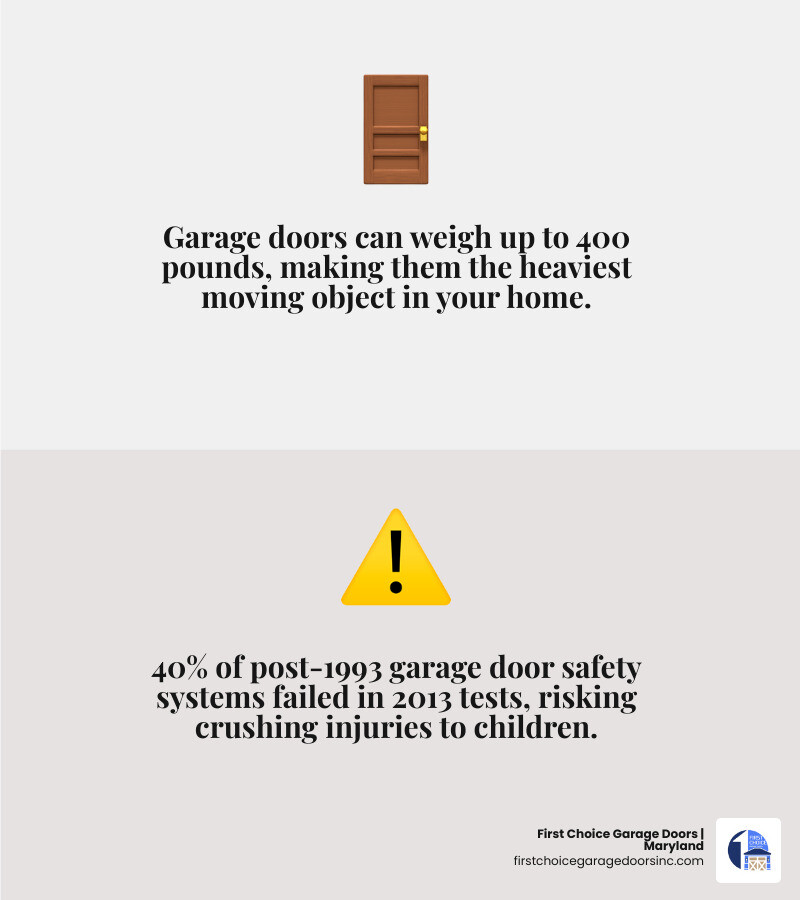
When we talk about Safety, we often think about car seats or kitchen cabinets, but the garage door is a massive mechanical system that requires just as much respect. A standard residential garage door can weigh up to 400 pounds. While springs make it feel light to an adult, that weight is still there, suspended above your family’s heads.
Since 1993, federal law has required garage doors to have built-in safety features, such as photoelectric sensors. However, as noted in our research, a 2013 study revealed that 40% of these safety systems failed to work properly. This failure rate means that the “auto-reverse” feature—which is supposed to stop the door if it hits an object—might not trigger in time to prevent a tragedy. The result is a crushing force that can easily entrap or kill a small child.
Understanding the mechanics is the first step in Safety Measures to Take with an Automated Garage Door. The door operates under immense pressure, primarily managed by the spring system.
Torsion vs. Extension Springs: A Comparison of Tension
| Feature | Torsion Springs | Extension Springs |
|---|---|---|
| Location | Mounted on a metal rod directly above the door opening. | Located above the horizontal tracks on both sides. |
| Tension Level | Extremely High (coiled tightly). | Extremely High (stretched long). |
| Risk Factor | Can snap with explosive force; should never be touched. | Can fly off if a safety cable isn’t installed. |
| Child Danger | High; looks like a “slinky” to curious kids. | High; accessible if kids climb on storage or ladders. |
Why Teaching Children About Garage Door Safety Starts with Education
Children are naturally inquisitive. If we simply tell them “don’t touch,” they might wait until we aren’t looking to investigate. Instead, we recommend demystifying the door. Show them how it works. Explain that while it looks like it’s floating, it’s actually being held up by heavy-duty steel cables and springs that are pulled as tight as a guitar string—but with enough power to lift a car’s worth of weight.
By satisfying their curiosity through a supervised explanation, you remove the “mystery” that leads to dangerous experimentation. Following Garage Door Safety Tips to Follow includes teaching them that the lifting cables are not ropes for climbing and the springs are not toys.
Essential Rules for Teaching Children About Garage Door Safety
Establishing “No-Play Zones” is critical. The area directly under the door and the path of the tracks should be strictly off-limits for toys, bikes, or hanging out.
When teaching children about garage door safety, consistency is key. We suggest implementing these 3 Garage Door Safety Tips as a baseline for your household:
- The “Safety Circle” Rule: Children must stay at least five feet away from the door whenever it is in motion.
- No Racing: Never try to “beat the door” by running under it while it is closing.
- Hands Off: Never touch the door, the tracks, or the hinges while the door is moving.
Identifying Pinch Points and Section Joints
One of the most common injuries involves little fingers getting caught in “pinch points.” These are the joints between the door sections that fold and unfold as the door moves. Even if the door doesn’t close on a child, their fingers can be crushed simply by being in the wrong place while the door is opening.
For more detailed guidance, review these 5 Garage Door Safety Tips to share with your family. Teach your children to only use the handles (if your door is manual) and never to place their hands near the rollers or the tracks.
Practical Steps for Teaching Children About Garage Door Safety Daily
Safety shouldn’t be a one-time conversation; it should be part of your daily routine. We recommend doing a “safety walk-through” once a month. Show your children the photo-eye sensors (the little “eyes” at the bottom of the tracks) and explain that if they are blocked or knocked out of alignment, the door might not work correctly.
This is also a great time to discuss Keeping Pets Safe Around Your Garage Door. Children often follow pets, and if a dog or cat runs under a closing door, a child might impulsively chase after them.
Enlisting Older Siblings for “Garage Duty”
If you have older children, give them a sense of responsibility. Assign them “Garage Duty,” where they are responsible for making sure their younger siblings are standing in a safe spot before the door is activated. This not only keeps the little ones safe but reinforces the rules for the older kids as well.
Teach all your children to report any strange noises, like grinding or popping, or if they see a “gap” in the springs. These are signs of wear that require professional attention. For more pet-specific advice, check out Garage Door Safety Tips for Pet Owners.
Managing Access: Remotes, Buttons, and Passcodes
The garage door opener is not a toy, yet many children see the “clicker” as a fun gadget. To prevent accidental operation, you must manage how your family accesses the controls.
The 5-Foot Rule and Remote Storage
The wall-mounted button inside your garage should be installed at least five feet above the floor. This ensures that toddlers cannot reach it. If yours is lower, it’s time to move it.
When it comes to remotes, treat them like car keys. Don’t leave them on coffee tables or in unlocked cup holders in the driveway. We often suggest following these 4 Garage Security Tips to keep your home Security tight. If your kids are old enough to have their own “keychain” remotes, they must be taught that these are tools for entry, not toys for play.
“Top Secret” Passcodes
If you have an exterior keypad, the code should be treated as “Top Secret.” Teach your children that they should never share the code with friends, even their best friends. A shared code can quickly spread around the neighborhood, leading to unsupervised children entering your garage.
When entering the code, teach them to “shield” their hand so no one can see the numbers. Maintaining Garage Door Security is about more than just keeping burglars out; it’s about controlling who has access to a potentially dangerous area.
Professional Maintenance and Total Garage Childproofing
A safe garage is a well-maintained garage. One of the easiest ways to check your door’s safety is the “Balance Test.”
- Disconnect the opener (pull the red emergency cord) while the door is closed.
- Lift the door manually.
- A properly balanced door should feel like it weighs only 8 to 10 pounds and should stay in place when opened halfway.
If the door slams shut or feels incredibly heavy, the springs are worn and dangerous. You can learn How to Get a Garage Door Safety Test Done to stay ahead of these issues.
Warning: Never attempt to fix springs or cables yourself. The Dangers That Come With a D.I.Y. Garage Door Repair are severe, including the risk of losing fingers or sustaining life-threatening injuries from high-tension parts.
Beyond the Door: Childproofing the Garage Space
While the door is the biggest risk, the rest of the garage needs attention too:
- Chemical Storage: Keep antifreeze, oil, and cleaning supplies in locked cabinets.
- Tool Organization: Use pegboards or locked chests for sharp tools.
- Lighting: Install motion-sensor lights so no one is ever moving around the garage in the dark.
- Internal Locks: Keep the door leading from the garage into the house locked to prevent toddlers from wandering into the garage unsupervised.
Conclusion
At First Choice Garage Doors, we’ve seen how a little bit of education and regular maintenance can prevent major accidents. Whether you are in Columbia, Frederick, or Easton, MD, our team of experts is dedicated to keeping your family safe.
Don’t wait for a “close call” to take action. Teaching children about garage door safety today ensures a safer tomorrow. If you haven’t had your door inspected recently, or if you’re worried your safety sensors aren’t up to the task, give us a call.
Schedule your professional garage door maintenance with First Choice Garage Doors today to ensure your system is operating at peak safety standards.
What are the most dangerous parts of a garage door for kids?
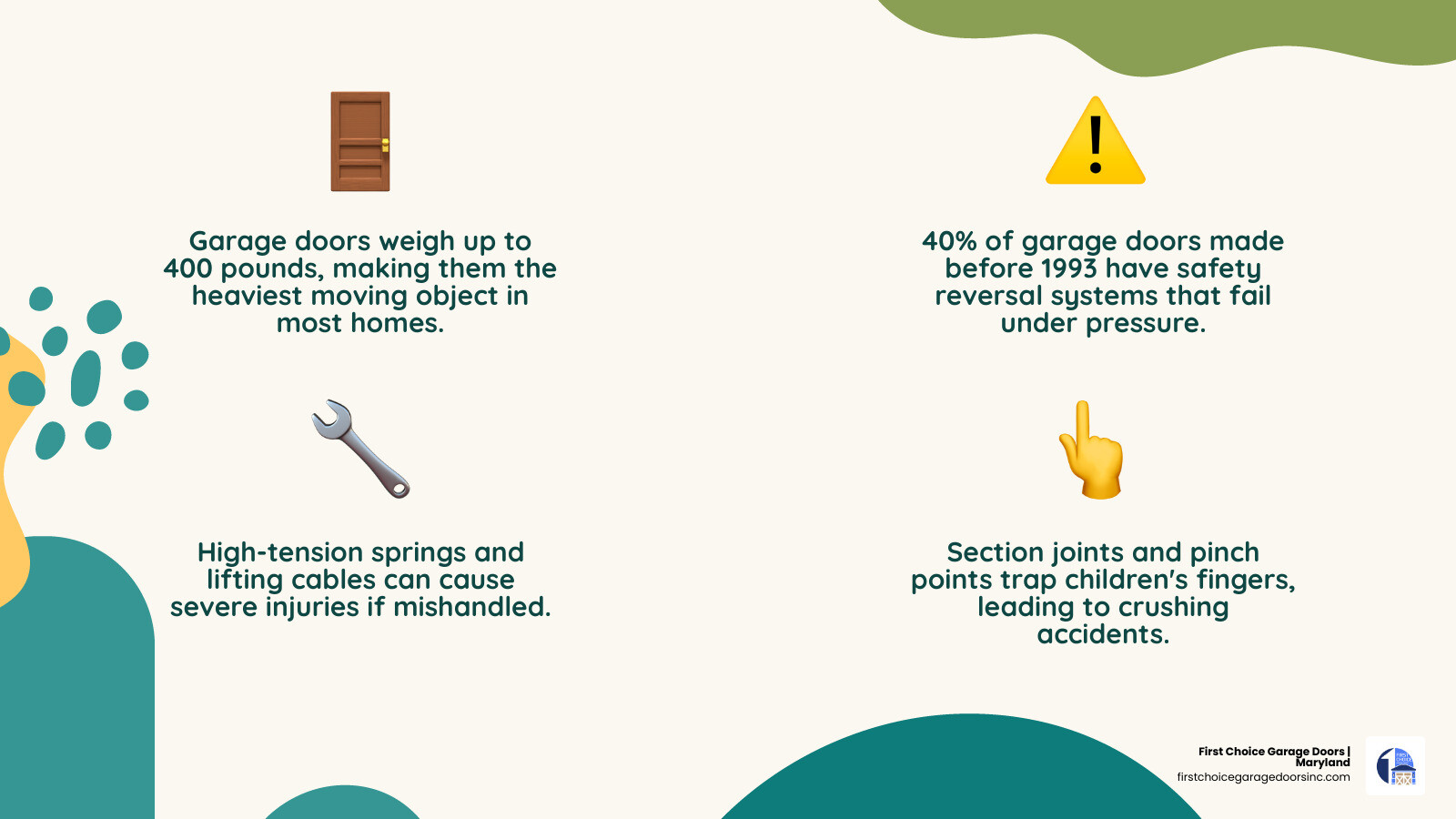
The most dangerous parts are the high-tension springs (torsion or extension), the lifting cables, the photo-eye sensors (if misaligned), and the section joints (pinch points) where fingers can get trapped.
How should I store my garage door remotes?
Remotes should be stored out of reach of children, ideally on high shelves or in a locked glove compartment. Using a wall-mounted keypad placed at least five feet high is a safer alternative for kids who need access.
Why is the 1993 safety system statistic important?
The 1993 statistic is vital because it highlights that even “modern” doors can have failing safety mechanisms. A 40% failure rate in reversal systems means you cannot rely solely on technology; regular professional testing and manual supervision are required to prevent crushing injuries.