
Why Getting Garage Door Sizing for Trucks and Tall Vehicles Right Matters Before You Build or Buy
Garage door sizing for trucks and tall vehicles is one of the most common planning mistakes homeowners in Northern Virginia make — and one of the most expensive to fix after the fact.
Here’s a quick reference to match your vehicle to the right door size:
| Vehicle Type | Recommended Door Width | Recommended Door Height |
|---|---|---|
| Standard sedan / small car | 8–9 ft | 7 ft |
| SUV / crossover | 9–10 ft | 7.5–8 ft |
| Full-size pickup truck | 10 ft | 8 ft |
| Dually pickup (e.g., Ram 3500) | 10 ft | 8 ft |
| Class B / B+ RV | 8–9 ft | 9–10 ft |
| Class C RV / motorhome | 9 ft | 12 ft |
| Class A motorhome | 12–14 ft | 14 ft |
| Horse trailer / living quarter trailer | 12–14 ft | 13–14 ft |
| Large farm tractor + implements | 24–32 ft | 14–18 ft |
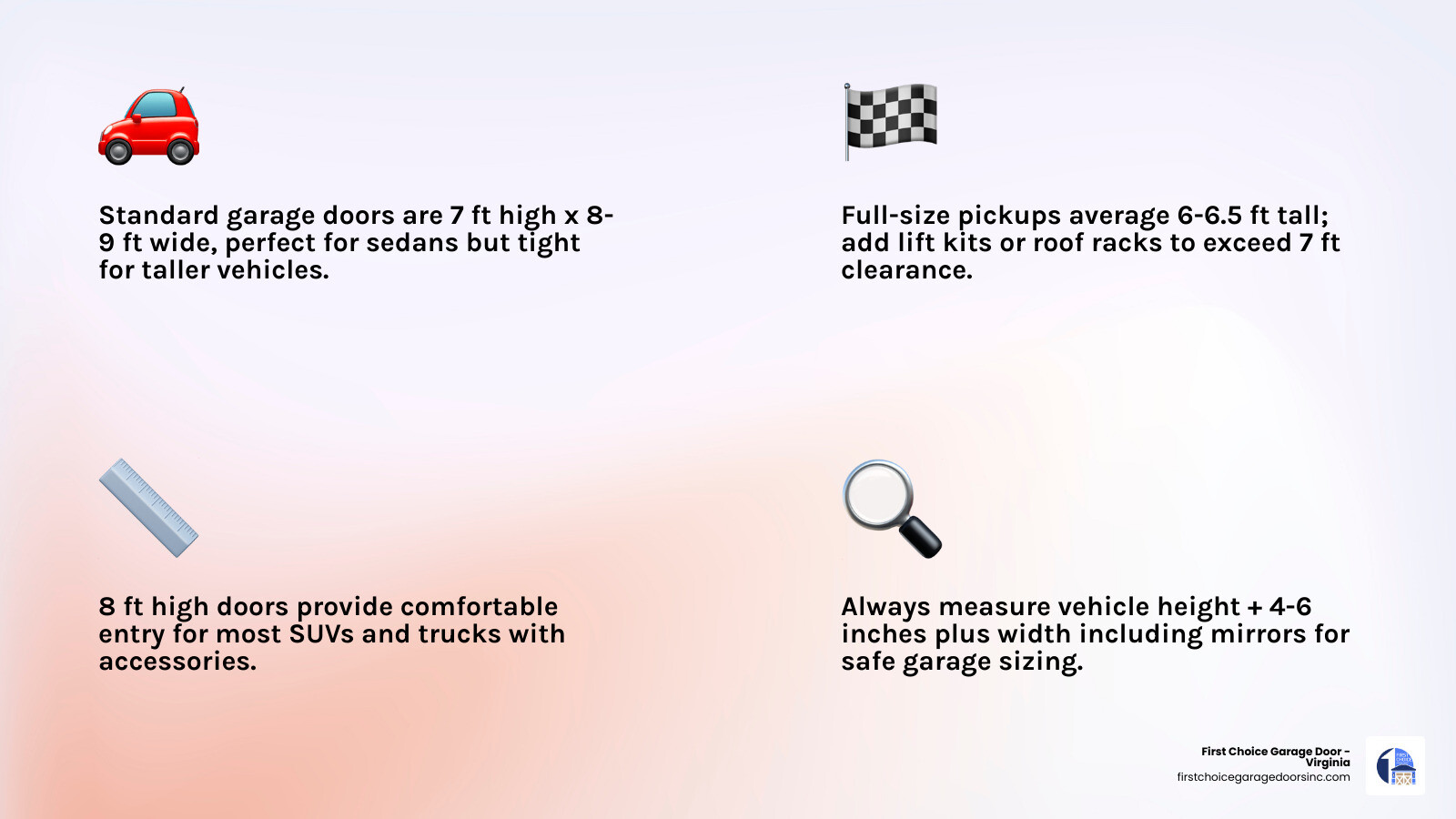
Most standard residential garage doors are 7 feet tall and 8–9 feet wide. That works fine for a sedan. But most full-size pickup trucks stand between 6 and 6’5″ tall, and many SUVs reach up to 6’4″. Add a roof rack, a lift kit, or a rooftop cargo box — and suddenly that 7-foot door becomes a very real problem.
Getting the wrong size isn’t just inconvenient. It can damage your vehicle, your door, and require costly structural changes to fix.
This guide walks you through every vehicle type — from lifted trucks to Class A motorhomes — so you know exactly what opening you need before installation day.
Standard vs. Oversized: Garage Door Sizing for Trucks and Tall Vehicles
When we talk about “standard” garage doors in Manassas or across Northern Virginia, we are usually referring to a door that is 7 feet high. For decades, this was the industry benchmark because most cars were low-profile sedans or station wagons. However, as of April 2026, the automotive landscape has shifted dramatically. Our driveways are now filled with full-sized SUVs and crew-cab pickups that push the limits of these traditional openings.
If you are Determining the Best Garage Door Size for a new build or a renovation, you need to look beyond the “standard.” Most common SUVs range from 5’5″ to 6’4″ in height. While a 7-foot door technically offers a few inches of clearance, it can feel like threading a needle every time you pull in. This is why many homeowners are now opting for 8-foot-high doors.
An 8-foot opening provides what we like to call “the comfort zone.” It accommodates the average pickup truck (averaging 6′ to 6’5″) with room to spare for a standard roof rack or a slight suspension lift. If you’re working with a multi-car garage, you might even consider mixing and matching sizes. You can find more details on this in our Sizing Up Fayetteville Single and Double Car Garage Door Installation Guide, which breaks down how to balance aesthetics with the practical needs of different vehicle heights.
Critical Clearance for Garage Door Sizing for Trucks and Tall Vehicles
The biggest mistake we see isn’t forgetting the height of the truck itself—it’s forgetting everything attached to the truck. When you are Making Measurements Before Installing a New Garage Door, you have to account for the “widest and highest” points.
- Side Mirrors: A Ford F-150 is approximately 80 inches wide, but that doesn’t include the mirrors. If you have “icky” tow mirrors that don’t fold automatically, a standard 8-foot-wide door is going to be a daily stressor. We recommend at least a 9-foot or 10-foot width for full-size trucks to avoid expensive mirror repairs.
- Lift Kits and Tires: That 3-inch lift kit you’re eyeing? It doesn’t just add 3 inches to the frame; larger tires can add another 2 or 3 inches. Suddenly, your “standard” truck is 6 inches taller.
- Roof Accessories: Light bars, ladder racks, and cargo boxes are the primary culprits for garage door damage. Always measure your vehicle at its absolute peak.
- Dually Fenders: If you’re driving a 3500 series dually, those flared rear fenders require serious width. A 10-foot-wide door is the bare minimum, though many of our clients in more rural parts of Northern Virginia prefer 12 feet for ease of entry.
Accommodating Recreational Vehicles and Horse Trailers
For the adventurers among us, a standard residential door simply won’t cut it. RVs and horse trailers are in a league of their own. If you’re building a “toy barn” or a dedicated RV bay, you need to plan for the maximum legal highway height, which is typically 14 feet.
Class A motorhomes are the giants of the road, averaging 12 to 14 feet in height. To park one safely, you’ll need a door that is at least 14 feet tall and 12 to 14 feet wide. Why so wide? Because backing a 40-foot rig into a tight space requires a bit of “wiggle room” on either side to account for the swing of the trailer or the rear of the motorhome.
Horse trailers, especially those with living quarters, often have roof-mounted AC units or hay racks that push their height requirements to the 13-foot mark.
| RV Class | Average Height | Recommended Door Size |
|---|---|---|
| Class A | 12–14 ft | 14′ x 14′ |
| Class B / B+ | 7–10 ft | 10′ x 10′ |
| Class C | 10–12 ft | 12′ x 12′ |
| Horse Trailer | 7–13 ft | 12′ x 14′ |
Structural Requirements for Heavy-Duty Openings
Installing an oversized door isn’t as simple as cutting a bigger hole in the wall. The larger the door, the more weight and wind pressure it has to withstand. This is particularly important in Northern Virginia, where we can experience heavy snow loads and high-wind thunderstorms.
First, let’s talk about Headroom. This is the space between the top of the door opening and the ceiling. A standard lift door usually requires about 12 inches of headroom. However, for tall vehicles, we often use High-Lift or Vertical Lift tracks. These allow the door to rise much higher before turning back along the ceiling, keeping the tracks out of the way of your truck’s roof or your RV’s AC unit.
Side room and backroom are also critical. You need enough space on the sides of the opening (usually 4–6 inches) for the vertical tracks and springs. Backroom is the distance from the opening to the rear of the horizontal tracks—typically the height of the door plus 18 inches.
When you are Picking the Right Size for Your Commercial Garage Door, you’ll notice that the hardware becomes much beefier. For doors over 8 feet tall, we move away from standard residential hinges and rollers. Instead, we use 12-gauge or 13-gauge steel tracks and heavy-duty torsion springs designed to balance the significant weight of a 14-foot insulated steel door.
Lift Systems and Openers for Garage Door Sizing for Trucks and Tall Vehicles
If you have a tall vehicle, the last thing you want is a traditional center-mounted opener hanging down from the ceiling right where your roof rack needs to be. This is where Jackshaft (Wall-Mount) Openers become a lifesaver.
These openers mount on the wall beside the garage door and connect directly to the torsion bar. By eliminating the rail and motor hanging from the center of the ceiling, you gain valuable vertical clearance. For RV garages with cathedral or sloped ceilings, we can even install inclined tracks that follow the roofline, maximizing every inch of interior space.
For these larger doors, we also recommend:
- Heavy-Duty Torsion Springs: Larger doors require more “muscle” to lift. High-cycle springs are a smart investment for doors that see frequent use.
- Smart Integration: Openers with myQ technology allow you to check if that massive RV door is closed from your smartphone—perfect for when you’re halfway to the Shenandoah Valley and realize you forgot to double-check.
Design Strategy: Single Large Door vs. Multiple Openings
A common question we hear in Manassas is: “Should I install one giant 16-foot wide door or two 9-foot doors?”
When you are Deciding Between a Single or Double Garage Door, consider how you use the space. A single large door (16 to 18 feet wide) is often more cost-effective because you only need one opener and one set of tracks. It also makes it much easier to maneuver a large truck into the center of the garage if you need to work on it.
However, there are benefits to Should You Install Two Single Garage Doors or a Double Garage Door. Two separate doors provide better thermal efficiency—you aren’t letting all the heat out of the entire garage just to pull one car out. From a design perspective, two doors often look more balanced on a traditional Virginia home and provide a “backup” plan; if one door’s spring breaks, you can still get your other vehicle out through the second door.
For those with a “mixed fleet”—say, a commuter car and a lifted Silverado—a popular design strategy is the Offset Configuration. This involves one standard 7-foot door for the car and one 8-foot or 9-foot “oversized” door for the truck. This keeps the house looking residential while providing the specialized clearance you actually need.
Frequently Asked Questions about Oversized Garage Doors
What are the most common mistakes to avoid when sizing for a truck?
The most painful mistake is measuring the vehicle’s height while it’s empty. A truck sitting on a trailer, or a truck with a full load of lumber in the back, might sit differently than a completely empty one. Always measure at the “worst-case scenario” height.
Another common oversight is the driveway approach angle. If your driveway has a steep incline leading up to the garage, the top of your truck or RV will actually be higher as it crests the threshold than it is when sitting flat on the garage floor. We always suggest adding at least 6 to 12 inches of “buffer” height to account for these angles.
Finally, don’t forget the inner projection. When a garage door is open, the bottom of the door often hangs down an inch or two into the opening. If your truck clears the header by only half an inch, it might still hit the door itself once it’s retracted.
How do I plan for future vehicle upgrades?
We always tell our clients: “Bigger is better, and you’ll never regret having too much space.” If you’re building today, plan for the vehicle you might buy in five years.
- Width: Even if you drive a mid-size SUV now, go for at least a 10-foot wide door. This ensures that if you upgrade to a full-size pickup or an EV (which tend to be wider due to battery placement), you won’t have to widen the structural opening later.
- Height: An 8-foot height should be your new “standard.” It adds resale value to your home because it appeals to the widest range of buyers—from hobbyists with roof racks to contractors with work vans.
- Electric Ready: While you’re sizing the door, ensure your opener is rated for heavier weights. Future-proofing also means ensuring there’s a 110v outlet near the torsion bar for a jackshaft opener.
What size door is needed for commercial or agricultural equipment?
For our neighbors in the more agricultural areas surrounding Manassas and Prince William County, standard residential sizes aren’t even in the conversation.
- Dump Trucks: Usually require a minimum of 14 feet in height.
- Tractors: While a small tractor might fit in a 10-foot door, large modern tractors with cabs and GPS antennas often need 14 to 16 feet.
- Implements: The real challenge is the width. If you’re pulling a planter or a wide mower deck, you may need a door spanning 24 to 32 feet. These massive openings require specialized “industrial” grade steel and high-output motor systems to operate safely.
Conclusion
Navigating garage door sizing for trucks and tall vehicles doesn’t have to be a guessing game. Whether you are trying to fit a lifted Jeep into your Manassas suburban garage or a Class A motorhome into a custom-built bay in Northern Virginia, the secret is in the details. Measure three times, account for your accessories, and always lean toward a slightly larger opening than you think you need.
At First Choice Garage Doors, we specialize in helping Northern Virginia homeowners find the perfect fit for their “big boys.” From custom retrofitting standard openings to installing heavy-duty high-lift systems, our team ensures your vehicles are stored safely and your garage looks great.
Ready to upgrade your clearance? Explore our residential garage door solutions in Northern Virginia and let us help you build a garage that actually fits your life.