
What to Check When Your Garage Door Won’t Open or Close
If your garage door wont open or close what to check first comes down to a short list of common culprits — and most of them take under five minutes to rule out.
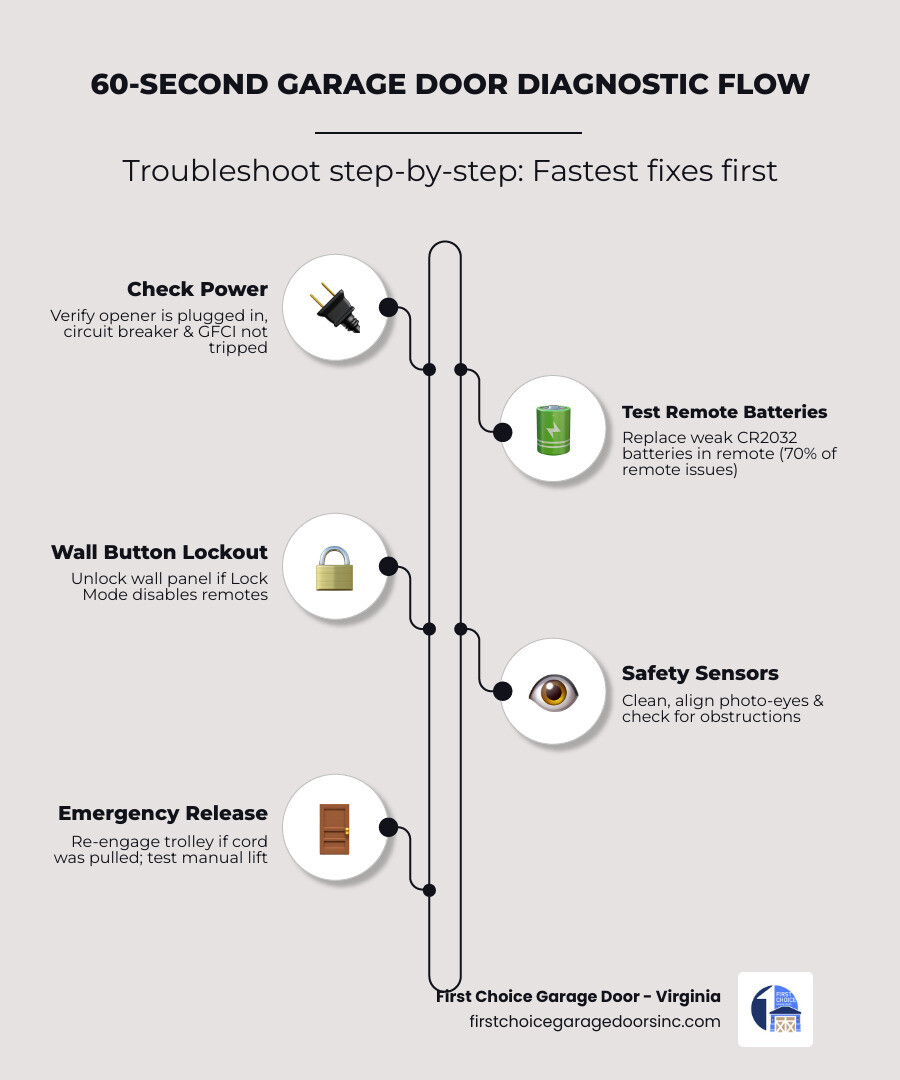
Start here (fastest fixes first):
- Power — Is the opener plugged in? Has a circuit breaker or GFCI outlet tripped?
- Remote batteries — Dead or weak batteries cause roughly 70% of remote failures.
- Wall button lockout (Lock Mode) — A locked wall panel disables all remotes.
- Safety sensors — Blocked, dirty, or misaligned photo-eyes stop the door from closing.
- Emergency release cord — If it was pulled, the trolley may be disconnected from the door.
- Manual lock — Check that the handle lock on the door itself isn’t engaged.
- Broken spring — If you heard a loud bang, the spring may have snapped and the door won’t budge.
These seven checks alone cover the vast majority of garage door failures.
The frustrating truth? You press the button and nothing happens. Or the door moves a few inches, then stops. Or it closes halfway and reverses. Each symptom points to a different cause — and knowing which one you’re dealing with saves you time, money, and stress.
This checklist walks you through every likely cause in order, from the simplest electrical checks to the mechanical issues that need a professional. If you’re a Northern Virginia homeowner dealing with a non-responsive garage door right now, you’re in the right place.
Immediate Safety Steps and the Manual Lift Test
Before we dive into the wires and gears, let’s talk safety. It is May 2026, and modern garage doors are heavier and more complex than ever. The very first step when your door is acting up is to ensure no one is standing under it. If the door is partially open, do not stand underneath it to investigate.
The most important tool in your diagnostic kit is the Manual Lift Test. This test tells us immediately if the problem lies with your opener (the motor) or the door itself (the springs and tracks).
To perform this, locate the red emergency release cord hanging from the opener rail. Pull this cord straight down. This disconnects the trolley from the carriage, allowing you to move the door by hand.
- If the door lifts easily: Your springs are doing their job, and the issue is likely with the motor, power supply, or 5 Reasons Your Garage Door Won’t Open or Close.
- If the door feels like it weighs 400 pounds: Stop immediately. This is a clear sign of a broken spring.
Many homeowners in Manassas and throughout Northern Virginia find themselves Troubleshooting a Garage Door That Won’t Open in Easton, MD only to realize the trolley was simply disengaged. If someone accidentally pulled that red cord, the motor will hum and the trolley will move back and forth, but the door will stay put. To fix this, ensure the lever on the trolley is in the “connect” position and run the opener until it clicks back into the carriage.
Garage Door Won’t Open or Close: What to Check for Power and Remote Issues
It sounds silly, but we see it all the time: the motor has simply lost its “juice.” Vibration from thousands of cycles can actually wiggle a plug right out of the ceiling outlet.
When your garage door wont open or close what to check for power includes:
- The Plug: Ensure the cord is seated firmly in the outlet.
- GFCI Outlets: Many Northern Virginia garages have GFCI outlets that can trip due to moisture or power surges. Look for the “Reset” button on the outlet and click it.
- The Circuit Breaker: Check your home’s main electrical panel for a tripped breaker.
If the motor has power but won’t respond to your remote, check the wall button. If the light on the wall button is blinking, you might have accidentally engaged “Lock Mode.” This is a security feature designed for when you go on vacation, but it’s easy to trigger by holding the lock button for too long. Simply hold it again for a few seconds to unlock the system.
If the wall button works but the remote doesn’t, you are likely part of the 70% of people dealing with dead batteries. Most remotes use a CR2032 or a similar coin-style battery. Replacing these often solves the mystery of Reasons Your Garage Door Isn’t Opening. If that fails, you may be Determining if You Have a Broken Garage Door Opener that requires a logic board reset.
Why Your Garage Door Won’t Open or Close: What to Check on Safety Sensors
If your door starts to close but immediately reverses (often with the opener lights flashing), the safety sensors are the prime suspect. These “photo-eyes” are located about 6 inches off the floor on either side of the door.
For Reasons Your Garage Door Isn’t Closing, check these three things:
- Obstructions: Even a stray leaf or a spider web can break the infrared beam.
- Alignment: The sensors must “see” each other. If one was bumped by a trash can, the LED light on the sensor will likely be blinking rather than solid. Gently nudge it back into place until the light stays steady.
- Cleanliness: Use a soft cloth to wipe the lenses. Dust and grime can block the signal.
Interestingly, The Easton Guide to Fixing Garage Door Sensors and Tracks notes that direct sunlight can sometimes “blind” the receiving sensor. If your door only fails to close at a specific time of day when the sun is low, you might need to create a small “sunshade” for the sensor using a piece of cardboard.
Garage Door Won’t Open or Close: What to Check for Signal Interference
Sometimes the door is fine, the power is on, and the batteries are new, but the remote only works when you’re standing three feet from the door. This is usually radio frequency (RF) interference.
A common culprit in 2026 is the humble LED light bulb. Some cheap LED bulbs emit a frequency that jams the signal from your garage door remote. If you recently replaced the bulb inside the opener unit, try unscrewing it to see if the remote range improves. This is one of many Problems Garage Door Opener Experience that can be fixed with a specialized “garage door-safe” LED bulb.
Also, check the antenna wire hanging from the motor unit. It should be hanging straight down. If it’s tucked up inside the housing, your range will drop significantly. If all else fails, you may need to perform a “hard reset” and follow the Why a Garage Door Might Not Work guide for remote reprogramming.
Diagnosing Mechanical Failures: Tracks, Rollers, and Hardware
If the motor is running and the door is trying to move but sounds like it’s in a wrestling match, you have a mechanical obstruction.
Start by inspecting the tracks. Are they bent? Is there a pebble or a child’s toy wedged in the rail? Stuck in the Driveway: Diagnosing Common Garage Door Issues in Easton highlights that even minor track misalignments can cause the opener’s safety force settings to kick in and stop the door.
Next, look at your rollers. If they are rusted or stuck, they won’t roll smoothly. We recommend a high-quality white lithium grease or silicone spray. Never use WD-40 on your garage door tracks or rollers; it’s a degreaser, not a lubricant, and it will actually attract dirt that gums up the works over time.
Finally, check the manual lock. If your door has a T-handle lock on the exterior, someone may have turned it, physically pinning the door to the track. Attempting to open a locked door with the motor is a fast way to burn out your opener. This is among the More Reasons a Garage Door Will Not Function Properly that are often overlooked during a morning rush.
Identifying Dangerous Hardware Issues: Springs and Cables
Now we enter the danger zone. Your garage door is balanced by high-tension springs—either torsion springs (located on a bar above the door) or extension springs (located along the side tracks).
Standard springs are rated for about 10,000 cycles. If you use your door four times a day, that’s roughly a seven-year lifespan. When a spring snaps, it often sounds like a gunshot or a loud firecracker.
- Look for a gap: A broken torsion spring will have a visible 2-inch gap in the coils.
- Check the cables: If a spring breaks, the lift cables often become loose or frayed.
Warning: Do not attempt to replace these yourself. Torsion springs store immense energy and can cause severe injury if they slip during repair. If you suspect a broken spring or snapped cable, this is the moment to call in the professionals.
Adjusting Opener Settings and Weather-Related Jams
Sometimes the door is healthy, but the “brain” of the opener is confused. This is where limit switches and force settings come into play. Limit switches tell the motor exactly where the door should stop (fully open or fully closed). Force settings tell the motor how much “muscle” to use before it assumes it has hit an object and reverses for safety.
In Northern Virginia, our winters can be tough on garage doors. A common issue is the frozen bottom seal. If water pools at the threshold and freezes overnight, your door may be literally glued to the driveway. If you press the button and hear the motor strain, stop immediately! You could strip the gears or burn out the motor. Use a bit of warm water or an ice scraper to free the seal, and apply silicone spray to the rubber to prevent it from happening again.
Limit Switch vs. Force Setting Symptoms
| Symptom | Likely Culprit | Fix |
|---|---|---|
| Door touches floor and immediately reverses | Close-limit switch | Adjust “Down” limit screw slightly |
| Door stops 6 inches before reaching the floor | Force setting (too sensitive) | Increase “Down” force slightly |
| Door stops halfway up and hums | Up-limit switch or obstruction | Adjust “Up” limit or check tracks |
| Door opens a few inches and reverses | Force setting (too sensitive) | Check for heavy door/broken spring |
Frequently Asked Questions about Garage Door Troubleshooting
Why does my garage door reverse immediately after touching the floor?
This is almost always a “limit” issue. The opener thinks it hasn’t reached the floor yet, so when it hits the ground, it assumes it has struck an object and triggers the safety reversal. You can fix this by adjusting the “down limit” screw on the side of the motor unit in small, quarter-turn increments.
How do I re-engage my garage door after pulling the emergency release?
First, make sure the door is in the fully closed position. Pull the red cord toward the door (away from the motor) to reset the lever. Then, press your remote button. The trolley will move along the rail until it meets the door’s carriage and “clicks” back into place.
Why is my garage door opener humming but the door isn’t moving?
If the motor hums but nothing moves, you likely have one of three issues: a disconnected trolley (see above), a broken torsion spring making the door too heavy to lift, or stripped internal gears. If you see plastic shavings on the garage floor directly under the motor, your drive gears are likely stripped and need replacement.
Conclusion
A non-responsive garage door is more than an inconvenience; it’s a disruption to your home’s security and your daily flow. Whether you are in Manassas, VA, or anywhere else in Northern Virginia, most issues can be solved by checking the power, batteries, and sensor alignment.
However, when the problem involves high-tension springs, snapped cables, or complex motor failures, DIY becomes dangerous. At First Choice Garage Doors, we bring years of expertise to every repair, ensuring your door operates safely and smoothly. Regular preventative maintenance and annual inspections can catch these issues before they leave you stuck in your driveway.
If you’ve gone through this checklist and your door still won’t budge, don’t risk your safety. We’re here to help get your home back on track. More info about garage door repair in Columbia, MD can be found on our service pages, or you can contact us directly for expert assistance in Northern Virginia.