
Why Knowing How Often Should You Service Your Garage Door Could Save You a Major Repair Bill
How often should you service your garage door is one of those questions most homeowners only ask after something goes wrong — a grinding noise at 7 a.m., a door that won’t close, or a spring that snaps without warning. The short answer is this:
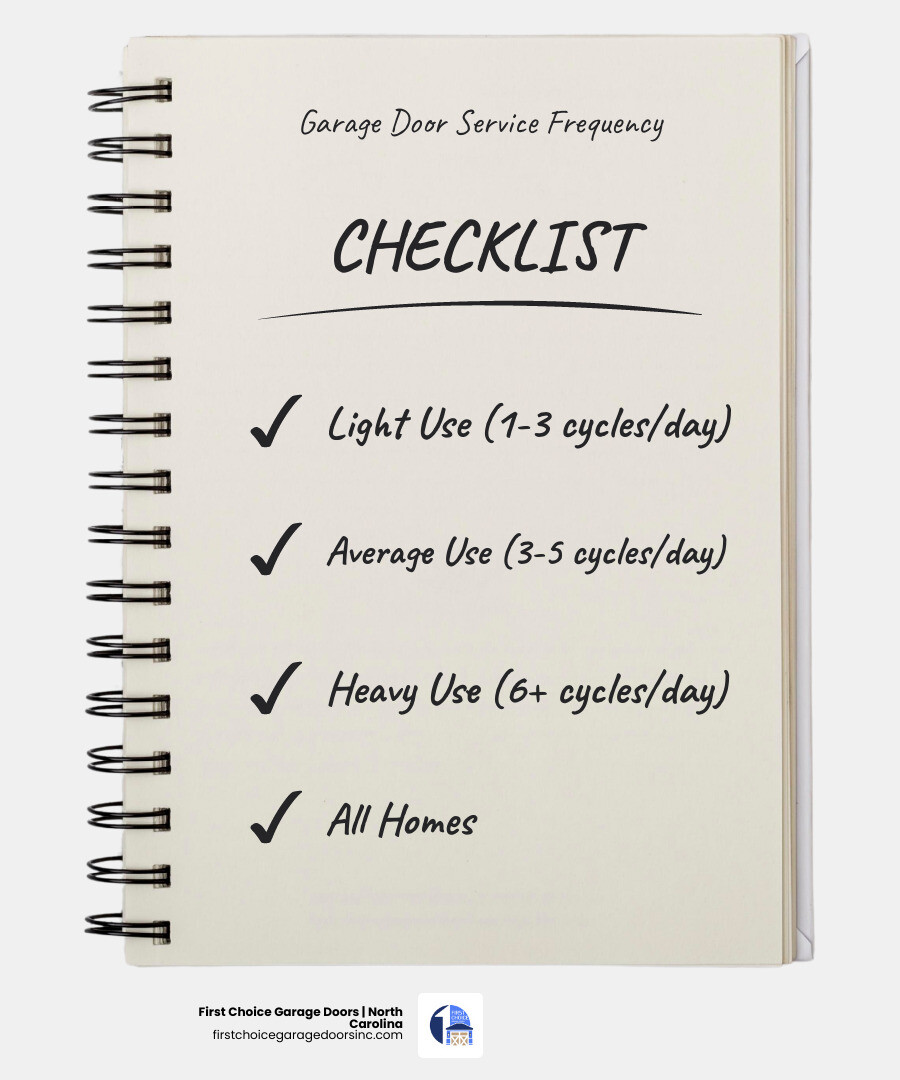
Garage Door Service Frequency at a Glance
| Usage Level | Cycles Per Day | Recommended Service Frequency |
|---|---|---|
| Light | 1-3 cycles | Once every 12-18 months |
| Average | 3-5 cycles | Once per year |
| Heavy | 6+ cycles | Every 6 months |
All homeowners should also:
- Perform a quick visual inspection monthly
- Lubricate moving parts twice a year (spring and fall)
- Test the auto-reverse safety feature monthly
- Schedule a professional tune-up at least once per year
Your garage door is the largest moving part of your home. It can weigh anywhere from 150 to 400 pounds and cycles over 1,500 times a year on average. Springs, cables, rollers, and sensors all wear down over time — often quietly, and without obvious warning signs until a breakdown happens. Regular maintenance is not just about convenience. It is about safety, reliability, and protecting a major investment in your home.
I’m Tony Aguilar, founder of First Choice Garage Doors, Inc., with over 30 years of hands-on experience helping homeowners understand how often should you service your garage door and what that service actually needs to include. In the guide below, I’ll walk you through everything you need to know — from simple monthly checks you can do yourself to the professional inspections that keep your system running safely for years.
How Often Should You Service Your Garage Door for Peak Performance?
For most residential homes, the “Golden Rule” is a professional service appointment once per year. Think of it like an oil change for your car; you wouldn’t drive 50,000 miles without a check-up, and you shouldn’t ask your garage door to lift 400 pounds 1,500 times a year without a tune-up.
When we talk about Keeping Up With Garage Door Maintenance, we are looking at the overall health of the system. A standard residential door cycles between 3 and 5 times every single day. Over the course of a year, that adds up to roughly 1,500 cycles. This constant movement leads to mechanical fatigue. Screws vibrate loose, rollers wear down, and the lubrication that keeps everything quiet begins to dry out or collect dust.
Annual tune-ups are essential because many mechanical issues develop invisibly. You might not notice that your door is slightly out of balance until the extra strain burns out your opener motor. By staying ahead of these issues, you can extend the lifespan of your door from a mere 5–10 years to upwards of 15–30 years.

Determining How Often Should You Service Your Garage Door Based on Usage
While the annual rule is a great baseline, your specific lifestyle might require a more aggressive schedule. We measure the life of a garage door in “cycles” — one full opening and one full closing.
Standard torsion springs are typically rated for 10,000 cycles. If you use your door 4 times a day, those springs should last about 7 years. However, if your garage serves as the primary entrance for a large family with multiple drivers, you might be hitting 8 to 12 cycles a day. In these “heavy usage” scenarios, we recommend a professional inspection every six months.
The stakes are even higher for business owners. Understanding Why Maintenance Is So Important For A Commercial Garage Door is critical because commercial doors are often larger, heavier, and cycled dozens of times daily. A failure at a loading dock or a warehouse entrance doesn’t just mean a minor inconvenience; it can halt operations entirely.
Climate Factors and How Often Should You Service Your Garage Door in North Carolina
In regions like Fayetteville, NC, and across our service areas in Maryland and Virginia, the climate plays a massive role in how your door performs. Our local weather patterns include high humidity in the summer and freezing temperatures in the winter, both of which stress metal components.
Extreme temperature swings cause metal to expand and contract rapidly, leading to “metal fatigue.” In the winter, cold weather increases internal stress on steel spring coils. Furthermore, if your bottom seals are worn, they can freeze to the driveway surface and tear when the door tries to open.
This is why we emphasize Garage Door Maintenance Tips For Winter and suggest following The Ultimate Post Winter Garage Door Maintenance Checklist. Salt from winter roads can also accelerate corrosion on tracks and cables, making a spring cleaning and inspection non-negotiable for homeowners in the Mid-Atlantic.
Essential DIY Maintenance Tasks for Homeowners
You don’t need to be a professional technician to perform basic upkeep. In fact, many of the Ten Residential Garage Door Maintenance Tips we share can be completed in less than 10 minutes.
Start with a visual inspection. Look for frayed cables, loose bolts, or rusted hinges. Next, focus on cleaning the tracks. Use a damp cloth to wipe away dust and debris. Do not use grease inside the tracks, as it will only trap dirt and create a “grinding paste” that destroys your rollers.
Seasonality is also key. Following Garage Door Maintenance Tips To Follow This Spring ensures that any winter damage is addressed before the summer heat arrives. One often-overlooked task is cleaning your photo-eye sensors. These small sensors near the floor can be misaligned by a stray broom or covered in cobwebs and pollen, causing the door to reverse for no apparent reason.
Proper Lubrication Protocols
If your door sounds like a “dinosaur giving birth” every time it moves, it’s screaming for lubrication. However, using the wrong product can do more harm than good.
What to use:
- Silicone-based spray: Excellent for weatherstripping and general parts.
- White lithium grease: The “gold standard” for metal-to-metal contact points.
What to avoid:
- WD-40: This is a solvent/degreaser, not a long-term lubricant. It will actually wash away existing grease and attract dust.
When performing Garage Door Maintenance Procedures You Should Get Done This Summer, focus your lubrication on the roller bearings (not the wheels themselves), the hinge pivot points, and the torsion springs. Lubricating the springs silences the “popping” sound of coils binding and helps prevent rust-related snaps.
Critical Safety Tests and Professional Inspections
Safety is our primary concern. A garage door is a heavy object under intense spring tension. To ensure your family is protected, you should know How To Test Your Garage Door Safety Features on a monthly basis.
The most important check is the Auto-Reverse Test. Place a flat 2×4 board on the ground where the door closes. When the door strikes the wood, it should reverse immediately. If it doesn’t, the force settings on your opener need professional adjustment.
While DIY checks are great, they don’t replace a professional’s eye. Here is how the two compare:
| Task | Homeowner (DIY) | Professional (Annual Tune-Up) |
|---|---|---|
| Visual Inspection | Check for obvious rust/frays | 25-point detailed system audit |
| Lubrication | Spray hinges and springs | High-grade lube on all bearings |
| Cleaning | Wipe tracks and sensors | Deep clean and track alignment |
| Balance Test | Lift door manually | Spring tension recalibration |
| Safety Tests | 2×4 and sensor check | UL 325 compliance verification |
| Hardware | Tighten visible bolts | Torque check on all critical fasteners |
Warning Signs Your System Needs Immediate Attention
Sometimes you can’t wait for your annual appointment. If you notice any of these signs, you need to call for service immediately to avoid a total breakdown:
- Excessive Noise: Screeching, grinding, or loud popping sounds usually mean parts are rubbing together without lubrication or a bearing is about to fail.
- Slow or Jerky Movement: If the door hesitates or moves in fits and starts, your tracks might be misaligned or your opener motor is struggling.
- The “Heavy Door” Syndrome: If you try to lift the door manually and it feels like it weighs 500 pounds, your springs are likely worn out and no longer providing the necessary counterbalance.
- Frayed Cables: Look at the steel cables near the bottom brackets. If you see “hair” or fraying, they are a ticking time bomb and could snap at any moment.
Following Six Preventive Residential Garage Door Maintenance Tips can help you spot these issues early. For example, replacing plastic builder-grade rollers with nylon rollers with sealed ball bearings can instantly quiet a door and last for over 20,000 cycles.
Frequently Asked Questions about Garage Door Servicing
What is the “7-Year Rule” for garage door springs?
The “7-Year Rule” is a proactive approach to safety. Since standard torsion springs are rated for 10,000 cycles, and the average home cycles the door 1,500 times a year, the springs will likely reach their breaking point around year seven. By following Garage Door Maintenance Tips To Ensure A Long Lasting Door, we recommend replacing springs at year seven before they snap and leave you stuck in your garage on a Monday morning.
Why shouldn’t I lubricate my garage door tracks?
It is a common mistake to think that more grease is always better. However, putting grease or oil inside the vertical tracks is a recipe for disaster. The grease acts as a magnet for dust, hair, and insects, creating a thick, gummy residue. This residue makes the rollers slip instead of roll, which puts immense strain on the opener. According to our Garage Maintenance Tips, the tracks should be kept bone-dry and clean.
How do I know if my garage door is out of balance?
A balanced door is easy to move. To test this, disconnect your opener by pulling the red emergency release cord. Lift the door manually to about waist height and let go. A perfectly balanced door will stay in place. If it slams shut or shoots upward, your springs are out of adjustment. Seeking Affordable Garage Door Maintenance Tips Columbia Md can help you find local pros to fix this, as spring adjustment is too dangerous for a DIY project.
Conclusion
Understanding how often should you service your garage door is the first step toward a safer, quieter, and more reliable home. While monthly visual checks and biannual lubrication are tasks you can easily handle, nothing beats the peace of mind that comes with a professional 25-point inspection.
At First Choice Garage Doors, we bring decades of expertise to every driveway in Fayetteville, NC, and beyond. We don’t just “fix” doors; we maintain systems to ensure they never fail you when you need them most. Whether you need a quick tune-up, a safety test, or a full component upgrade, our team is ready to help.
Ready to give your door the care it deserves? Explore our full range of Products And Services/Garage Door Maintenance and schedule your visit today. Don’t wait for the “dinosaur” sounds — stay ahead of the curve and keep your home moving smoothly.