
Why is my garage door making noise in April 2026?
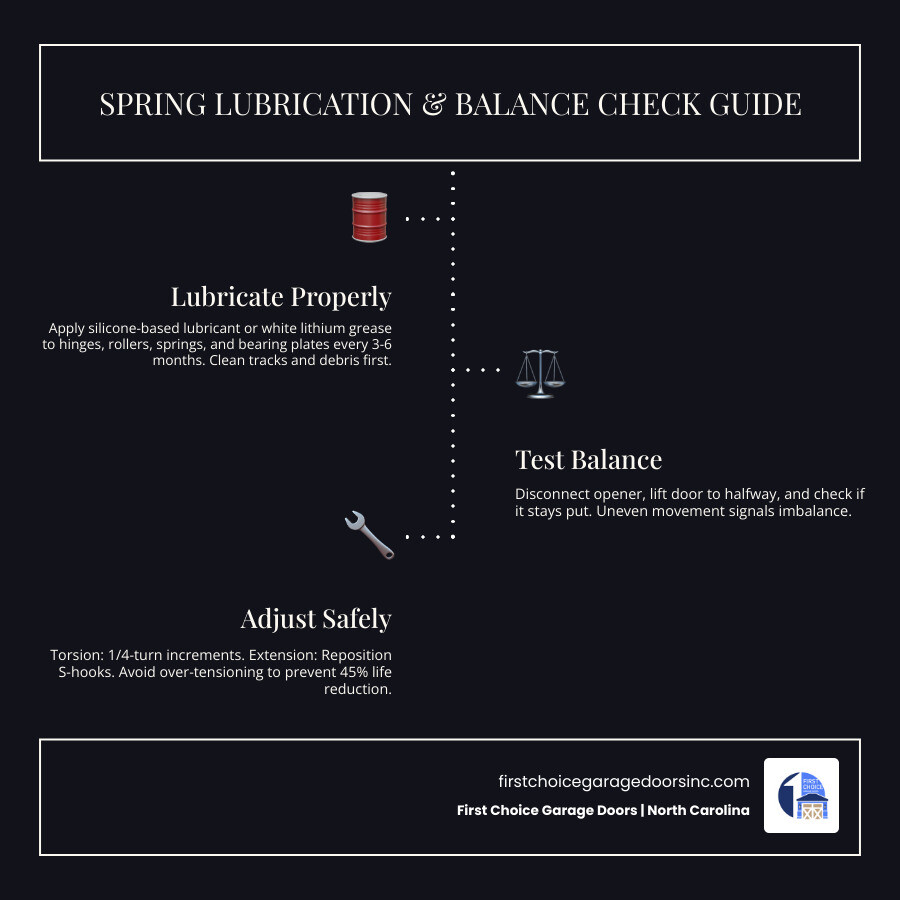
A spring lubrication and balance check guide is something every homeowner with a garage door needs — and for good reason. Here’s a quick overview of what proper spring maintenance involves:
Quick Spring Lubrication and Balance Check Guide:
- Lubricate every 3–6 months using silicone-based lubricant or white lithium grease on hinges, rollers, springs, and bearing plates
- Avoid WD-40 and oil-based lubricants — they attract dirt and break down quickly
- Clean before you lubricate — wipe down tracks and remove debris first
- Test balance by disconnecting the opener, lifting the door to waist height, and checking if it stays in place
- Adjust torsion springs in 1/4-turn increments or reposition extension spring S-hooks to correct imbalance
- Never over-tension springs — even one extra turn can reduce spring life by up to 45%
- Call a professional if springs are broken, cables are frayed, or the door won’t stay balanced after adjustments
Your garage door is one of the most mechanically active parts of your home. It cycles up and down thousands of times per year, putting constant stress on springs, hinges, rollers, and cables. Over time, that friction and tension build up — and without regular maintenance, small problems quietly become expensive ones. A door that’s even slightly out of balance forces the opener motor to work harder than it should, wearing out components far ahead of schedule.
The good news is that a proper lubrication and balance routine isn’t complicated. With the right lubricant, a few basic steps, and an eye for warning signs, you can keep your garage door running smoothly and safely through every season.
I’m Tony Aguilar, founder of First Choice Garage Doors, Inc., with over 30 years of hands-on experience in the garage door industry — and this spring lubrication and balance check guide reflects what I’ve seen work (and fail) in the field since 1993. Whether your door is squeaking, struggling to stay level, or just overdue for seasonal attention, this guide will walk you through everything you need to know to maintain it safely and confidently.

If you’ve noticed your garage door screaming for attention this April 2026, you aren’t alone. As temperatures shift, the metal components in your door system expand and contract, which can exacerbate existing friction issues. Proper lubrication is the primary defense against this noise. By reducing the metal-on-metal contact between hinges, rollers, and springs, you significantly decrease the decibel level of your door’s operation.
However, noise reduction is just the tip of the iceberg. Proper maintenance is essential for component longevity. When parts aren’t lubricated, they grind against each other, creating heat and wear that can lead to premature failure. This is especially true for your opener motor. A door that is poorly lubricated or out of balance creates “drag,” forcing the motor to pull much more weight than it was designed for.
To keep things running smoothly, we recommend a 3-6 month maintenance interval. If you live in a coastal area like Fayetteville, NC, or experience high usage (opening the door more than four times a day), you should lean toward the three-month mark. Following Garage Door Maintenance Tips To Follow This Spring/ ensures that you catch small issues before they turn into a full system breakdown.
I need a spring lubrication and balance check guide for my Fayetteville home. Where do I start?
Starting your maintenance routine begins with choosing the right products. In our experience at First Choice Garage Doors, using the wrong “grease” is just as bad as using none at all.
Choosing the Right Lubricant
- Silicone-Based Lubricants: These are the gold standard. Silicone maintains its viscosity across a wide range of temperatures, making it perfect for the humid summers and chilly winters in North Carolina.
- White Lithium Grease: This is a thick, heavy-duty option that stays in place well on metal-to-metal contact points like hinges.
- What to Avoid: Never use WD-40 or standard automotive oil. WD-40 is a degreaser, not a permanent lubricant; it will actually strip away existing grease and attract dust, creating a “sludge” that binds your rollers.
Before you spray anything, you must prepare the door. Use a damp cloth to clean the tracks—do not lubricate the tracks themselves, as this causes the rollers to slip rather than roll. Take a moment to check for loose hardware. Vibration from daily use can loosen the bolts on your hinges or track brackets. Tightening these now prevents the door from rattling out of alignment later. For more details on the “prep” phase, check our tag/lubrication/ resources.
| Feature | Silicone Lubricant | White Lithium Grease |
|---|---|---|
| Best For | Springs and Pulleys | Hinges and Metal Rollers |
| Climate Performance | Excellent in all temps | Better in stable temps |
| Dirt Attraction | Very Low | Moderate |
Preparing your hardware for a spring lubrication and balance check guide
Focus your attention on the moving parts. Apply a small amount of lubricant to the hinge pins where the panels fold. For your rollers, aim the spray at the bearings inside the roller itself, not the outer surface that touches the track.
Don’t forget the bearing plates located at either end of the torsion bar (above the door). These support the entire weight of the door as it spins. If these are caked with old grease and dirt, use a bit of brake cleaner to dissolve the gunk before applying fresh silicone. Following these Garage Maintenance Tips/ will keep your hardware from seizing up.
Utilizing digital tools for a spring lubrication and balance check guide
In April 2026, maintenance isn’t just about a wrench and a grease gun; it’s about data. Professionals often use tools like the SSC Spring Engineering app to diagnose balance issues. This app allows us to calculate IPPT (Inch Pounds Per Turn), which tells us exactly how much lifting power a spring has based on the door’s weight and height.
While homeowners might not need to calculate drum comparisons or specific cable length factors daily, knowing these tools exist helps you understand why your door might feel “heavy” even if the springs look fine. Proper cable length and drum timing are vital; if one cable is even a fraction of an inch longer than the other, the door will pull unevenly. You can find more technical insights under our Tag/Garage Maintenance/ section.
What are the common signs that my garage door is out of balance?
A door that is out of balance is a safety hazard waiting to happen. Here are the red flags we tell our customers in Fayetteville to watch for:
- Uneven Movement: Does one side of the door seem to “lag” behind the other? This often points to a cable or spring tension issue.
- Motor Strain: If your opener sounds like it’s lifting a tank, it probably is. A balanced door should feel like it weighs only 5 to 10 pounds.
- The “Drop” Test: If you partially open the door and it slams shut, the springs are too weak. If it flies open on its own, the springs are over-tensioned.
- Weather Seal Gaps: Look at the bottom of the door when it’s closed. If there’s a gap on one side but not the other, the door is likely crooked.
- Excessive Noise: Popping or snapping sounds often indicate that the springs are binding or the cables are overlapping on the drums.
Catching these signs early is part of the Six Preventive Residential Garage Door Maintenance Tips/ we recommend. Ignoring an unbalanced door can lead to the door falling off its tracks entirely, which is a much more expensive (and dangerous) repair. For more visual cues, browse our Tag/Garage Door Maintenance/ archive.
How do I safely perform a balance test and adjust my springs?
Testing your door’s balance is something you can—and should—do yourself at least twice a year.
Step-by-Step Balance Test:
- Close the door completely.
- Pull the emergency release cord (the red handle) to disconnect the door from the opener.
- Manually lift the door to about waist height.
- Let go. A perfectly balanced door should stay in place or move only slightly. If it crashes to the ground, your springs lack tension. If it shoots upward, they have too much.
Adjusting Tension (Proceed with Caution): Adjusting springs is the most dangerous part of garage door maintenance. Torsion springs are under immense pressure. If you are confident and have the proper winding bars, you can adjust torsion springs in 1/4-turn increments. However, we highly recommend reading The Northern Virginia Guide To Opener And Spring Maintenance/ before attempting this.
For extension springs (the ones that run along the side tracks), you can often adjust the balance by repositioning the S-hooks into different holes on the track bracket. This changes the “stretch” and tension.
A Word on Over-Tensioning: It might be tempting to give the spring “one more turn” to make the door feel lighter. Don’t. Research shows that adding just one extra turn of tension can shorten spring life by up to 45%. It’s better to have a slightly heavy door than a spring that snaps prematurely. You can find more safety protocols in our tag/maintenance/ section.
Inspecting cables, drums, and tracks
While you are checking the springs, look at the “supporting cast.”
- Cables: Check for fraying or “bird-nesting” (where the wires start to unravel). A frayed cable can snap at any moment, causing the door to fall.
- Drums: Ensure the cables are seated neatly in the grooves. In vertical lift or high-lift scenarios, “cable timing” is everything. The cable should hit the flat part of the drum exactly as the top roller enters the horizontal track.
- Tracks: Ensure they are plumb and level. If the tracks are bent, no amount of lubrication will make the door quiet.
For residents in specific areas, we’ve tailored local advice like the Garage Door Maintenance Guide Annapolis Md/, which covers how local humidity affects track alignment.
Frequently Asked Questions about Garage Door Maintenance
How often should I lubricate my garage door components?
For the average home in North Carolina, we recommend every 3 to 6 months. If you use your garage as your primary entrance, aim for every 3 months. Regular lubrication prevents the metal from becoming brittle and reduces the workload on your opener.
What is the safest way to test my garage door balance at home?
The safest way is the manual lift test. Always ensure the door is disconnected from the opener first. Never try to “feel” the balance while the motor is doing the lifting, as the opener’s safety sensors can mask a major imbalance until the motor finally burns out.
Why should I avoid using standard oil or WD-40 on my rollers?
Standard oil is too thin and will drip off, leaving a mess on your garage floor. WD-40 is a solvent; it’s great for loosening a rusted bolt, but it evaporates quickly and leaves the metal unprotected. Stick to silicone or lithium-based sprays designed for garage doors.
Who provides reliable garage door maintenance in Fayetteville?
While this spring lubrication and balance check guide is designed to help you handle the basics, some jobs are best left to the pros. At First Choice Garage Doors, we specialize in professional safety inspections and high-cycle spring replacements.
Most standard garage doors come with springs rated for 10,000 cycles. Depending on your usage, that might only last 5 to 7 years. We offer high-cycle replacements that can last 25,000 to 50,000 cycles—essentially the lifetime of the door. Our technicians are trained to handle the high-tension environment of torsion systems safely, ensuring your door is balanced to the ounce.
Whether you’re in Fayetteville, NC, or our other service areas like Manassas, VA, or Columbia, MD, we are here to help. Don’t wait for a snapped cable or a burnt-out motor to take action. Proper maintenance is an investment that pays for itself in avoided repairs and peace of mind.
Ready to ensure your door is in top shape for 2026? Explore our full range of Products And Services/Garage Door Maintenance/ and let us take the heavy lifting off your hands.