
Is It Better to Repair a Panel or Replace the Whole Garage Door?
When it comes to garage door panel replacement vs full door replacement, the right answer depends on a handful of clear factors — and getting it wrong can cost you more in the long run.
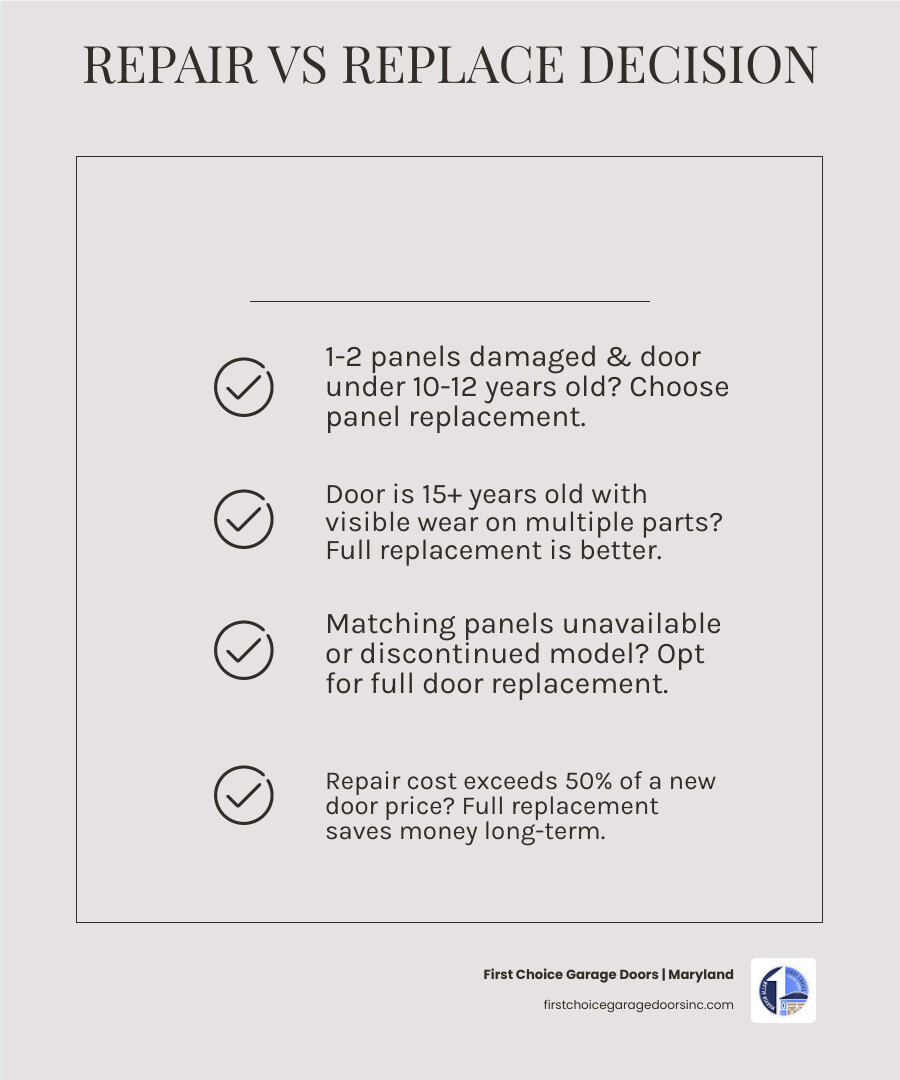
Here’s a quick breakdown to help you decide:
| Situation | Best Option |
|---|---|
| Damage limited to 1-2 panels, door under 10-12 years old | Panel replacement |
| Matching panels still available from manufacturer | Panel replacement |
| Door is 15+ years old with visible wear | Full replacement |
| 3 or more panels damaged | Full replacement |
| Tracks, springs, or hardware are also worn | Full replacement |
| Discontinued door model, no matching panels available | Full replacement |
| Repair cost exceeds 50% of a new door’s price | Full replacement |
Your garage door takes a beating. It opens and closes roughly 1,500 times a year, and over time that adds up — cracked panels, worn hardware, and fading finishes are all part of the picture. When a panel gets dented by a stray basketball or warped by a bad storm, it’s tempting to assume a quick panel swap will fix everything. But that single damaged section can point to a much bigger question about the overall health of your door system.
For Maryland homeowners, making the right call between panel repair and full replacement can protect your home’s curb appeal, security, and energy efficiency — and avoid paying for the same problem twice.
Garage Door Panel Replacement vs Full Door Replacement: Key Decision Factors

When you are staring at a fresh dent in your garage door, your immediate instinct is probably to look for the quickest, most budget-friendly fix. However, evaluating whether to swap out a single section or invest in a brand-new setup requires looking at the big picture.
The first step is identifying the difference between cosmetic issues and structural damage. If a minor low-speed bumper tap left a shallow crease in your bottom steel panel, but the door still glides smoothly up and down its tracks, you are likely dealing with a cosmetic issue. In this scenario, replacing the single section is highly practical.
On the other hand, if a structural support beam is warped, or if a storm has buckled multiple panels, the structural integrity of the entire door is compromised. A warped panel can cause the door to bind in its tracks, putting immense strain on your electric opener and potentially causing the entire system to fail during operation.
Additionally, we must look at panel availability. Garage door manufacturers frequently update their product lines. If your door was installed more than a decade ago, there is a strong chance the original manufacturer has discontinued that specific model. Because tongue-and-groove joints, emboss patterns, and section thicknesses differ significantly between brands, you cannot simply mix and match panels from different manufacturers.
If you are trying to decide which route makes the most sense for your home, take a look at our guide on Choosing Between a Garage Door Repair or Replacement for a deeper dive into these initial steps.
Deciding on Garage Door Panel Replacement vs Full Door Replacement for Older Models
As a general rule of thumb in the garage door industry, the “sweet spot” for performing individual panel repairs starts to shrink rapidly once a door crosses the 10-to-12-year mark. While high-quality garage doors are designed to last anywhere from 15 to 30 years with proper maintenance, the mechanical components supporting them have a much shorter operational lifespan.
Consider your garage door’s torsion springs. These heavy-duty springs are rated for a specific number of cycles—typically between 10,000 and 20,000 open-and-close operations. For the average family, this translates to roughly 8 to 14 years of normal use. If your door is approaching 15 years of age and experiences panel damage, the springs, rollers, cables, and hinges are likely nearing the end of their functional lives as well.
In fact, industry data shows that about 60% of garage doors over 15 years old that undergo single panel work require a complete system replacement within two years anyway, as other mechanical components inevitably begin to fail. Investing in a single new panel for an aging, heavy door can also create an imbalance. A brand-new panel may be significantly stiffer and heavier than weathered, older panels, which can place uneven stress on your aging opener.
To help determine if your old door is sending you warning signs that it is ready to retire, read through our helpful breakdown on Do You Need a Garage Door Replacement? Check for These Signs to Find Out.
Why Professional Assessment Matters for Garage Door Panel Replacement vs Full Door Replacement
It is easy to look at a garage door as just a series of painted metal or wood sections that roll up and down. In reality, it is the largest, heaviest moving object in your home, operating under extreme mechanical tension. This is why having a professional technician perform a comprehensive safety inspection is so critical before making a final decision.
When we inspect a damaged door, we do not just look at the dented panel. We evaluate the entire system as a single cohesive unit:
- System Balance: We perform balance tests to ensure the door stays in place when opened halfway by hand. If it crashes down or flies upward, the spring tension is incorrect.
- Track Alignment: We check for bent or misaligned tracks that could cause a new panel to bind or wear out prematurely.
- Structural Stress Points: We look for hidden damage, such as hairline fractures near the center hinge stiles or corrosion along the bottom retainer.
- Opener Force Limits: We test the safety reversal system to ensure your opener is not straining against a heavy or warped door.
A professional assessment ensures you do not spend money on a cosmetic panel replacement only to discover that the structural framework or spring system is dangerously compromised. For a comprehensive look at what goes into evaluating a single section swap, check out The Ultimate Guide to Replacing Just One Garage Door Panel.
Structural and Material Considerations
The material your garage door is constructed from plays a massive role in whether a panel repair is a smart long-term decision or a temporary band-aid. Different materials handle wear, impacts, and environmental exposure in entirely different ways.
| Material Type | Repair Feasibility | Aesthetic Matching | Weather Resistance | Long-Term Recommendation |
|---|---|---|---|---|
| Steel (Single-Layer) | High (if model is active) | Moderate (fading issues) | High | Replace panel if damage is isolated |
| Steel (3-Layer Insulated) | Moderate | Moderate | High | Replace panel if inner insulation is intact |
| Natural Wood | Low (custom matching required) | Difficult (grain & stain) | Low (prone to rot) | Replace full door to modern composite/steel |
| Aluminum & Glass | High (modular design) | High | High | Replace individual section frame or glass |
Steel remains the most common material for residential garage doors. If you have a standard single-layer steel pan door, replacing a section is relatively straightforward, provided the manufacturer still fabricates that model. However, if you own a custom wood door, panel replacement becomes highly complex. Wood panels naturally warp, expand, and contract over time due to Maryland’s humid summers and freezing winters. Crafting a single replacement wood section that matches the exact grain, moisture content, and weight of your existing weathered sections is incredibly difficult.
To explore how different materials affect your door’s durability and performance, read our guide on Garage Door Materials to Consider When Replacing Your Door.
Aesthetics, UV Fading, and Curb Appeal
Your garage door can represent up to 40% of your home’s street-facing facade. Because it is highly visible, aesthetics should play a major role in your decision-making process.
One of the biggest hurdles with single panel replacement is the color matching problem. Even if you order the exact same manufacturer paint color (such as standard white or almond), your existing door has likely spent years exposed to direct sunlight. UV radiation causes paint oxidation and gradual fading.
If you install a brand-new panel in the middle of a sun-bleached, seven-year-old door, the new section will stand out noticeably—often resembling a fresh patch of paint on an old, faded car. While you can repaint a steel door to unify the color, the cost of professional surface preparation and painting can quickly approach the cost of a full door replacement.
This aesthetic mismatch is not just an eyesore; it has real financial consequences. Real estate data shows that a mismatched, patchy garage door repair can actually reduce a home’s overall value by 1% to 2%. Conversely, replacing your entire garage door with a uniform, modern system can increase your home’s value by 1% to 3%, making it one of the highest-return exterior home improvement projects you can undertake.
For a detailed look at how a new door impacts your home’s street appeal compared to a simple panel repair, read The Cost of a Facelift: Panel Replacement vs New Door Comparison.
Single Section vs Multiple Section Damage
When assessing damage, the quantity of affected panels is often the ultimate deciding factor. Sectional garage doors typically consist of three to four hinged horizontal sections.
If a single section is damaged—for example, if a fallen branch dented the top section during a summer storm—replacing that lone section is highly practical. However, if a vehicle back-up accident has creased two or more sections, the math changes completely.
Replacing multiple panels requires purchasing multiple individual sections, transferring the hardware for each, and re-balancing the spring system. Once you cross the threshold of needing two or more panels, the cumulative cost of parts and labor closely approaches the cost of a brand-new, fully warrantied door system.
Additionally, multi-panel damage often indicates that the vertical tracks, hinges, and roller assemblies have also absorbed a significant impact. Reusing these stressed components with new panels can lead to noisy operation, rapid wear, and safety hazards.
To learn more about the limitations and realities of isolated section repairs, check out The Lone Ranger: Can You Really Replace Just One Garage Door Section?.
Safety Considerations and Professional Requirements
Under no circumstances should garage door panel replacement be treated as a weekend DIY project. Garage doors rely on a system of high-tension springs—either torsion springs mounted on the header above the door or extension springs running along the horizontal tracks. These springs store an incredible amount of mechanical energy to counterbalance the heavy weight of the door.
Risks of DIY Panel Swaps
Attempting to swap a panel yourself without the proper training and commercial-grade tools is highly dangerous. To replace a bottom or middle panel, the tension on the garage door springs must be completely unloaded.
Unwinding a torsion spring requires specialized winding bars and an intimate understanding of the physics involved. If a winding bar slips or a spring snaps during a DIY repair, the sudden release of energy can cause catastrophic physical injury or severe property damage.
Furthermore, simply bolting a new panel into place without checking the balance of the door can ruin your electric opener. If the new panel alters the door’s weight distribution, the opener will have to work twice as hard to lift it, leading to a burned-out motor or stripped gears.
Before you grab your socket wrench and attempt a dangerous repair, read our warning guide: Don’t Get Unhinged During Your Residential Garage Door Replacement in Annapolis, MD.
To understand more about the structural warning signs that indicate you need professional intervention, take a look at Knowing When You Need a Garage Door Replacement.
Professional Installation Steps
When our professional technicians perform a garage door panel replacement, we follow a strict multi-step safety and quality protocol:
- Securing the System: We lock the garage door in place and use professional clamps to secure the tracks.
- Unloading Tension: We safely unwind the torsion springs using rated winding bars to eliminate tension on the cables.
- Hardware Transfer: We carefully remove the hinges, rollers, and operator brackets from the damaged section.
- Panel Removal and Re-stacking: We slide out the damaged panel and install the new manufacturer-matched section, ensuring the tongue-and-groove joints align perfectly.
- Re-tensioning and Balancing: We wind the springs back to the precise number of turns required for the door’s weight.
- Safety Testing: We perform a full 25-point safety inspection, testing the balance, track alignment, and the opener’s safety reversal sensors.
To see what signs point to a system that requires this level of professional care, read our article on Signs You Need a Garage Door Replacement.
Frequently Asked Questions about Garage Door Panels
Can you replace just one panel on a garage door?
Yes, in most cases you can replace a single panel on a sectional garage door. This is highly practical if the damage is isolated to one section, the door is relatively new (under 10 years old), and the manufacturer still produces your exact model. However, custom carriage house doors or overlay doors are exceptions; because their exterior designs must align perfectly across all sections, you usually have to replace the entire set of panels.
Will a new replacement panel match my existing weathered door?
It is very difficult to get a perfect aesthetic match on a door that is more than five years old. Sunlight and weather exposure naturally fade paint and oxidize finishes. While a new panel will match structurally, it will likely look brighter and have a different sheen than your older, weathered panels. Repainting the entire door after the panel swap is the best way to achieve a uniform look.
When does a full replacement make more sense than a panel repair?
A full replacement is the smarter, safer, and more economical choice if:
- Your door is over 15 years old.
- Three or more panels are damaged.
- The original door model has been discontinued by the manufacturer.
- The door has severe structural warping or sagging.
- You want to upgrade your home’s energy efficiency with a modern, insulated door.
For a detailed breakdown of how to weigh these options, read our guide on When to Repair vs Replace Your Garage Door.
Conclusion
Deciding between a single panel swap and a brand-new garage door does not have to be a stressful guessing game. By evaluating the age of your door, the extent of the structural damage, and the availability of matching parts, you can easily determine the safest and most practical path forward for your home.
Whether you need a precise, professional single panel swap to fix a minor dent or a complete, beautiful garage door upgrade to boost your home’s curb appeal and energy efficiency, we are here to help. At First Choice Garage Doors, we provide honest assessments and expert service across Columbia, MD, Frederick, MD, and Easton, MD.
Don’t leave your home’s safety and curb appeal to chance. Contact us today to schedule a professional evaluation, or explore our Garage Door Repair Services to get your door back on track!