
Your Garage Door’s Lifespan: What Every Fayetteville Homeowner Should Know
How long does a garage door last is one of the most practical questions you can ask as a homeowner — and the short answer is: most garage doors last between 15 and 30 years, depending on the material, how often you use it, and how well you maintain it. Here’s a quick breakdown:
| Component | Typical Lifespan |
|---|---|
| Steel garage door | 20–30 years |
| Wood garage door | 15–25 years |
| Aluminum garage door | 20–25 years |
| Fiberglass garage door | 20–25 years |
| Vinyl/composite garage door | 25–35 years |
| Garage door opener | 10–15 years |
| Torsion springs | ~10,000 cycles (7–10 years) |
But here’s the thing — those numbers assume average conditions. In Fayetteville, NC, where humidity is relentless and seasonal temperature swings are real, your garage door can age faster than the national average if it isn’t properly cared for.
That’s especially true in neighborhoods where the garage is the main entrance to the home. More on that ahead.
I’m Tony Aguilar, founder of First Choice Garage Doors, Inc., with over 30 years of hands-on experience helping homeowners understand how long a garage door lasts — and how to get every year possible out of it. Having worked in this industry since 1993, I’ve seen how climate, usage habits, and material choice can make the difference between a door that lasts 15 years and one that pushes well past 25.
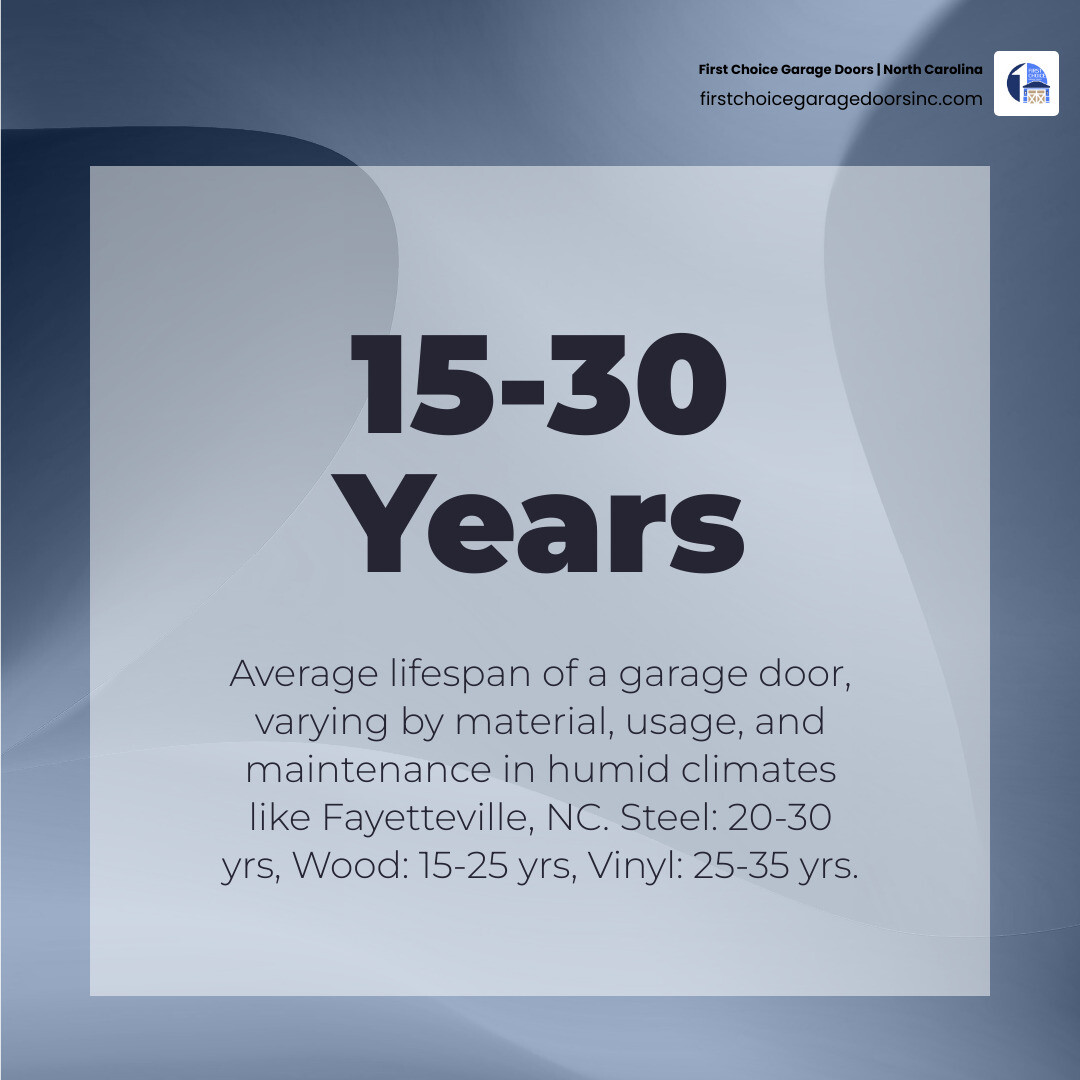
How long does a garage door last in Fayetteville?
In the Fayetteville area, we face a unique set of environmental challenges. While the national average suggests a door can reach 30 years, our local climate—marked by high humidity and the occasional salt air drift from the coast—can be tough on mechanical systems. When we discuss The Secret Life Of Garage Doors And How Long They Actually Last, we have to account for the “North Carolina tax.”
Moisture is the primary enemy here. High humidity levels can lead to premature rust on steel components and rot or warping in natural wood doors. If you live in a part of the state where salt air is a factor, that corrosion can accelerate significantly. Generally, you can expect a well-installed door in our region to stay functional for 15 to 30 years, but the lower end of that spectrum is more common for doors that are neglected or made of less resilient materials.
How long does a garage door last based on material?
The material you choose is perhaps the biggest indicator of your door’s “expiration date.” Each material reacts differently to the Fayetteville sun and moisture levels. Understanding What Is Able To Influence The Longevity Of Your Garage Door starts with the substance it’s built from.
| Material | Expected Lifespan | Key Characteristics in NC |
|---|---|---|
| Steel | 20–30 Years | The “gold standard.” Highly durable and dent-resistant, especially in triple-layer models. |
| Vinyl/Composite | 25–35 Years | The longevity champions. They don’t rust, rot, or dent easily, making them “set it and forget it” options. |
| Fiberglass | 20–30 Years | Great for humidity and salt air, though they can become brittle in rare extreme cold snaps. |
| Aluminum | 20–25 Years | Naturally rust-resistant and lightweight, but more prone to denting from stray basketballs. |
| Natural Wood | 15–25 Years | Beautiful curb appeal but high maintenance. Vulnerable to moisture and insects without frequent sealing. |
Steel remains a top choice for many of our customers because of its balance between strength and longevity. However, for those looking for the absolute maximum lifespan, vinyl and composite doors often win out because they are virtually immune to the moisture-related issues that plague other materials.
How long does a garage door last with high-frequency use?
We often tell our clients to stop thinking about their garage door in terms of years and start thinking in terms of cycles. A “cycle” is one full opening and closing of the door.
The average American household opens their garage door 3 to 5 times per day. That adds up to roughly 1,000 to 1,500 cycles per year. If your family uses the garage as the primary entrance to the home—letting the kids in after school, taking out the trash, and parking the cars—you might be hitting 8 to 10 cycles a day.
High-frequency use leads to mechanical fatigue. Every time that door moves, the springs are under immense tension, the rollers are spinning, and the cables are pulling. A door that is cycled 10 times a day will likely need major component replacements (like springs) every 3 years, whereas a low-traffic door might go a decade without a hitch. To keep these high-traffic doors running, regular garage door maintenance is non-negotiable.
The Lifespan of Openers and Springs
While the door panels themselves might last 30 years, the “guts” of the system usually don’t. The garage door opener—the motorized box on your ceiling—typically has a lifespan of 10 to 15 years.
Modern openers often reach “technological obsolescence” before they actually break. For example, openers manufactured before 1993 lack modern safety sensors, and older “dip switch” remotes are far less secure than today’s rolling code technology. We often recommend learning How To Increase The Longevity Of Your Garage Door Opener by ensuring the door it’s pulling is perfectly balanced; a struggling motor will burn out years ahead of its time.
Then there are the springs. Standard torsion springs are rated for 10,000 cycles. If you use your door three times a day, they’ll last about 7 to 10 years. If you use it ten times a day, they might snap in under three years. When a spring breaks, it’s often a “diagnostic moment” for the whole system—it’s the perfect time to evaluate if the rest of the hardware is worth saving.
Maintenance Strategies to Extend Longevity
If you want to know how long does a garage door last when it’s pampered, the answer is “significantly longer.” Proactive care can add 5 to 10 years to the life of your system. At First Choice Garage Doors, we emphasize that Keeping Up With Garage Door Maintenance is the best ROI you can get for your home.
Here are our top Garage Door Maintenance Tips To Ensure A Long Lasting Door:
- Lubricate twice a year: Use a silicone-based spray or white lithium grease on the rollers, hinges, and springs. Avoid WD-40, as it can actually strip away the necessary grease.
- The Balance Test: Disconnect your opener and lift the door manually halfway. If it stays in place, it’s balanced. If it slams down or shoots up, your springs are strained and are killing your opener motor.
- Clear the Tracks: Use a vacuum or a damp cloth to remove debris and cobwebs from the tracks. Do not lubricate the inside of the tracks; they need friction for the rollers to work correctly.
- Check the Seals: In Fayetteville, humidity creeps in through cracked bottom seals. Replace your weatherstripping as soon as you see light peeking through the bottom of the door.
- Rinse the Panels: If you live near coastal areas, rinse your door with fresh water every few months to remove salt buildup that causes rust.
Knowing When to Repair vs. Replace
There comes a point where “one more repair” is just throwing good money after bad. We generally use the “15-year threshold.” If your door is over 15 years old and needs a major repair—like a panel replacement or a full motor swap—it’s usually more cost-effective to replace the whole system.
There are several Signs You Need A Garage Door Replacement. If your door makes a screeching or grinding noise that lubrication won’t fix, it could indicate structural issues. Visible sagging, slow operation, or sections that are out of alignment are also major red flags.
Knowing When Is It Time To Have A Garage Door Replacement often comes down to safety and security. If your door lacks modern auto-reverse sensors or if the wood is so soft you can poke a screwdriver through it, it’s time. Knowing When You Need A Garage Door Replacement can save you from an emergency failure on a Monday morning when you’re trying to get to work.
Choosing Between Garage Door Repair Or Replacement
Deciding When To Repair Vs Replace Your Garage Door involves looking at the long-term ROI. A new door provides an immediate boost to curb appeal and home value. Furthermore, modern doors are significantly more energy-efficient. A triple-layer insulated steel door can reduce energy loss in an attached garage by up to 20%, which is a huge plus during those humid North Carolina summers.
Choosing Between Garage Door Repair Or Replacement also allows you to upgrade to smart technology. Newer systems offer Wi-Fi connectivity, battery backups (essential during our summer storms), and much quieter belt-drive operation. If your current door is a “clunker” that wakes up the neighbors, the peace and quiet of a new installation might be worth the investment alone.
Frequently Asked Questions about Garage Door Lifespan
How many years do garage door springs typically last?
Most standard springs are rated for 10,000 cycles. For the average family, this translates to about 7 to 10 years. However, if you use your garage as your primary entrance, you might see them fail in as little as 3 to 5 years. We offer high-cycle spring upgrades (rated for 20,000 to 50,000 cycles) for households that are always on the go.
Does the direction my garage door faces affect its life?
Absolutely. In Fayetteville, south-facing and west-facing doors take a beating from the UV rays. Intense sun exposure can bake the finish, causing paint to fade and vinyl to become brittle over time. It also dries out rubber weather seals much faster. If your door faces the sun all day, we recommend using lighter colors to reflect heat and applying a UV-protective coating if possible.
Is it worth repairing a 20-year-old garage door opener?
Generally, no. Since the average lifespan of an opener is 10 to 15 years, a 20-year-old unit is well past its prime. Older units lack modern security features like rolling codes (which prevent hackers from “grabbing” your remote signal) and essential safety sensors. Replacing an obsolete unit is usually a smarter financial move than trying to find parts for a motor that could fail again next month.
Conclusion
At First Choice Garage Doors, we take pride in helping our Fayetteville neighbors make the best decisions for their homes. Whether you are wondering how long does a garage door last because yours is starting to creak, or you’re ready to upgrade your home’s curb appeal, our team is here to provide professional installation and unmatched expertise.
We prioritize quality and safety above all else, ensuring that every door we install or repair is built to withstand the North Carolina climate. Don’t wait for your door to fail—if you’re noticing the signs of age, reach out to us for a professional evaluation.
For expert service and reliable results, contact us for your Fayetteville garage door replacement today. We’ll help you find a door that doesn’t just look great, but lasts for decades to come.