
Is It Time to Repair or Replace Your Garage Door? Here’s How to Decide Fast
If you’re looking for a repair vs replace your garage door decision guide, here’s a quick answer before we dive deeper:
Quick Decision Guide:
| Situation | Best Action |
|---|---|
| Door is under 10 years old, isolated issue | Repair |
| Repair cost is less than 50% of a new door | Repair |
| Single damaged panel, working structure | Repair |
| Broken spring, cable, or rollers | Repair |
| Door is 15+ years old with recurring problems | Replace |
| Repair cost exceeds 50% of replacement cost | Replace |
| Structural damage, sagging, or major rust | Replace |
| Missing modern safety features (auto-reverse) | Replace |
| Multiple failed components or frequent breakdowns | Replace |
Your garage door is one of the hardest-working parts of your home. It opens and closes roughly 1,500 times a year — that’s a lot of wear on springs, cables, rollers, and panels. And because a garage door can make up as much as one-third of your home’s front exterior, when something goes wrong, it’s hard to ignore.
The real challenge isn’t noticing the problem. It’s knowing what to do next. A grinding noise might mean a $150 roller fix — or it might be the first sign that a 20-year-old system is finally giving out. Making the wrong call in either direction costs you money you didn’t need to spend.
That’s where a clear, honest framework makes all the difference.
I’m Tony Aguilar, founder of First Choice Garage Doors, Inc., with over 30 years of hands-on experience helping homeowners navigate exactly this kind of repair vs replace your garage door decision guide moment. In the sections ahead, I’ll walk you through the key factors — age, damage type, cost thresholds, and safety — so you can make a confident, informed decision.
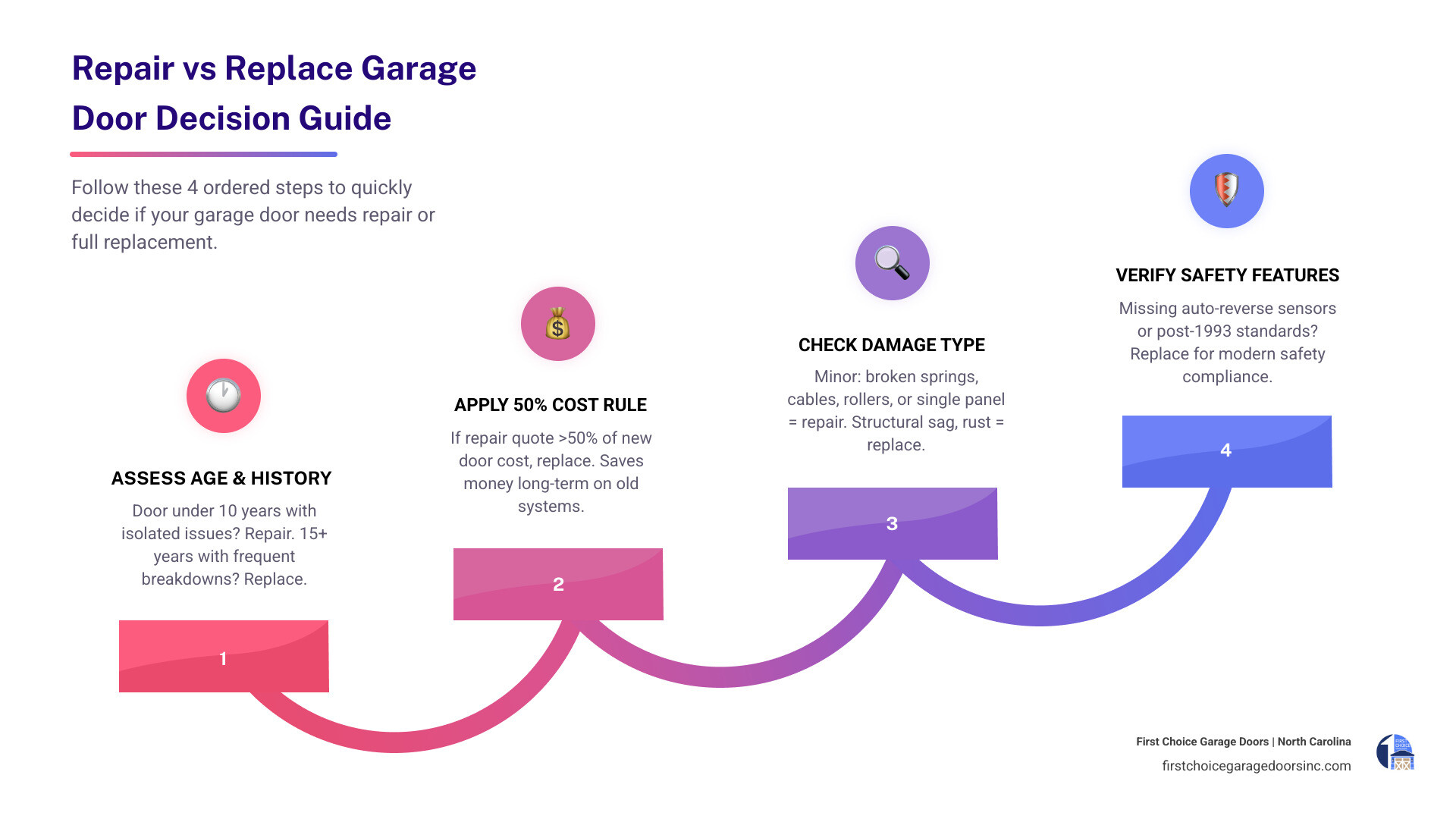
Repair vs Replace Your Garage Door Decision Guide

Deciding whether to patch up your current door or invest in a brand-new one often feels like a gamble. However, we like to take the guesswork out of the equation by using what we call “The 50% Rule.” It’s a simple financial metric: if the quote for a professional repair exceeds 50% of the cost of a full replacement, it’s usually time to fold.
Why? Because a repair only fixes the immediate symptom. It doesn’t reset the clock on the rest of the aging components. If your door is over 15 years old, you might fix a spring today only to have the cables snap or the rollers seize up three months later.
Another critical factor is component compatibility. As garage door technology evolves, finding parts for older models becomes increasingly difficult. If your door uses obsolete hardware, a “simple” repair can quickly turn into an expensive custom-machining project. By following a structured Choosing Between Garage Door Repair or Replacement strategy, you can weigh the immediate savings of a fix against the long-term reliability of a new installation.
| Benefit of Repair | Advantage of Replacement |
|---|---|
| Lower immediate out-of-pocket expense | Resets the 15-30 year lifespan clock |
| Quick turnaround for minor issues | Significant boost to curb appeal and home value |
| Preserves original architectural style | Modern safety features and smartphone integration |
| Ideal for doors under 10 years old | Improved energy efficiency and lower utility bills |
Identifying Common Issues That Only Require a Professional Repair
Not every squeak or stall necessitates a trip to the showroom. In many cases, your door is structurally sound but suffering from “tired” mechanical parts. These components are designed to wear out over time—much like the brake pads on your car—and replacing them is a standard part of home ownership.
Common Signs You Need a Garage Door Repair include the door moving unevenly, making excessive grinding noises, or failing to respond to the remote. These issues are often rooted in the high-tension hardware that does the heavy lifting. Our team provides comprehensive Products and Services – Garage Door Repair to address these mechanical failures without requiring a total system overhaul.
When to repair vs replace your garage door components like springs
Garage door springs have a very specific engineered lifespan. Most residential torsion springs are rated for approximately 10,000 cycles. If your family uses the garage as the main entry point—opening it 3 to 5 times a day—those springs will likely reach their limit in about 6 to 10 years.
When a spring breaks, you’ll often hear a loud “bang” like a gunshot. This is a classic “fix” scenario. If the door panels are in good shape and the tracks are straight, replacing the springs is a cost-effective way to get another decade of life out of your door. Knowing When to Get Your Garage Door Repaired for spring issues can save you from the much larger expense of a full replacement when it isn’t yet necessary.
Addressing cosmetic damage and minor mechanical malfunctions
Sometimes the problem is purely visual. A stray basketball or a minor “fender bender” might dent a single panel. If your door is a relatively modern sectional model, we can often source a single matching panel from the manufacturer. This restores your curb appeal for a fraction of the cost of a new door.
Similarly, if you notice a draft or light peeking through the edges of your door, you likely just need new weatherstripping. This is a minor maintenance task that significantly impacts your garage’s internal temperature. Understanding When You Might Need a Garage Door Repair for these cosmetic or minor seal issues helps keep your home looking sharp and staying efficient without a major investment.
When Structural Damage and Age Demand a Full Replacement
There comes a point where “one more repair” is just throwing good money after bad. Structural integrity is the non-negotiable factor here. If the door itself is sagging, warped, or showing significant “daylight” underneath when closed, the internal structure has failed.
Most garage doors are designed to last between 15 and 30 years. Once you cross that 15-year threshold, the metal can become fatigued, and wood can begin to rot from the inside out. Recognizing the Signs You Need a Garage Door Replacement is vital for your home’s security. A weakened door is an easy target for intruders and a safety hazard for your family. There are specific milestones in a door’s life When a Garage Door Replacement Should Be Done to prevent an emergency failure at the worst possible time.
Using the repair vs replace your garage door decision guide for aging systems
If you find yourself calling a technician every six months, your door is trying to tell you something. Frequent breakdowns across different components—first the rollers, then the cables, then the opener—signal that the entire system has reached the end of its service life.
In Fayetteville, we often see older doors that have simply been outpaced by technology. Parts for doors manufactured 20 years ago are often obsolete. If we can’t find a safe, manufacturer-approved part, we will always recommend replacement to ensure your system meets current building codes. Knowing When You Need a Garage Door Replacement often comes down to tracking these recurring “minor” costs; when they start to add up, the “fold” becomes the smarter financial move.
Upgrading for modern safety and technology standards
Safety standards have changed dramatically over the last few decades. If your garage door opener was manufactured before 1993, it likely lacks the federally mandated auto-reverse sensors (the “photo-eyes” at the bottom of the tracks). These sensors prevent the door from closing on children, pets, or vehicles.
Replacing an outdated system isn’t just about convenience; it’s about liability and protection. Modern doors also feature pinch-resistant panels and enhanced security encryption that prevents “code grabbing” by tech-savvy thieves. Do You Need a Garage Door Replacement? Check for These Signs to Find Out! If your door lacks these basic modern protections, an upgrade is a wise investment in your family’s safety.
Maximizing Home Value and Energy Efficiency in Fayetteville
One of the most surprising facts for homeowners is the incredible Return on Investment (ROI) of a new garage door. In 2024, garage door replacement projects had the highest ROI of all remodeling projects across the country. In many cases, a new door offers an ROI of 193%, meaning it can actually add more value to your home than the project costs.
This is especially true in Fayetteville, where curb appeal drives property value. Since the garage door can comprise up to a third of your home’s front exterior, a modern, stylish door completely transforms the look of the house. Beyond aesthetics, there are practical Perks of Getting a Garage Door Replacement.
Modern insulated doors can reduce thermal loss by up to 20%. If you have a room above the garage or use your garage as a workspace, an insulated door (using polyurethane or polystyrene cores) can cut your annual energy costs by up to 20%. These are just a few of the Reasons to Get a New Garage Door that go beyond mere functionality.
Prioritizing Safety: Why Professional Assessment Matters
We cannot stress this enough: garage door systems are under extreme tension. A standard residential door can weigh anywhere from 150 to over 500 pounds, and the springs are wound with enough force to lift that weight a thousand times a year.
Attempting a DIY repair on springs or cables is incredibly dangerous. One wrong turn of a winding bar can lead to serious injury or property damage. There are many Dangers That Come with a D-I-Y Garage Door Repair, which is why professional assessment is the only safe way to handle high-tension components.
When we perform a professional balance test, we disconnect the opener and lift the door by hand. A properly balanced door should stay in place halfway up. If it crashes down or flies open, your springs need professional adjustment. Comparing a DIY vs Professional Garage Door Repair shows that the expertise of a trained technician ensures the door is not only working but is safe for every member of your household.
Frequently Asked Questions about Garage Door Decisions
How long do garage doors and their components typically last?
On average, a well-maintained garage door will last between 15 and 30 years. However, the individual components have shorter lifespans. Springs usually last 6–10 years (10,000 cycles), openers last about 10–15 years, and rollers or cables may need attention every 5–7 years depending on usage and local humidity levels.
Can I install a new garage door on my existing tracks?
While it is technically possible if the tracks are perfectly compatible and in pristine condition, we almost always recommend replacing the tracks along with the door. New doors often have different weight distributions or thickness levels than older models. Using old tracks with a new door can lead to premature wear, noisy operation, and potentially void the manufacturer’s warranty.
Does homeowners insurance cover the cost of a new garage door?
Generally, homeowners insurance covers garage door replacement if the damage was caused by a “covered peril,” such as a fire, a severe storm, or vandalism. However, insurance typically does not cover replacement due to standard wear and tear, age, or if you accidentally backed your own car into the door. It is always best to review your specific policy details with your agent.
Conclusion
Making the right choice between fixing a broken part and investing in a new system doesn’t have to be stressful. By using our repair vs replace your garage door decision guide, you can look at the age of your door, the cost of the fix, and the safety of your family to find the path that offers the best long-term value.
At First Choice Garage Doors, we pride ourselves on providing honest, professional assessments. Whether you need a simple spring replacement to get through the year or a high-efficiency insulated door to transform your home’s look, our team in Fayetteville is ready to help. We prioritize your safety and the reliability of your home above all else.
Ready to find out where your door stands? Contact us for a garage door estimate in Fayetteville today, and let’s make sure your garage door is an asset to your home, not a liability.