
Why Matching a Replacement Panel to Your Existing Door Is Harder Than It Looks
How to match a replacement panel to your existing door is one of the most common questions homeowners face after a single panel gets dented, cracked, or warped — and the answer depends on several key factors working together.
Here’s a quick overview of what the process involves:
- Identify your door’s brand, model, and serial number — usually found on a sticker on the interior surface or end stile
- Measure the damaged panel — width, height, and section thickness must be exact
- Verify the panel style — raised, recessed, or flush, plus edge profile and joint type
- Match the color and finish — using factory paint codes and accounting for UV fading on existing panels
- Confirm availability — panels for doors older than 15 years may be discontinued
- Remove and install safely — garage door springs are under tension and can cause serious injury if mishandled
A single damaged panel can make your entire garage door look neglected — and since the garage door often takes up roughly a third of your home’s visible front facade, that matters more than most homeowners expect.
The tricky part isn’t always finding a replacement panel. It’s finding the right one — one that fits precisely, matches your existing style, and blends with panels that have been exposed to years of sun, rain, and temperature swings in Northern Virginia.
Get this wrong, and you end up with a door that looks patched rather than restored.
This guide walks you through every step of the matching process, from reading your door’s serial number to final alignment checks.
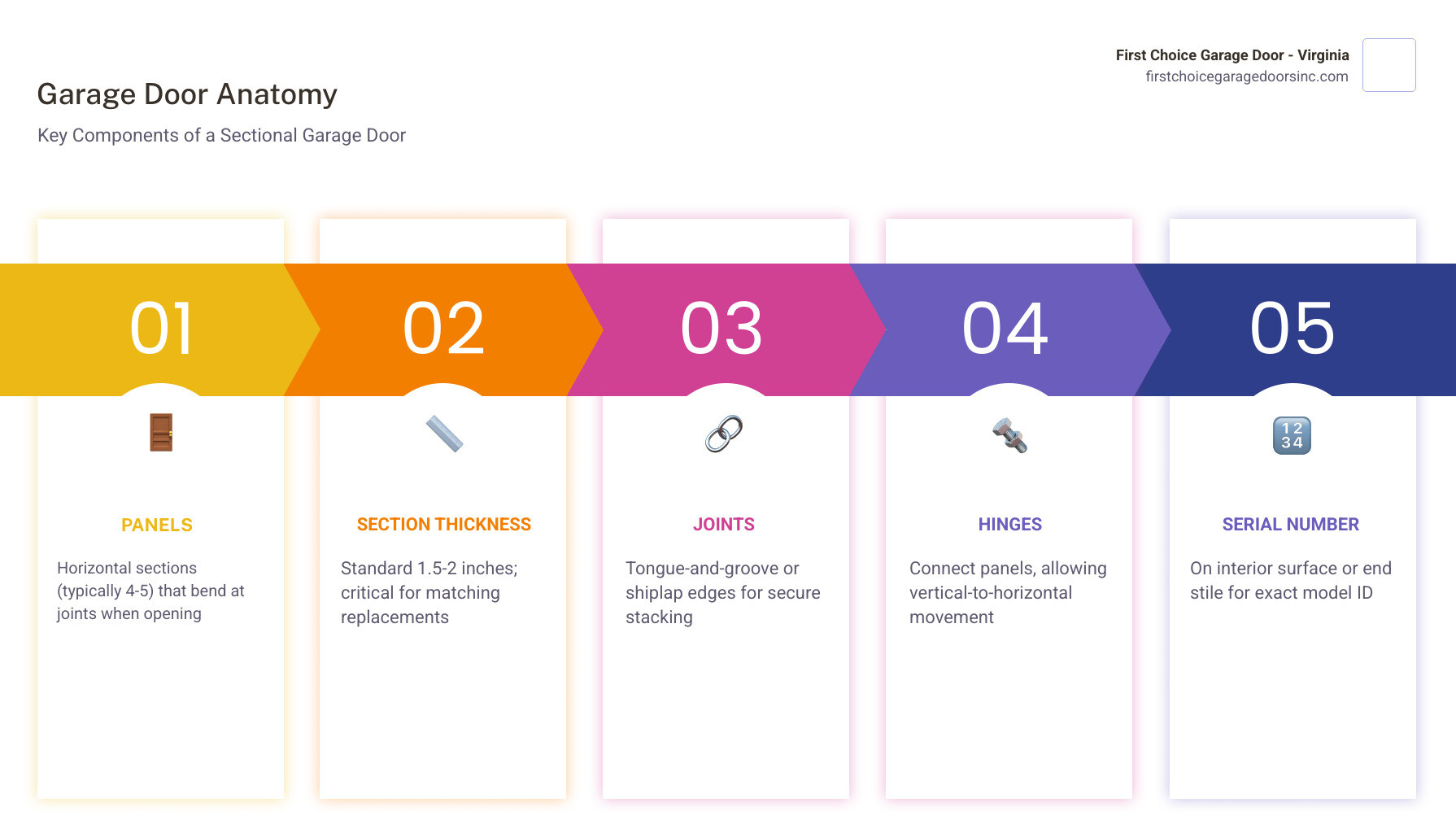
Determining if a Single Panel Replacement is Right for You

When we arrive at a home in Manassas or elsewhere in Northern Virginia, the first thing we do is assess whether a single panel swap is actually feasible. Most modern residential garage doors are sectional, meaning they are composed of four or five horizontal panels. If a “rookie driver” in the family accidentally backs into the door, the damage is often isolated to the bottom or second-to-bottom section.
However, before you order a part, you must consider the structural integrity of the entire system. Should You Use a Dented Garage Door? The answer depends on the severity. If the dent is minor and cosmetic, the door may still operate safely. But if the panel is “creased” or buckled, it can put immense strain on the opener and the tracks.
We also look at the extent of the damage across the whole door. If three out of four panels are damaged, the material cost for those individual sections often approaches the price of a brand-new door. Furthermore, Knowing When You Need a Garage Door Replacement involves checking the frame alignment and track condition. If the impact that dented the panel also bent the tracks or pulled the vertical wood jambs out of alignment, simply swapping a panel won’t solve the underlying functional issues.
How to match a replacement panel to your existing door
The secret to a successful restoration is “DNA identification.” Garage doors are not universal; a panel from one manufacturer will almost never fit into the track or joint system of another. To begin the process of how to match a replacement panel to your existing door, we start by hunting for the manufacturer’s label.
This label is typically located on the interior surface of the door, often on the very end of the panel (the end stile). It contains the model number, the manufacture date, and most importantly, the serial number. This information allows us to verify the exact Garage Door Materials to Consider When Replacing Your Door and ensure the replacement part is brand-compatible. Using the serial number is the most reliable way to ensure that the brand-specific hardware, such as hinges and rollers, will align perfectly during Garage Door Installation.
Identifying Your Door’s DNA: Model, Size, and Brand
If the sticker is missing—which often happens with older doors—we have to go old-school with a tape measure. We record the exact width and height of the panel, but section thickness is the real deal-breaker. A door might be 1-3/8 inches thick, 1-5/8 inches, or even 2 inches thick. Even a fraction of an inch difference will prevent the door from sealing properly against the weatherstripping.
There are many Things to Consider When Choosing a Garage Door panel, including the joint type. Does your door use tongue-and-groove joints or shiplap edges? These profiles must match exactly so the panels can hinge and “break” correctly as the door move up the radius of the track. This is equally important for businesses, as the Materials You Could Use For Your Commercial Garage Door are often heavier and require even more precise joint matching for safety.
How to match a replacement panel to your existing door: Color and Finish
Even if you find the exact model, the color can be a major hurdle. Most manufacturers have standard Garage Door Color Options like White, Almond, Sandstone, or Brown. However, “White” from 2010 is not the same as “White” in April 2026.
UV fading is a significant factor in Northern Virginia. Years of direct sunlight will oxidize the paint on your existing panels, making them look slightly chalky or lighter than a factory-fresh panel. When What to Avoid Doing When Selecting a Garage Door Color, many homeowners forget that a brand-new panel will likely look darker and “richer” than the old ones.
For wood doors, the challenge is even greater. You’ll need to decide between Deciding Between Painting and Staining Your Garage Door to achieve a match. Custom stain matching often requires a professional touch to account for the natural grain variations in the wood.
Navigating the Challenges of Weathering and Discontinued Styles
As of 2026, many manufacturers have updated their production lines, which means doors installed 15 to 20 years ago may have “discontinued” status. If the specific die used to stamp the steel pattern is no longer in use, an exact match might be impossible.
| Feature | Steel Panels | Wood Panels |
|---|---|---|
| Aging Effect | Oxidation and chalking | Rot, warping, and silvering |
| Texture Match | Stamped wood grain varies by year | Natural grain is unique to each piece |
| 2026 Standard | High R-value polyurethane common | Sustainable/reclaimed sourcing |
| Repairability | Replacement is usually required | Can sometimes be filled/sanded |
When comparing Wood vs Steel Garage Doors, steel is generally easier to match if the model is still in production. However, matching the specific texture—the “pebble” or “stucco” grain stamped into the metal—is vital. If you have a fiberglass or aluminum door, Comparing Fiberglass and Aluminum Garage Doors shows that aluminum is prone to different types of denting that might require specialized blending techniques.
If the color mismatch is too jarring due to weathering, you might need to consider Considerations Before Garage Door Painting. Sometimes, the most cost-effective way to make a new panel blend in is to install it and then repaint the entire door so the color is uniform across all sections.
Safety First: Removing and Installing Your New Panel
We cannot stress this enough: garage door repair is dangerous. The torsion springs located above the door are under extreme tension—enough to lift a several-hundred-pound door. If you attempt to replace a panel without properly securing these springs, you risk catastrophic injury.
While we are experts in Garage Door Repair, we often see DIY attempts gone wrong. Common risks include the door falling unexpectedly or fingers getting caught in the joints. If you are looking for Garage Door Replacement Fayetteville NC or service here in Northern Virginia, always ensure the technician is licensed and insured.
Before any work begins, the door must be locked in the down position or securely clamped to the tracks, and the automatic opener must be disconnected to prevent it from cycling during the repair.
How to match a replacement panel to your existing door: Installation Steps
The actual physical swap involves more than just unscrewing a few bolts. Here is how we ensure a seamless fit:
- Support Adjacent Panels: We use locking pliers (Vise-Grips) on the tracks to prevent the upper panels from sliding down when the damaged one is removed.
- Hinge Transfer: We carefully remove the hinges from the old panel. This is a great time to inspect them for wear. We then transfer them to the new panel, ensuring they sit in the exact same pilot holes.
- Roller Replacement: We check the rollers. If they are wobbly or the bearings are shot, we replace them during the panel swap to ensure smooth operation.
- Alignment Checks: Once the new panel is slid into the tracks, we check the gaps. The door should be level, and the tongue-and-groove joints should “nest” tightly without any daylight showing through.
- Fastener Security: We use high-quality fasteners to ensure the hinges stay put. Avoid Garage Door Painting Errors to Avoid by ensuring the hardware is clean and oil-free if you plan to paint later.
- Testing Balance: After installation, we reconnect the opener and test the door balance. A new panel might have a slightly different weight than an old, water-logged wood panel or a non-insulated steel one, which might require a slight adjustment to the spring tension.
Maintenance Tips for a Seamless Look
Once your new panel is installed, you want it to stay looking great. Regular cleaning is the best defense against the Virginia elements. Use a mild detergent and a soft cloth to wash away salt, pollen, and dirt that can degrade the finish.
Choosing Between Garage Door Repair or Replacement often comes down to how well the door was maintained. We recommend using a silicone-based lubricant on the hinges and rollers every six months. Avoid petroleum-based greases, as they attract dust and can gum up the tracks.
Finally, perform a monthly visual inspection. Check the weatherstripping at the bottom of the new panel to ensure it’s creating a tight seal against the garage floor. If the seal is cracked, it can let in moisture that leads to rust on steel doors or rot on wood ones.
Frequently Asked Questions
Are garage door panels universal?
No. Panel dimensions, joint styles (tongue-and-groove vs. shiplap), and section thicknesses vary wildly between manufacturers. A panel from one brand will rarely, if ever, fit into a door made by another brand. Compatibility issues can even exist between different models from the same manufacturer.
Can I replace a panel on a door older than 15 years?
It is possible, but challenging. By the 15-year mark, many models are discontinued, and manufacturers stop stocking replacement sections. Additionally, the structural wear on the rest of the door might make it more practical to replace the entire system rather than investing in a single panel.
How do I find the serial number on my garage door?
Look at the inside of the door. Check the “end stiles”—the vertical metal pieces at the very left or right edge of each panel. You may also find a manufacturer sticker on the interior face of the second panel from the bottom. If the door was professionally installed, there might also be a sticker from the installation company with the model details.
Conclusion
Restoring your garage door’s aesthetic cohesion is one of the fastest ways to boost your Northern Virginia home’s value. While the process of how to match a replacement panel to your existing door requires some detective work and a focus on safety, the results are well worth the effort.
At First Choice Garage Doors, we pride ourselves on our unmatched expertise and commitment to quality. Whether you have a minor dent or need a full system overhaul, our team ensures a stress-free experience from start to finish. Don’t let a damaged panel drag down your curb appeal—trust the professionals to get the job done right.
Contact us for expert Garage Door Repair today and let us help you master your home’s makeover!