
Why You Should Never Repair Garage Door Springs Yourself
Why you should never repair garage door springs yourself comes down to one simple truth: these springs store an enormous amount of energy, and one wrong move can cause life-altering injury — or worse.
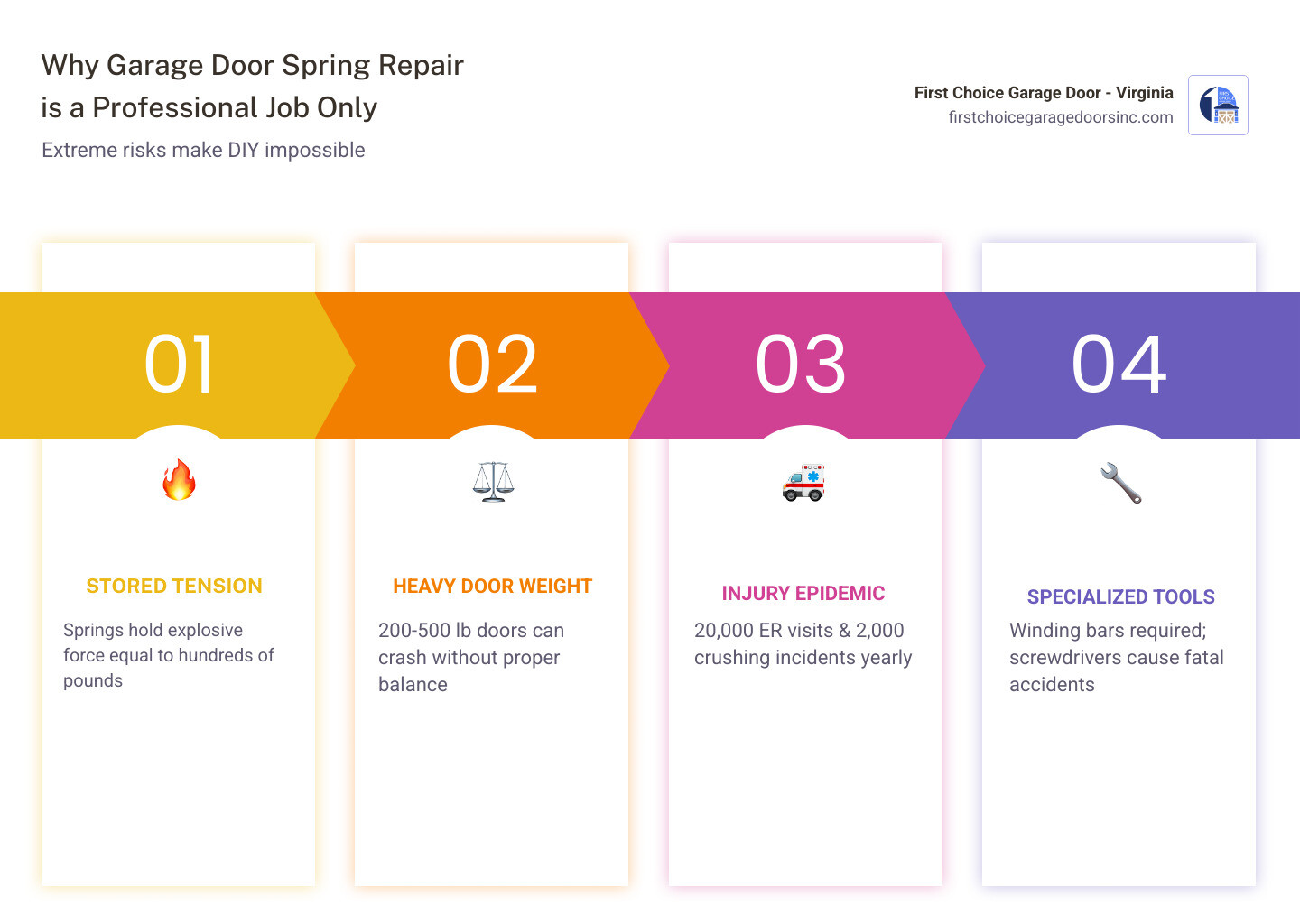
Garage doors weigh anywhere from 200 to 500 pounds. The springs are what make that weight manageable. But that also means they are wound extremely tight, holding hundreds of pounds of force at all times. When something goes wrong during a DIY repair, that energy releases instantly and violently.
This isn’t a minor risk. Garage door-related injuries send more than 20,000 people to the emergency room every year in the United States. Over 2,000 Americans are crushed by garage doors annually, and thousands more suffer serious pinching and impact injuries.
Here’s a quick summary of why this is a job for professionals only:
- Extreme stored tension — Springs can snap with explosive force, sending metal flying across the garage
- Specialized tools required — Proper winding bars are essential; improvised tools like screwdrivers cause accidents
- Heavy door collapse risk — Without correct spring tension, a 200-500 lb door can crash down without warning
- Collateral damage — Incorrect installation damages openers, cables, and tracks
- No room for error — Even a small miscalculation in winding can have severe consequences
- Voided warranties and denied insurance claims — DIY repairs can leave you fully liable
The rest of this guide covers everything you need to know about garage door spring safety — from how the springs work, to the real injuries that happen, to what you can safely do yourself as a homeowner in Northern Virginia.
Why You Should Never Repair Garage Door Springs Yourself
When a spring snaps, it usually makes a sound like a gunshot echoing through your home. It’s tempting to head to a big-box store in Manassas, grab a replacement, and pull up a YouTube tutorial. However, Dangers That Come With a D.I.Y. Garage Door Repair are far more severe than most homeowners realize.
The primary reason to avoid this task is the sheer weight of the door. A standard residential door can weigh up to 400 or 500 pounds. The springs act as the “muscles” of the system, counterbalancing that weight so a small motor (or your arm) can lift it. If those muscles are detached or installed incorrectly, you are essentially standing under a massive, heavy guillotine.
Why you should never repair garage door springs yourself due to extreme tension
The physics of a garage door spring is all about potential energy. Torsion springs, which sit on a bar above the door, work by being wound into a tight coil. To replace them, a technician must “wind” the spring to a specific tension using specialized steel winding bars.
If you attempt this without professional training, one slip of the tool can cause the spring to unwind instantly. This release of energy is explosive. We have seen cases where the force was enough to shatter bones or send tools flying through drywall. Understanding Knowing When Your Garage Door Springs Are Broken is the first step, but the second step should always be picking up the phone, not the wrench. High-cycle springs require precise torque that simply cannot be guessed.
Why you should never repair garage door springs yourself to prevent property damage
Beyond personal safety, DIY attempts often lead to “collateral damage.” If the springs aren’t perfectly balanced, the garage door opener has to work twice as hard to lift the door. This often leads to the motor burning out prematurely.
Furthermore, improper installation can cause track misalignment or cable snapping. If a cable snaps while the door is mid-travel, the door can twist in the tracks, bending the metal and potentially falling onto your vehicle. Why Garage Door Springs Should Be Replaced by Professionals is often a matter of protecting your largest investments—your car and your home.
Understanding the Mechanics: Torsion vs. Extension Springs
To stay safe, it helps to know what you’re looking at. There are two main types of spring systems used in Northern Virginia homes.
- Torsion Springs: These are located on a metal shaft directly above the door opening. They lift the door by twisting. They are generally considered safer during operation because if they break, they stay on the shaft, but they are the most dangerous to repair due to the high torque required.
- Extension Springs: These run along the upper tracks on the sides of the door. They lift by stretching and contracting. These are notorious for flying across the room like a projectile if they snap without a safety cable.
Most springs have a lifespan of about 10,000 “cycles” (one cycle is the door going up and then down). For the average family in Northern Virginia, this translates to roughly 7 to 9 years of use. Factors like the wire gauge, the diameter of the spring, and even the humidity in your garage can cause Reasons for Garage Door Springs to Break sooner than expected.
The Severe Physical Risks of DIY Spring Replacement
The statistics we shared earlier aren’t just numbers; they represent real people who thought they could handle a “quick fix.” The injuries associated with spring failure and improper repair are gruesome.
- Lacerations: When a spring snaps or a tool slips, the sharp metal edges can cause deep, jagged cuts.
- Facial Trauma and Eye Injuries: Because you are often looking directly at the spring while working on it, any failure sends debris straight toward your face.
- Broken Bones: The force of a winding bar spinning out of control is enough to break wrists, fingers, and even jaws.
- Crushing Injuries: If the door is not properly secured, it can fall. With doors weighing hundreds of pounds, the Risks That Come With Having a Damaged Garage Door include being pinned or crushed, leading to internal injuries or worse.
Common Mistakes and Collateral Damage in DIY Attempts
Even the most well-meaning DIYer can fall into traps that a professional is trained to avoid. One of the most common issues is ordering the wrong spring size. Springs are not “one size fits all.” They are calibrated based on the height, weight, and track radius of your specific door. Using a spring that is even slightly too strong or too weak will leave the door unbalanced, causing it to slam shut or “fly” open, both of which are dangerous.
Another frequent mistake is using the wrong tools. We have seen homeowners try to use screwdrivers, pliers, or even rebar as winding bars. These tools aren’t designed to hold the tension of a torsion spring and will almost always slip. When you ignore the Signs You Have Damaged Garage Door Springs and try to “make do” with what’s in your toolbox, you’re inviting a disaster.
Why Professional Service is the Safest Choice in Northern Virginia
Choosing professional service isn’t just about avoiding a trip to the ER; it’s about ensuring the long-term health of your home. At First Choice Garage Doors, our technicians undergo hundreds of hours of training to handle high-tension systems safely.
| Feature | DIY Repair | Professional Repair |
|---|---|---|
| Safety | High risk of severe injury | Strictly followed safety protocols |
| Tools | Improvised (Dangerous) | Specialized winding bars & clamps |
| Warranty | None (Often voids door warranty) | Labor and parts warranties included |
| Precision | Guesswork on tension | Precise calibration to door weight |
| Insurance | May deny claims for DIY damage | Fully insured and licensed |
There are many Reasons You Should Hire a Professional for a Garage Door Repair, including the peace of mind that comes with a 25-point safety inspection. We don’t just swap the spring; we check the cables, drums, rollers, and bearings to ensure the whole system is working in harmony.
Safe Maintenance Tasks Homeowners Can Perform
While you should never touch the springs, there are plenty of ways you can help extend the life of your garage door system safely. We encourage homeowners to take an active role in maintenance. When comparing DIY vs Professional Garage Door Repair: When Each Is Best, the following tasks fall firmly in the “Safe for Homeowners” category:
- Lubrication: Once or twice a year, use a silicone-based garage door lubricant on the rollers, hinges, and the springs themselves. This prevents rust and reduces the friction that leads to metal fatigue.
- Visual Inspection: Look for gaps in the spring coils or frayed cables. If you see them, don’t touch them—call us immediately.
- Balance Testing: Disconnect the opener and lift the door halfway manually. If it stays in place, it’s balanced. If it crashes down or shoots up, your springs need professional adjustment.
- Cleaning Tracks: Use a damp cloth to wipe out the inside of the tracks. Do not use grease here, as it actually attracts dirt and clogs the rollers.
- Sensor Checks: Ensure your safety “eyes” are aligned and free of cobwebs so the door reverses properly when something is in its path.
Frequently Asked Questions
Should I replace both garage door springs if only one breaks?
Yes, absolutely. Garage door springs are almost always installed at the same time and undergo the same amount of wear and tear. If one has snapped, the other is likely just days or weeks away from failing. Replacing both ensures a balanced door and saves you the hassle of a second service call in the near future. This is a standard recommendation in our Fayetteville Garage Door Spring Repair Guide and across all our service areas.
How long do garage door springs typically last?
The average spring is rated for 10,000 cycles. Depending on how often you use your door (the average family goes in and out 3-4 times a day), this usually lasts between 7 and 9 years. Extreme temperature swings in Northern Virginia can also play a role, as cold weather makes metal more brittle. You can find more details in our guide on Everything You Should Know About Garage Door Spring Repair in Annapolis, MD.
Can I open my garage door manually if a spring is broken?
We strongly advise against it. Without the springs, the door is “dead weight.” Lifting a 300-pound door manually can result in severe back strain. Furthermore, if you try to use your automatic opener with a broken spring, you will likely burn out the motor, turning a simple spring replacement into a much more expensive opener replacement.
Conclusion
Your garage door is the largest moving object in your home, and its springs are under more pressure than almost any other component in your house. While the “do-it-yourself” spirit is great for painting a room or planting a garden, garage door springs are a different beast entirely.
At First Choice Garage Doors, we pride ourselves on providing Northern Virginia with prompt, professional, and—most importantly—safe service. Don’t risk your safety or your property on a repair that requires specialized expertise. Whether you’re in Manassas or anywhere else in Northern Virginia, we are here to help.
Schedule your professional garage door maintenance today to ensure your home stays safe and your door stays on track.