
Why Garage Door Safety Matters More Than You Think
Garage door safety tips for homeowners are something every Virginia household should know — because this one moving part causes more injuries than most people realize.
Here are the most important garage door safety tips to follow:
- Test the auto-reverse mechanism monthly — place a 1.5-inch object in the door’s path and confirm the door reverses on contact
- Check photo-eye sensors — they should be mounted 4–6 inches above the floor and trigger a stop when the beam is blocked
- Never attempt spring or cable repairs yourself — these components are under extreme tension and can cause serious injury
- Mount wall controls at least 5 feet high — keeps them out of reach of young children
- Keep remotes secured — never leave them visible in an unattended car
- Watch the door fully close — never walk away while it’s still in motion
- Inspect springs, cables, and rollers monthly — look for rust, fraying, or gaps in spring coils
- Know how to use the emergency release cord — essential during power outages
- Schedule a professional inspection annually — a trained technician catches what homeowners miss
- Upgrade openers made before 1993 — they likely lack required auto-reverse and photo-eye safety features
Your garage door is likely the largest and heaviest moving object in your home — a typical residential door weighs between 150 and 400 pounds and moves up and down roughly 1,500 times per year. Each year, around 30,000 people end up in the emergency room from garage door-related injuries in the U.S. alone.
Yet most of these accidents are preventable.
Whether you’re a longtime homeowner or new to the responsibility, understanding how your garage door system works — and where it can fail — is one of the simplest ways to protect your family and property.
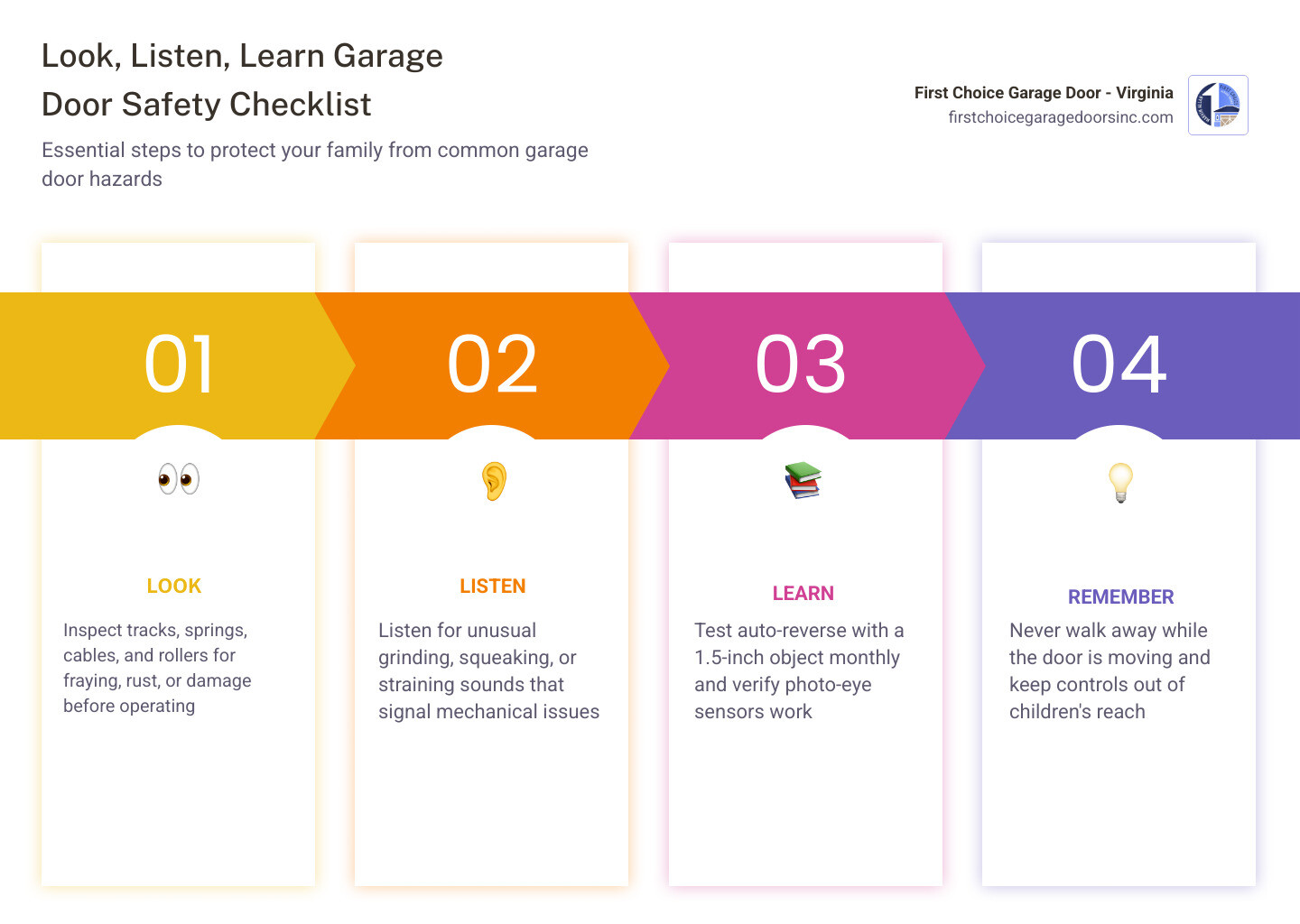
Essential Garage Door Safety Tips for Homeowners
When we talk about garage door safety tips for homeowners, the first step is situational awareness. Because a garage door is such a common part of our daily routine, it is easy to forget that it is a massive piece of heavy machinery. In Northern Virginia, where many of us use our garages as the primary entrance to our homes, the sheer volume of “cycles” (opening and closing) means components wear out faster than you might think.
One of the most common causes of injury is the “pinch point.” These are the areas where the door panels fold and meet. It is incredibly tempting to grab the door by the joints when moving it manually, but this is a recipe for crushed fingers. We always recommend using the handles or the bottom lift bar.
Furthermore, never stand or walk under a moving door. It sounds obvious, but many injuries occur when people try to “beat the door” as it closes. Modern Safety Measures To Take With An Automated Garage Door are designed to stop the door, but technology can fail. By following these 5 Garage Door Safety Tips, you can ensure that your garage remains a convenience rather than a hazard.
Protecting Children and Pets: Garage Door Safety Tips for Homeowners
Children and pets are the most vulnerable members of our household when it comes to garage door accidents. Statistics show that automatic garage doors have been involved in at least 85 child fatalities or permanent brain injuries since 1974. To keep the little ones safe, we follow the “5-foot rule.”
The wall-mounted control button for your garage door should be at least 5 feet from the floor. This height ensures that curious toddlers cannot reach the button and operate the door without supervision. Additionally, remotes and transmitters should be treated like car keys—kept out of reach and never used as toys.
It is also vital to establish clear house rules. Teach your children that the garage door is not a game. They should never race under a closing door or try to “ride” a door as it opens. For our furry friends, always check the path of the door before hitting the button. We’ve put together specific Garage Door Safety Tips To Teach Your Kids and Garage Door Safety Tips For Pet Owners to help you create a safer environment for the whole family.
Securing Your Property with Modern Technology
Safety isn’t just about preventing physical injury; it’s also about securing your home against intruders. In April 2026, we are seeing more homeowners in Manassas and Northern Virginia upgrade to smart technology to keep their garages locked down.
Old-fashioned garage door openers used “fixed codes” that burglars could easily record and replay. Modern systems use “rolling code” technology, which changes the access code every time the remote is used. This makes it nearly impossible for a thief to “grab” your signal.
Another simple but effective security measure is the “zip tie trick.” Burglars sometimes use a coat hanger to reach through the top of the door and pull the emergency release cord, allowing them to open the door manually. A simple zip tie on the release lever can act as a deterrent. For more ways to protect your home, check out these 4 Garage Security Tips.
The Three-Step Monthly Safety Check
Federal law has required all garage door openers manufactured after 1993 to include safety features like an auto-reverse mechanism and photo-eye sensors. However, millions of doors in the U.S. are either older than this or have safety features that are no longer functioning correctly.
We recommend a monthly three-step safety check. This is something every homeowner can do in about ten minutes. It’s the best way to catch a problem before it leads to an accident. If you aren’t sure how to start, you can learn How To Get A Garage Door Safety Test Done through our professional guidance.
Testing the Auto-Reverse Mechanism: Vital Garage Door Safety Tips for Homeowners
The auto-reverse mechanism is designed to stop and reverse the door if it hits an object. To test this, place a 1.5-inch object (like a 2×4 wood block, a hardcover book, or even a roll of paper towels) flat on the floor in the center of the door’s path.
When you activate the door to close, it should hit the object and immediately reverse back to the open position. If the door continues to press down on the object or stops without reversing, the sensitivity settings or the opener itself may need adjustment. This is one of the most 3 Garage Door Safety Tips that can literally save a life.
Verifying Photo-Eye Sensor Alignment
The photo-eye sensors are the two small “black boxes” located near the bottom of your garage door tracks. They send an invisible infrared beam across the opening. If that beam is broken while the door is closing, the door should stop and reverse.
- Check the Height: The sensors should be mounted no higher than 6 inches off the floor. If they are too high, a small pet or a child lying down might not trigger them.
- Check the Alignment: Most sensors have a small LED light. If the light is flickering or off, the sensors are misaligned.
- The Obstruction Test: Wave a broom handle or a long object through the beam while the door is closing. The door should reverse instantly.
- Clean the Lenses: Dust, cobwebs, and even stinkbugs can block the sensors. Wipe them periodically with a soft cloth.
Recognizing Dangerous Component Failures
While many garage door safety tips for homeowners focus on the opener, the physical hardware of the door carries the most risk. Specifically, the springs and cables are under extreme tension. A standard torsion spring stores enough energy to lift a 400-pound door thousands of times. If that energy is released all at once due to a break, it can be catastrophic.
During your monthly inspection, look for these warning signs:
- Frayed Cables: If you see loose strands or “hairiness” on the steel cables, they are about to snap.
- Gaps in Springs: If you have a torsion spring (the big coil above the door) and you see a visible gap in the coils, the spring is already broken.
- Rusted Hardware: Rust weakens metal. If your rollers or hinges are orange and flaky, they need attention.
Following these Garage Door Safety Tips To Follow will help you identify these issues before the door becomes stuck or dangerous.
Why You Should Never Attempt DIY Spring Repairs
We cannot stress this enough: Never attempt to repair or adjust garage door springs or cables yourself. Even if you are a skilled DIYer who handles your own plumbing or electrical work, garage door springs are a different beast.
Professional technicians use specialized winding bars and tools to safely manage the torque of these springs. A single slip with a standard screwdriver or wrench can result in broken bones, facial injuries, or worse. At First Choice Garage Doors, we have the expertise to calibrate these systems safely, ensuring the door remains balanced without putting you at risk.
Identifying an Unbalanced Garage Door
A garage door that is “out of balance” is a major safety hazard. It puts immense strain on the opener motor, causing it to fail prematurely, and makes the door unpredictable.
To check the balance:
- Close the door and pull the red emergency release cord to disconnect the opener.
- Lift the door manually. It should move smoothly with little resistance.
- Open the door halfway (about 3–4 feet off the ground) and let go.
- The Result: A balanced door should stay in place or move only slightly. If it crashes to the floor or snaps open, the spring tension is incorrect and needs professional adjustment.
Maintenance and Emergency Preparedness
Regular maintenance is the difference between a door that lasts 20 years and one that fails in five. In addition to your monthly checks, we recommend a professional “tune-up” once a year. This includes tightening all bolts, lubricating the moving parts with a high-quality silicone spray, and checking the track alignment.
| Task | Frequency | Who Should Do It? |
|---|---|---|
| Visual Inspection (Cables, Springs, Rollers) | Monthly | Homeowner |
| Auto-Reverse & Photo-Eye Test | Monthly | Homeowner |
| Lubricate Rollers, Hinges, and Springs | Every 6 Months | Homeowner |
| Professional Safety Inspection | Annually | First Choice Technician |
| Spring Replacement or Adjustment | As Needed | Professional Only |
In Northern Virginia, we often deal with power outages due to storms. Modern openers often come with battery backup systems. These systems provide enough power for about 40 up-and-down cycles, ensuring you aren’t locked out of your home when the grid goes down.
Operating Your Door During a Power Outage
If you don’t have a battery backup, you’ll need to use the emergency release cord (usually a red cord with a handle).
- Only pull the cord when the door is closed. If you pull it while the door is open and the springs are weak, the door could come crashing down.
- Once disconnected, you can lift the door by hand.
- To re-engage the opener once power returns, pull the cord back toward the opener and operate the door with the remote; it should click back into place.
Frequently Asked Questions about Garage Door Safety
How often should I test my garage door’s safety features?
You should perform a visual inspection and test the auto-reverse and photo-eye sensors once a month. It only takes a few minutes and is the best way to ensure your family’s safety.
What are the signs that my garage door springs are about to break?
Listen for loud “banging” sounds coming from the garage, which often indicate a spring has already snapped. Other signs include the door moving very slowly, the opener straining, or the door looking crooked as it moves up the tracks. If you see a gap in the coils of your torsion spring, it is already broken.
Can I add safety sensors to a garage door opener made before 1993?
Generally, no. Openers manufactured before 1993 were not designed to support modern photo-eye sensors or the specific logic boards required for auto-reversal. If your opener is that old, it is a significant safety risk, and we strongly recommend replacing it with a modern, UL-325 compliant unit.
Conclusion
At First Choice Garage Doors, we believe that a safe home starts with a safe garage. Serving the Northern Virginia and Manassas areas, our mission is to provide you with the unmatched expertise and quality service you need to keep your home’s largest moving object in peak condition.
Don’t wait for a frayed cable to snap or a sensor to fail. Taking a proactive approach to garage door safety tips for homeowners is the best investment you can make in your family’s well-being. Whether you need an emergency repair, a new installation, or just a routine safety check, we are here to help.
Schedule your annual garage door maintenance today and let our professional technicians give you the peace of mind you deserve.