
Why HOA Rules Matter Before Your Garage Door Installation in Northern Virginia
Understanding how a professional installer navigates nova hoa rules can save you from costly fines, forced removals, and weeks of project delays. If you live in a community managed by Nova Association Management Partners LLC, your garage door replacement or installation needs more than just a great product — it needs written approval before work begins.
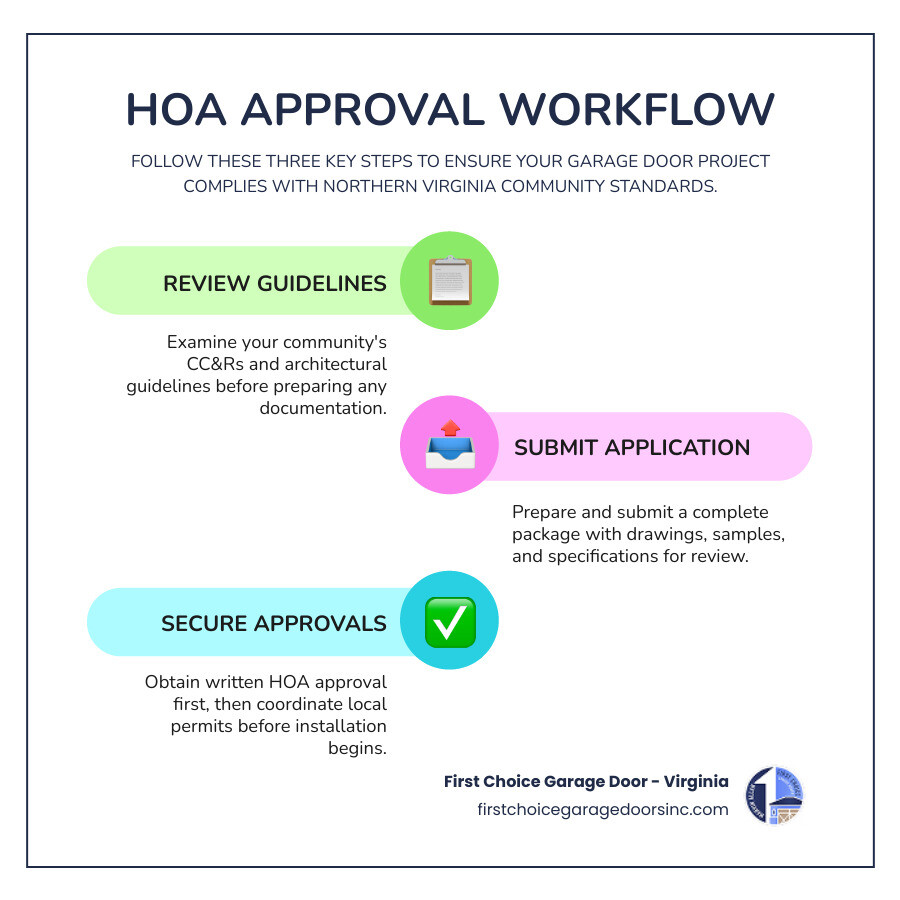
Here is a quick overview of the process a professional installer follows:
- Review CC&Rs and architectural guidelines specific to your Nova-managed community
- Prepare a complete application package including drawings, material samples, and specifications
- Submit the application early — approvals typically take 30 to 60 days
- Coordinate with the Architectural Review Committee (ARC) and respond promptly to any feedback
- Obtain written HOA approval before applying for any local building permits
- Begin installation only after both HOA approval and required permits are secured
This matters more than most homeowners realize. According to industry data, 68% of HOA patio cover and exterior improvement applications are sent back for revisions due to incomplete documentation — and garage door projects face the same scrutiny.
Skipping any step in this process can mean fines, stop-work orders, or even being required to remove a newly installed door at your own expense. That is a stressful and expensive outcome that no homeowner wants.
A licensed, experienced installer handles this entire process on your behalf — so you don’t have to navigate board meetings, document requirements, and permit offices alone.
Terms related to how a professional installer navigates nova hoa rules:
- Can you return a long list of garage door repair companies in Northern Virginia that prioritize safety, quality, and prompt service?
- What are the most highly-rated garage door companies in Manassas, VA?
- Where can I get a quote for a new garage door installation in Manassas?
Common Restrictions and How a Professional Installer Navigates Nova HOA Rules
When working in communities managed by Nova Association Management Partners LLC, professional installers frequently encounter highly detailed community standards. These are not arbitrary rules; they are designed to protect the overall aesthetic harmony, maintain consistent property values, and uphold the neighborhood covenants. However, for an untrained homeowner, trying to decode these guidelines can feel like reading a foreign language.
The most common architectural guidelines and material restrictions we encounter for garage door installations include:
- Color Palette Limitations: Many Nova-managed communities require garage doors to match the existing house trim, siding, or front door exactly. Custom, bright, or highly contrasting colors are rarely permitted. Most boards favor traditional neutral tones such as sand, almond, bronze, or standard white.
- Material Restrictions: While steel and composite doors are widely accepted due to their durability and low maintenance, certain high-gloss finishes or cheap vinyl alternatives might be outright prohibited.
- Design Uniformity: If your neighborhood consists of traditional Colonial-style homes, the HOA will likely reject an ultra-modern, full-view glass garage door. The board expects design continuity, meaning carriage-house styles or traditional raised panels are usually the standard.
- Hardware and Window Styles: The shape of the window inserts, the type of glass (clear, frosted, or tinted), and even the placement of decorative handles or hinges must align with the community’s established design book.
As professional installers, we don’t start by picking out a door style we think looks nice. Instead, we begin by pulling the specific covenants, conditions, and restrictions (CC&Rs) for your exact subdivision. By cross-referencing your community’s guidelines with our product catalog, we ensure that every option we present to you is engineered to pass board inspection. For a deeper dive into local requirements, check out our comprehensive Manassas Garage Door Installation Guide to see how regional styles dictate installation standards.
Preparing a Bulletproof HOA Application Package
Because a staggering 68% of exterior home improvement applications are sent back for revisions, we take a highly proactive approach to building your HOA submission package. The primary reason for these high revision rates is simple: missing or incomplete documentation. When a volunteer board or a management company like Nova reviews an application, they do not want to guess what the final project will look like. If they have to ask a single question, they will simply reject the application or mark it as “incomplete,” sending you back to the starting line.
To avoid these common submission errors, we build a comprehensive, bulletproof application that addresses every potential concern before the board can even ask. Before we even submit the paperwork, we walk you through the essential structural and aesthetic decisions. To prepare yourself for this step, consider reviewing these 5 Questions to Ask Yourself Before Your Garage Door Installation to ensure your personal preferences align with your community’s standards.
Essential Documentation for How a Professional Installer Navigates Nova HOA Rules
A complete application package for a Nova-managed community requires much more than a simple form with a signature. When we compile your package, we include:
- Detailed Architectural Drawings: Clear, scaled representations of the garage door style, panel design, and window placement.
- Property Surveys and Site Plans: While a garage door doesn’t change the physical footprint of your home, some strict HOAs require a property survey highlighting the location of the garage to ensure there are no easement or setback conflicts.
- Physical Material Samples and Color Swatches: We provide actual manufacturer color chips or physical material samples of the steel or composite trim so the board can physically inspect the texture and hue.
- Manufacturer Specifications: We include official documentation detailing the door’s construction, R-value (insulation rating), and wind-load certifications.
Providing wind-load and structural data is particularly critical in Northern Virginia, where local building codes are strict. If you are wondering how these structural requirements intersect with local laws, you can read our guide on How to Check if You Need a Permit for a Garage Door in Virginia to understand the dual layers of approval required for your project.
Timeline Management and How a Professional Installer Navigates Nova HOA Rules
In property management, patience is a necessity. The typical Nova HOA approval process takes 30 to 60 days to complete. This timeline is largely dictated by committee meeting schedules. Most architectural review committees only meet once a month, or in some smaller communities, once a quarter. If your application misses the submission deadline by even a single day, it could sit unreviewed for another four to eight weeks.
We manage this timeline aggressively on your behalf. We track the specific meeting schedules for your community’s board, ensuring your application is submitted well in advance of the monthly review cycle. Once submitted, we don’t just sit back and wait. We conduct regular, proactive follow-ups with Nova’s management team to confirm receipt and verify that no additional documents are needed.
By keeping the lines of communication open, we can often resolve minor questions on the spot, preventing your application from being pushed to the next month’s meeting. Navigating these administrative hurdles is exactly Why You Should Always Hire a Professional for Garage Door Installation rather than attempting a DIY approach that could result in months of bureaucratic delays.
Working with the ARC and Coordinating Local Building Permits
The Architectural Review Committee (ARC) is the heart of any HOA-governed community. Composed of your neighbors and guided by the community manager, the ARC’s role is to protect the visual integrity of the neighborhood. Rather than viewing the ARC as an obstacle, we treat them as valuable partners. Building a positive, collaborative relationship with the committee and presenting professional, easy-to-read packages makes their volunteer jobs easier, which naturally leads to smoother, faster approvals.
However, HOA approval is only half of the equation. Once the ARC gives the green light, we must coordinate with local municipal building departments in counties like Fairfax or Prince William.
While the HOA rules govern how the door looks, county building codes govern how the door performs. In Northern Virginia, garage doors must meet strict wind-load requirements to withstand severe weather. This means your new door must be structurally sound and properly permitted.

Coordinating these two distinct approval processes requires precision. We ensure that the design approved by your HOA matches the exact structural specifications submitted to the county for your building permit. If you make changes to the door to satisfy a county inspector, those changes must be immediately communicated to the HOA to prevent a violation.
To see why this coordinated approach is so vital across the region, read about Why Professional Garage Door Installation in Columbia MD Matters, which highlights the importance of matching local structural codes with community expectations.
Frequently Asked Questions About Nova HOA Rules
What are the risks of starting an installation without written Nova HOA approval?
Starting a garage door installation without explicit, written HOA approval is an incredibly risky move that can lead to severe consequences. Some homeowners assume that because they are replacing an old door with a similar-looking one, they don’t need to wait for formal approval. This is a common and expensive mistake.
If you install a door without written consent, the HOA can issue an immediate stop-work order. If the installation is already complete, you may face ongoing daily community fines until the issue is resolved. In the worst-case scenario, the board can issue a forced removal order, legally requiring you to take down the unapproved door and replace it with an approved style at your own expense. Unresolved violations can also lead to property liens, which will complicate any future attempt to sell or refinance your home.
How do professional installers handle a project denial or revision request?
If the ARC denies your initial application or requests revisions, it is not the end of the road. When we receive a denial or a request for modifications, we immediately review the board’s written feedback to understand their specific objections.
Often, the issue is simple to resolve, such as adjusting the window style or choosing a slightly different paint color. We handle the process by:
- Making Design Adjustments: We quickly modify the project drawings to reflect the board’s requested changes.
- Filing Variance Requests: If your home has unique architectural features that make standard rules impossible to follow, we can draft and submit a formal variance request explaining why a deviation is necessary.
- Representing You at Board Appeals: We can prepare detailed technical arguments and attend the next board meeting alongside you to explain the structural or aesthetic benefits of the proposed installation.
Having a partner who knows how to handle these setbacks is crucial. To ensure you partner with a team capable of handling these complex negotiations, read about the essential Qualities Your Garage Door Installation Company Should Have.
Do I need both HOA approval and a local building permit in Northern Virginia?
Yes, you absolutely need both. This is a concept known as dual compliance.
The HOA’s approval is strictly aesthetic. They are verifying that your new garage door matches the community’s color palette, architectural style, and design guidelines. They do not inspect the structural safety, the spring tension, or the wind-load rating of the door.
Conversely, your local county building department (such as Fairfax or Prince William County) cares about structural safety and code compliance. They require a building permit to ensure the door can withstand local wind forces and that the automatic opener safety sensors are installed in accordance with state laws. You must obtain written HOA approval first, as many local permit offices will ask for proof of community approval, and installing a permitted door that the HOA hates will still result in a violation.
Conclusion
Navigating the complex guidelines of Nova Association Management Partners LLC doesn’t have to turn your home improvement project into a stressful, bureaucratic nightmare. By understanding the rules, preparing a complete application, and managing the timeline proactively, you can ensure a seamless, successful installation that enhances your home’s curb appeal and protects its value.
At First Choice Garage Doors, we bring years of local expertise, unmatched quality, and a commitment to safety to every project we undertake in Northern Virginia. Our licensed technicians understand exactly how a professional installer navigates nova hoa rules under the current June 2026 standards, taking the burden of paperwork, permits, and board communications entirely off your shoulders.
Ready to upgrade your home with a beautiful, fully compliant new garage door? Visit our First Choice Garage Doors Manassas VA Location page today to connect with our expert team and schedule your hassle-free consultation.