
Do You Need a Permit to Replace a Garage Door in Virginia? Here’s the Quick Answer
If you’re wondering do I need a permit to replace my garage door in Virginia, the short answer is: usually no — but it depends on the scope of work.
Under the Virginia Uniform Statewide Building Code (USBC), a straight like-for-like garage door swap typically qualifies as an ordinary repair and does not require a permit. But certain situations — like changing the opening size or adding new electrical wiring — can change that quickly.
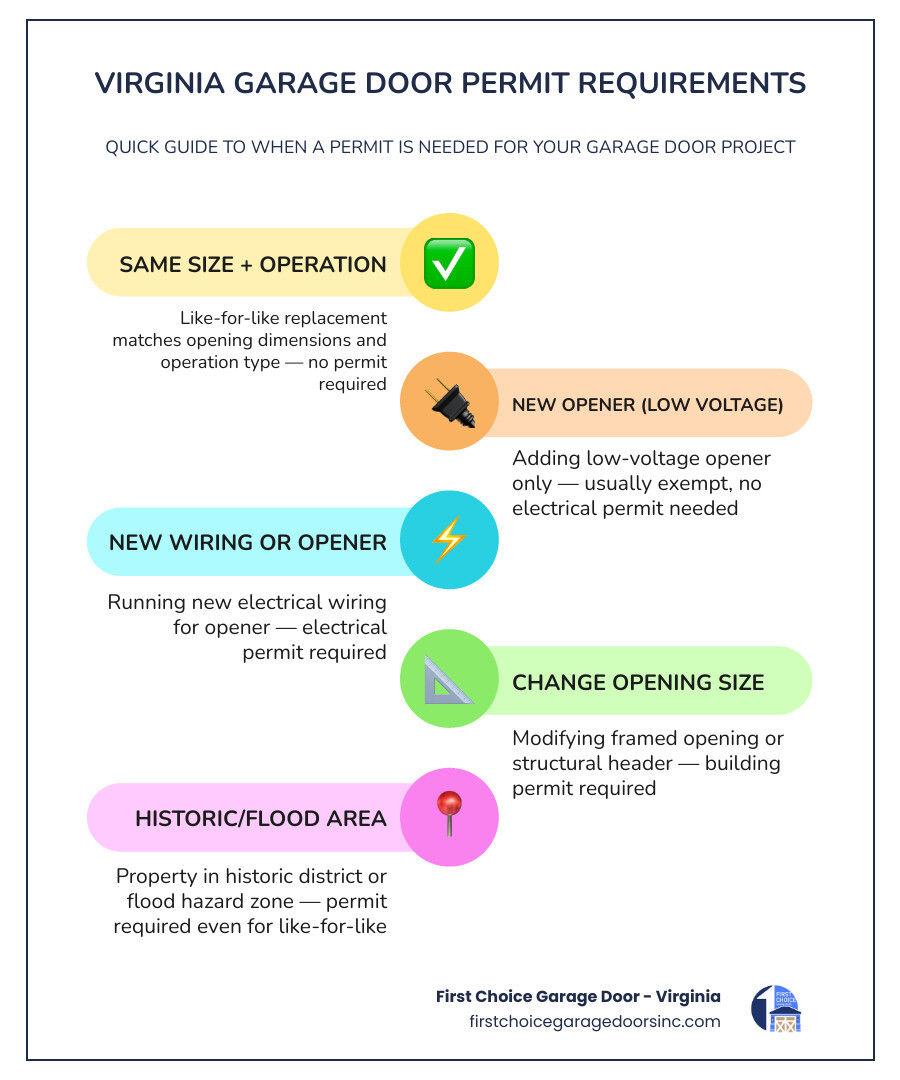
Here’s a fast breakdown:
| Scenario | Permit Required? |
|---|---|
| Replacing door with same size and operation type | No |
| Changing the framed opening or structural elements | Yes |
| Adding a new garage door opener (low-voltage only) | Usually No |
| Running new electrical wiring for an opener | Yes (electrical permit) |
| Property in a historic district or flood hazard area | Yes (even for like-for-like) |
The rules come from Section 108.2 of the Virginia USBC, which exempts replacement doors in residential properties (Groups R-3, R-4, and R-5) from permit requirements — as long as the new door matches the existing opening dimensions and operation type, and doesn’t need to be fire-rated.
Local jurisdictions like Fairfax County and Manassas enforce these rules at the local level, so the specifics can vary depending on where you live in Northern Virginia.
The sections below walk you through every scenario in detail so you can move forward with confidence.
Key terms for do i need a permit to replace my garage door in virginia:
- Can you return a long list of garage door repair companies in Northern Virginia that prioritize safety, quality, and prompt service?
- What are the most highly-rated garage door companies in Manassas, VA?
- Where can I get a quote for a new garage door installation in Manassas?
Do I Need a Permit to Replace My Garage Door in Virginia?

When we talk about home improvements in May 2026, the first thing we look at is the Virginia Uniform Statewide Building Code (USBC). This code is the “law of the land” for construction in our state. According to Section 108.2, many common home maintenance tasks are classified as “ordinary repairs.”
An ordinary repair is essentially work that maintains the structure without changing its fundamental nature or safety. For most homeowners in Northern Virginia, a “like-for-like” replacement is the gold standard for avoiding a permit. This means if you are taking down an old sectional door and putting up a new sectional door of the exact same size, you are likely exempt.
This exemption applies specifically to Residential Groups R-3 (single-family homes) and R-5 (townhomes and other smaller residential structures). As long as the framed opening—the actual wood or steel “box” the door sits in—remains untouched, you are generally in the clear. However, if you’re curious about the deeper details of the process, The Homeowner’s Guide to Installing a New Door offers a great look at what to expect during the physical installation.
When a Building Permit is Required for Garage Door Projects
While a simple swap is easy, there are several “red flags” that will trigger the need for a building permit. In Virginia, permits are mandatory whenever work involves structural components, means of egress (your exits), or fire-rated assemblies.
If your garage is attached to your home, the door may need to meet specific fire-rating standards depending on its proximity to living spaces. Furthermore, if your home is located in a historic district or a flood hazard area, local officials often override the standard exemptions. In these zones, even a simple door replacement might require a permit to ensure the new door matches the historical aesthetic or can withstand specific environmental pressures like wind loads or water.
Before you pull the trigger on a new purchase, it is vital to Before Your Garage Door Installation Consider the Following to ensure you aren’t accidentally violating a local ordinance. Knowing How to Choose Professional Garage Door Installation in Northern Virginia can also save you a headache, as experienced pros will know exactly which local codes apply to your specific street.
Do I need a permit to replace my garage door in Virginia if I am adding a new opener?
This is a common question we hear at First Choice Garage Doors. If you are simply replacing an old opener with a new one using the existing outlet, you typically do not need a permit. This is considered a “trade” replacement of low-voltage equipment or a simple appliance swap.
However, if your garage never had an opener and you need to run new electrical wiring from your breaker panel to a new ceiling outlet, you will need an electrical permit. Virginia is strict about new wiring to prevent fire hazards. When deciding between Professional vs DIY Garage Door Installation, a licensed professional can often handle these “trade permits” as part of their service package.
Do I need a permit to replace my garage door in Virginia if the opening size changes?
Yes, absolutely. If you decide to turn two small single garage doors into one large double door, or if you want to make your door taller to fit a new SUV, you are performing a structural alteration.
Changing the opening size requires modifying the “header”—the heavy beam that supports the weight of the wall above the garage door. Because this involves the structural integrity of your home, the building official will require a permit application. You will likely need to submit scaled drawings or plans showing how the new header will be supported. For those in our local area, our Garage Door Installation Manassas VA Guide provides more insight into how these larger projects are handled.
Local Permit Requirements Across Northern Virginia Jurisdictions
While the USBC is a statewide code, it is enforced locally. This means the “how-to” of getting a permit changes depending on which side of the county line you are on.
- Fairfax County: Fairfax uses the PLUS system (Planning and Land Use System). Most applications are handled online. If you are doing work that requires a permit, you’ll need to create a “record” in their digital portal.
- Manassas: The Manassas Building Permit Office handles local enforcement. They are known for being thorough, especially regarding zoning approval. Even if a building permit isn’t needed, you should always check if a zoning permit is required to ensure your door doesn’t violate “setback” rules (how close your garage can be to the property line).
- Henrico County: Like Fairfax, Henrico requires permits for any alterations involving electrical or mechanical systems regulated by the USBC.
If you are looking for a Manassas Garage Door Fitting Service: Who to Trust with Your Home’s Biggest Entrance, we recommend choosing someone who is intimately familiar with these local offices. We’ve seen how Why Professional Garage Door Installation in Columbia MD Matters (and similarly in Virginia) because a pro knows the local inspectors and what they look for during a final walkthrough.
Consequences of Skipping the Permit Process in 2026
It might be tempting to skip the paperwork to save time, but the risks in 2026 are higher than ever. Local governments have become much more efficient at tracking unpermitted work through satellite imagery and property tax assessments.
| Risk Factor | Consequence |
|---|---|
| Legal | Stop-work orders and civil penalties/fines. |
| Financial | Issues during property resale; buyers may demand you get “retroactive” permits. |
| Insurance | Insurance claims may be denied if a fire or injury is linked to unpermitted work. |
| Safety | High risk of safety hazards, such as a collapsing header or electrical fire. |
If you are a business owner, the stakes are even higher. Following Your Guide to Professional Business Overhead Door Installation ensures that your commercial property remains compliant with OSHA and local fire codes, protecting you from massive liability.
Frequently Asked Questions about Virginia Garage Door Permits
Does replacing a garage door count as an ordinary repair under the Virginia USBC?
Generally, yes. As long as the replacement door has a similar operation (e.g., sectional to sectional) and matches the existing opening dimensions, it is considered a non-structural ordinary repair. This means you do not need to file an application. For a look at how this works in other regions, you can check out the Seamless Garage Door Installation Fayetteville NC Edition, though remember that Virginia’s USBC is unique in its statewide uniformity.
What documentation is typically required for a permit application?
If your project does require a permit (like widening the opening), you will usually need:
- A completed permit application with applicant and contractor information.
- Site plans showing where the garage sits on the property.
- Floor plans or structural drawings showing the new header and framing.
- Proof of contractor licensing (Class A, B, or C).
Where can homeowners check local permit requirements?
Your best bet is the local Department of Building Construction or the Permit Center for your specific county or city. Most Northern Virginia jurisdictions now have robust local government portals where you can search for your address and see existing permits or download FAQ sheets. If you’re looking for commercial-specific advice, The Annapolis Guide to Seamless Commercial Garage Door Installation provides a good framework for how businesses should approach these regulatory hurdles.
Conclusion
At First Choice Garage Doors, we believe that a new garage door should be a source of pride and security, not a legal headache. While the answer to do I need a permit to replace my garage door in Virginia is often “no,” the exceptions are critical to your home’s safety and value.
Our team brings unmatched Northern Virginia expertise to every job. We ensure professional compliance with the USBC and local Manassas ordinances, providing you with a stress-free installation that meets the highest safety standards. Don’t leave your home’s biggest entrance to chance.
Contact our Manassas VA team for expert guidance and let us handle the heavy lifting—and the paperwork—for you.