
Your Maryland Garage Door Works Hard — Here’s How Often It Needs Help
How often should you service your garage door depends on how much you use it — but for most Maryland homeowners, the answer is at least once a year by a professional, plus simple monthly and seasonal checks you can do yourself.
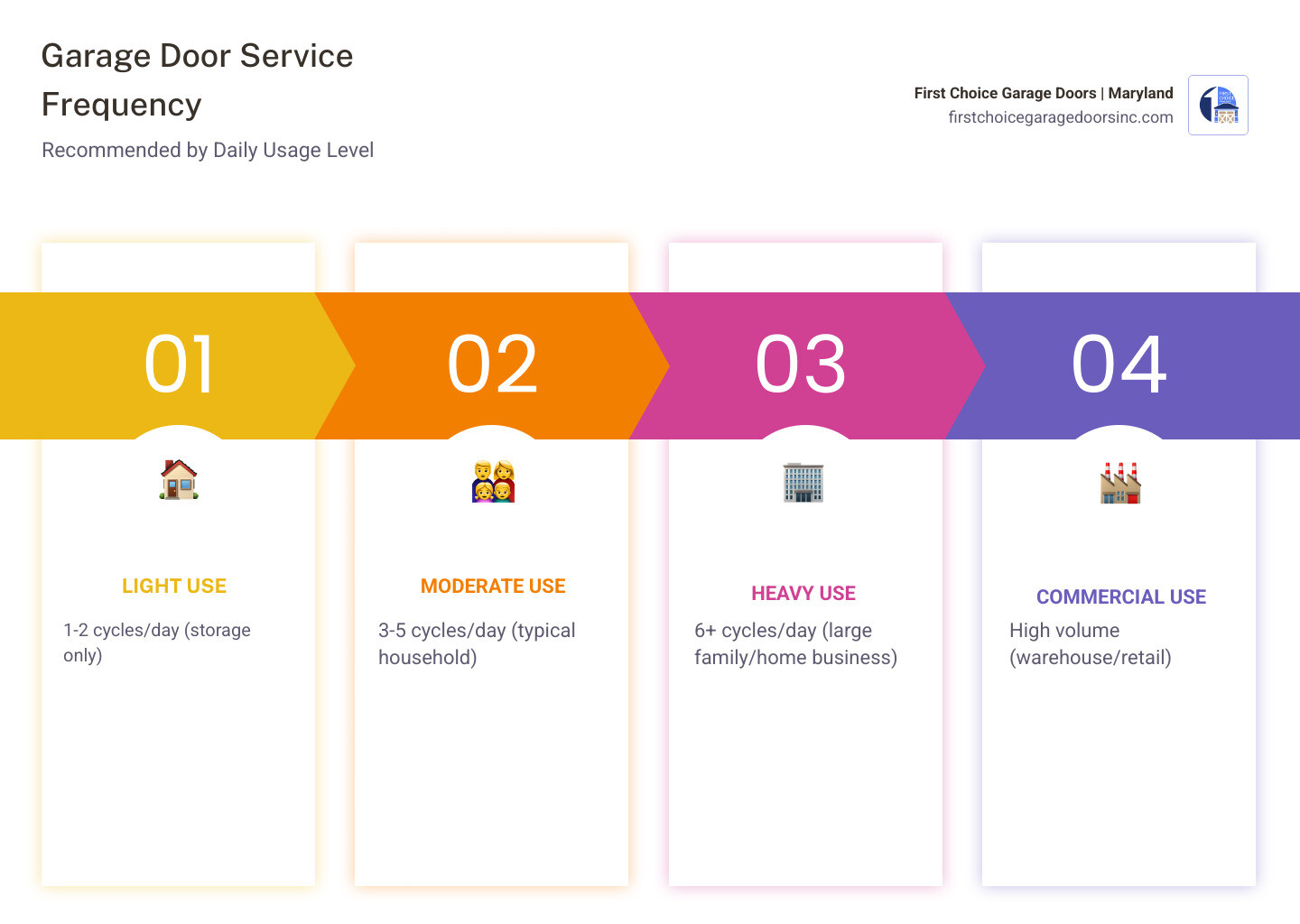
Quick answer by usage level:
| Usage Level | Cycles Per Day | Recommended Service Frequency |
|---|---|---|
| Light (storage only) | 1-2 | Every 12-18 months |
| Moderate (typical household) | 3-5 | Once a year |
| Heavy (large family, home business) | 6+ | Every 6 months |
| Commercial | High volume | Quarterly |
Your garage door is likely the largest moving part of your home. It cycles up and down roughly 1,500 times a year — and in Maryland, it does that through humid summers, freezing winters, coastal salt air, and everything in between. That kind of workload adds up fast on springs, cables, rollers, and tracks.
Most failures are not random. They are the result of gradual wear that goes unnoticed until something breaks — often at the worst possible moment. A consistent service schedule catches that wear early, keeps your door safe, and extends its working life to 15-30 years instead of the 5-10 you can expect from a neglected system.
How Often Should You Service Your Garage Door for Peak Performance?
At First Choice Garage Doors, we’ve seen it all—from doors that purr like kittens to those that sound like a dinosaur giving birth. The general recommendation is to have your garage door serviced at least once a year by a professional technician. Think of it like a physical for your home’s biggest moving part.
While an annual visit is the “sweet spot” for most, keeping up with garage door maintenance involves a mix of professional expertise and homeowner vigilance. Residential doors and commercial doors have very different needs. A family in Columbia MD might open their door four times a day, while a warehouse in Frederick MD might cycle their door forty times. Because of this, how often your commercial garage door will need servicing is usually much more frequent—often quarterly—to prevent downtime that can stall a business.
Regular servicing allows for “predictive maintenance.” By tracking the condition of components like springs and cables over time, our technicians can tell you when a part is nearing the end of its life before it actually snaps.
Determining how often should you service your garage door based on usage
Every time your door goes up and down, it completes one “cycle.” Most standard torsion springs are rated for about 10,000 cycles. If you use your door four times a day, those springs should last about seven years. However, if you have teenagers, a home gym in the garage, or a home-based business, you might be hitting 10 cycles a day. In those cases, you’ll reach that 10,000-cycle limit in less than three years.
Understanding how often a garage door repair may be needed requires looking at your daily habits. High-traffic households should consider professional servicing every six months to stay ahead of the accelerated wear on rollers and bearings.
The “Golden Rule” for Maryland homeowners
For our neighbors in Maryland, we recommend the “Spring and Fall” rule. Scheduling your service during these transitional seasons ensures your door is ready for the extreme temperatures of summer and winter. You can keep your Annapolis home rolling with annual garage door maintenance by booking a tune-up in October to ensure the lubricant doesn’t thicken in the cold, or in April to check for any damage caused by winter ice and salt. This proactive approach prevents the dreaded “stuck in the driveway” morning when you’re already running late for work.
Key Factors Influencing Your Maintenance Schedule
The Maryland climate is beautiful, but it can be brutal on mechanical systems. Our proximity to the Chesapeake Bay means salt air can accelerate corrosion on metal tracks and springs. High humidity in Easton MD can cause wooden doors to swell or warp, while the freezing winters in Frederick cause steel components to contract, increasing the tension on already-strained springs.
When reviewing our garage door maintenance guide for Annapolis MD, we highlight several factors that might force you to service your door more often:
- Age of the System: Older doors (10-15+ years) naturally have more “play” in their parts and require more frequent tightening and lubrication.
- Material: There are specific reasons to perform preventive maintenance on a wood garage door, such as checking for rot or repainting to prevent moisture absorption, which steel doors don’t require.
- Installation Quality: A door that wasn’t perfectly balanced during installation will put uneven stress on the opener, leading to premature failure.
Essential DIY Tasks and Professional Tune-Up Components
While we recommend a pro for the heavy lifting, there is plenty you can do to keep things running smoothly. Our garage door maintenance services are designed to complement the small tasks homeowners perform monthly.
A basic DIY routine should include a visual inspection of the cables (look for fraying), checking the weatherstripping for cracks, and tightening any loose nuts or bolts with a socket wrench. Just remember: stay away from the red-colored bolts—those are attached to the high-tension system!
Following the ultimate guide to garage door care in Columbia MD means keeping your tracks clean. Use a damp cloth to wipe out dust and debris. Do not grease the inside of the tracks; this actually attracts dirt and creates a sticky “sludge” that makes the motor work harder.
Safety tests to perform when considering how often should you service your garage door
Safety isn’t just a suggestion; it’s a standard. Since 1993, federal law (UL 325) has required garage door openers to have safety features like photo-eye sensors. You should perform garage door inspections at least once a month to test these systems:
- The Auto-Reverse Test: Place a 2×4 board or a roll of paper towels on the ground where the door closes. When the door hits the object, it should reverse within two seconds.
- The Photo-Eye Test: Wave a broomstick in front of the sensors at the bottom of the tracks while the door is closing. The door should immediately stop and reverse.
- The Balance Test: Disconnect the opener by pulling the red emergency release cord. Lift the door manually to about waist height. A well-balanced door should stay in place. If it slams shut or shoots upward, your springs need professional adjustment.
Lubrication best practices for moving parts
Lubrication is the “secret sauce” of a quiet door. If you want the silent treatment: how regular maintenance reduces garage door noise, you need the right products.
Use a silicone-based spray or white lithium grease. Never use WD-40. While great for cleaning, WD-40 is a solvent, not a lubricant; it will actually strip away the existing grease and attract more grit. Apply a light coating to the hinges, metal rollers (at the bearings), and the torsion spring itself. Lubricating the spring helps reduce the friction between the coils, which prevents that “clacking” sound as the door moves.
Warning Signs That Immediate Service Is Required
Sometimes, the door tells you it’s time for a check-up before your annual date arrives. There are clear signs that a garage door repair service will be needed soon. If you notice any of the following, don’t wait for your scheduled maintenance:
- Excessive Noise: Grinding, squeaking, or “banging” sounds usually mean something is loose or dry.
- Slow Operation: If the door hesitates like it’s debating its life choices, you might have a failing motor or a broken spring.
- Jerky Movement: This is a classic sign of track misalignment or worn rollers.
- Sagging Panels: This can happen with older wooden doors or if the door has been hit.
- Intermittent Sensor Failure: If the door starts to close and then reverses for no reason, your photo-eyes might be dirty or misaligned.
Knowing when to get your garage door repaired is about listening to the machine. A door that is straining the opener will eventually cause the gears to strip, turning a simple maintenance visit into a much larger repair.
DIY vs. Professional Maintenance: Knowing the Limits
We love a good DIY project, but garage doors are unique. They are the largest moving object in your home and operate under thousands of pounds of spring tension. When deciding DIY vs. professional garage door repair, the rule is simple: if it’s under tension, don’t touch it.
Homeowners can safely handle lubrication, cleaning, and visual checks. However, tasks like replacing cables, adjusting torsion springs, or repairing the opener drive system require specialized tools and training. One slip with a winding bar can lead to serious injury. Furthermore, many manufacturer warranties are voided if a non-professional attempts a repair. When you choose a professional garage door maintenance service, you’re paying for safety and the peace of mind that the job is done right.
Frequently Asked Questions about Garage Door Servicing
How long do garage door components last with proper maintenance?
With annual servicing, a quality garage door system can last 15 to 30 years. Without it, you might be looking at a full replacement in as little as 5 to 10 years.
| Component | Lifespan (Maintained) | Lifespan (Neglected) |
|---|---|---|
| Torsion Springs | 7-10 years | 3-5 years |
| Plastic Rollers | 2-3 years | 1 year |
| Nylon Rollers | 10-15 years | 5 years |
| Garage Door Opener | 10-15 years | 5-7 years |
What parts of the garage door should I never lubricate?
Never lubricate the tracks (keep them clean instead), the photo-eye lenses (wipe with a dry cloth), or any plastic components. Lubricant on tracks actually makes it harder for the rollers to gain traction and attracts debris that can cause jams.
Why is my garage door making a grinding noise?
Grinding is usually the sound of metal-on-metal. This happens when roller bearings dry out, hardware becomes loose and vibrates, or the tracks have fallen out of alignment. A professional tune-up can usually solve this in under an hour by tightening and lubricating the system.
Conclusion: Protecting Your Maryland Home with Regular Care
At First Choice Garage Doors, we believe that a little prevention goes a long way. Your garage door is more than just an entrance; it’s a primary security feature and a major part of your home’s curb appeal. Whether you’re at home in Easton, Columbia, or Frederick, regular care ensures your door remains a reliable part of your daily routine.
We understand why maintenance is so important for a commercial garage door and bring that same level of industrial-grade precision to every residential driveway. Our expert technicians are ready to help you extend the life of your door and keep your family safe.
Don’t wait for a snap or a grind to interrupt your day. Schedule your professional garage door maintenance today and let us handle the heavy lifting.