
Why Garage Door Safety Tips for Homeowners Can Prevent Serious Injuries
Following garage door safety tips for homeowners can protect your family from one of the most overlooked hazards in your home. Here are the most important ones to know:
- Test the auto-reverse feature monthly – Place a 2×4 flat on the ground in the door’s path. The door must reverse within two seconds of contact.
- Check photo-eye sensors – They should be mounted no more than 6 inches off the floor and have solid LED indicator lights.
- Inspect springs, cables, and rollers – Look for rust, fraying, or wear every month. Never attempt to repair springs or cables yourself.
- Mount wall controls at least 5 feet high – This keeps buttons out of reach of young children.
- Store remotes securely – Keep transmitters out of children’s reach and out of plain sight in vehicles.
- Know your emergency release – Locate the red cord and practice using it so you can open the door manually during a power outage.
- Schedule annual professional maintenance – A trained technician can catch issues you may miss during routine checks.
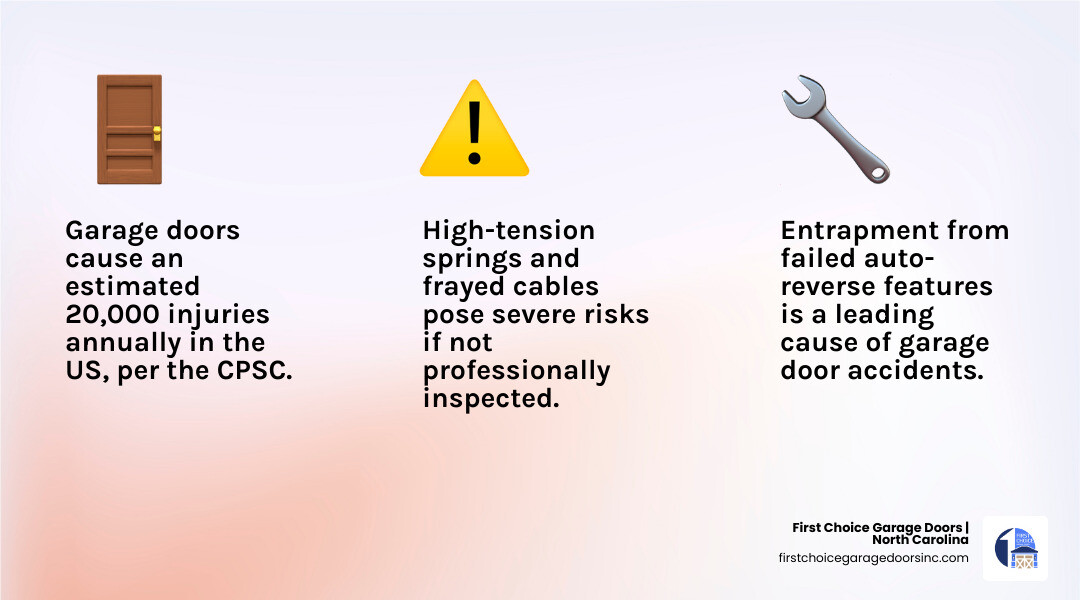
Your garage door is the largest moving object in your home — and one of the most frequently used. According to the U.S. Consumer Product Safety Commission, garage doors are linked to an estimated 20,000 or more injuries every year in the United States. Despite that, most homeowners rarely think about safety until something goes wrong.
May is National Garage Door Safety Month, making it the perfect time to take stock of how well your door is actually protecting your family. Whether your system is brand new or decades old, a few simple checks can make a significant difference.
I’m Tony Aguilar, founder of First Choice Garage Doors, Inc., with over 30 years of hands-on experience in the garage door industry — including educating homeowners on practical garage door safety tips for homeowners that prevent accidents before they happen. I’ll walk you through everything you need to know to keep your Fayetteville home and family safe.
Essential Garage Door Safety Tips for Homeowners in Fayetteville

When we talk about the largest moving part in your home, we aren’t exaggerating. A typical residential garage door in North Carolina can weigh anywhere from 150 to 400 pounds. When that much weight is moving under the power of an electric motor and high-tension springs, the potential for injury is high. Statistics show that roughly 20,000 to 30,000 people seek medical attention for garage door-related injuries each year.
The most common hazards include:
- Pinch Points: Fingers can easily get caught between door sections as they close. Modern doors often feature pinch-resistant designs, but older models are notorious for this.
- Entrapment: This occurs when a person (often a child) is pinned under a closing door that fails to reverse.
- Falling Doors: If a spring or cable snaps, the door can crash down with enough force to crush anything beneath it.
To address these risks, federal standards like UL 325 were established in 1993, requiring all automatic openers to have safety reversal features. However, these features only work if they are maintained. For more quick wins on keeping your system secure, check out our guides on 3 Garage Door Safety Tips and 5 Garage Door Safety Tips.
Testing Your Door’s Automatic Safety Features
Modern convenience shouldn’t come at the cost of safety. Your garage door opener is essentially a “smart” device that relies on two primary systems to prevent accidents: the mechanical auto-reverse and the photoelectric sensors. We recommend making these tests a part of your monthly home maintenance routine. If you’re unsure how to start, you can learn more about How To Get A Garage Door Safety Test Done to ensure your home remains a safe environment.
How to perform a garage door safety tips for homeowners auto-reverse test
The auto-reverse feature is the “saving grace” of garage door safety. It is designed to detect an obstruction through physical resistance and immediately send the door back up.
To test this:
- Open the garage door fully.
- Place a 2×4 piece of lumber or a roll of paper towels flat on the ground in the center of the door’s path.
- Press the wall button to close the door.
- The door should strike the object and reverse within two seconds.
If the door continues to press down on the object or stops without reversing, the sensitivity settings on your opener may be too high. This is a critical failure that requires immediate attention. For a deeper dive into these procedures, see How To Test Your Garage Door Safety Features.
Maintaining and aligning photo-eye sensors
The photo-eye sensors (the small “black boxes” at the bottom of your tracks) create an invisible infrared beam. If that beam is broken while the door is closing, the door will stop and reverse.
- Height Matters: These must be mounted no higher than 6 inches off the floor. If they are too high, a small child or a pet could crawl under the beam undetected.
- Alignment: Most sensors have LED indicator lights. Usually, a solid green or amber light means they are aligned. A flickering or red light suggests they are knocked out of place.
- Cleaning: Dust, cobwebs, and dirt on the lenses can cause the door to “ghost” (reverse for no apparent reason). Simply wipe the lenses with a soft, dry cloth.
Implementing these Safety Measures To Take With An Automated Garage Door ensures the technology is actually working for you, not against you.
Visual Inspections and Mechanical Maintenance
While the electronics are vital, the mechanical components do the heavy lifting. We suggest a “Look and Listen” approach every few months. Stand inside your garage with the door closed and look at the hardware. Do you see frayed cables? Are the springs covered in heavy rust? Are there loose bolts on the mounting brackets?
Unusual noises like grinding, scraping, or a loud “bang” (which often indicates a broken torsion spring) are red flags. Keeping an eye on these details is a core part of any Garage Door Safety Tips To Follow.
Checking balance and hardware for garage door safety tips for homeowners
A garage door that is “out of balance” puts immense strain on the opener, shortening its lifespan and creating a safety risk.
The Balance Test:
- Close the door and disconnect the opener by pulling the red emergency release cord.
- Manually lift the door about halfway (3-4 feet off the ground).
- Let go. A properly balanced door should stay in place or move only slightly. If it slams shut or shoots upward, the spring tension is incorrect.
For more details on what to look for during your walk-through, refer to The Homeowners Guide To Garage Door Safety.
Why you should avoid DIY spring and cable repairs
We love a good DIY project as much as any Fayetteville homeowner, but garage door springs and cables are the exception. These components are under extreme tension—enough to lift a 400-pound door. If a spring snaps while you are working on it, it can release energy with the force of a gunshot, leading to severe injury or even death.
Professional technicians use specialized winding bars and tools to manage this tension safely. Furthermore, extension springs should always have safety cables running through them to contain the spring if it breaks. Understanding Garage Door Spring Safety What Every Homeowner Should Know can literally save your life.
Protecting Your Family and Securing Your Fayetteville Home
Safety isn’t just about the machinery; it’s about habits. Children are naturally curious and often view the garage door as a giant toy. It is vital to teach them that the garage is not a playground.
- The 5-Foot Rule: Mount your wall-mounted push buttons at least five feet from the floor. This ensures small children cannot reach them to “play” with the door.
- Remote Security: Never leave your remote on the dashboard or visor of your car where it can be stolen. Instead, keep it in the glove box or use a keychain remote. Better yet, upgrade to a smart opener that uses rolling code technology, which changes the access code every time the door is used to prevent burglars from “grabbing” your signal.
We take Teaching Children About Garage Door Safety seriously, and we encourage you to share these Garage Door Safety Tips To Teach Your Kids with your family today.
Pet safety and garage organization
Our furry friends are also at risk. Because pets are low to the ground, the 6-inch height requirement for photo-eye sensors is non-negotiable. Additionally, keep the area around the tracks clear of clutter. A stray bicycle or garden tool can knock a sensor out of alignment or jam the door.
Beyond the door itself, consider the garage environment:
- Chemicals: Store yard chemicals and flammable liquids in locked cabinets.
- Carbon Monoxide: Never warm up your car inside the garage, even with the door open. Fumes can linger and seep into the home. Install a CO detector in the room adjacent to the garage.
- Walkways: Keep paths clear to prevent trips and falls.
For more pet-specific advice, see our guides on Garage Door Safety Tips For Pet Owners and Keeping Pets Safe Around Your Garage Door.
Emergency Preparedness and Scam Prevention
Fayetteville storms can lead to sudden power outages. Do you know how to get your car out if the power goes out? Locate the red emergency release cord. Pulling this disconnects the door from the opener, allowing you to lift it manually. If you find the door too heavy to lift, it is likely out of balance and needs professional service. Many modern openers now come with battery backup systems that provide up to 40 cycles during an outage—a worthwhile upgrade for peace of mind.
Unfortunately, the garage door industry is sometimes targeted by “rebuild scams.” These occur when a technician claims your entire system is failing and needs a total overhaul, often at an inflated price.
| Feature | Reliable Professional Service | Common Industry Scams |
|---|---|---|
| Identification | Branded vehicle and uniform | Unmarked personal vehicle |
| Business Name | Clear, established name | Vague names like “Garage Door Services” |
| Warranty | Clear, written parts and labor warranty | “Lifetime” warranty that only covers cheap parts |
| Transparency | Explains the “why” behind repairs | Pressure tactics and “emergency” upselling |
Frequently Asked Questions about Garage Safety
What should I do if my garage door fails a safety test?
If your door fails the auto-reverse or photo-eye test, stop using the automatic opener immediately. Pull the emergency release cord and operate the door manually until a professional can inspect and repair the safety features.
How often should professional maintenance be scheduled?
We recommend a professional tune-up at least once a year. While monthly homeowner checks are great, a technician can check the tension of the torsion springs, lubricate internal bearings, and ensure the door is perfectly balanced—tasks that require specialized knowledge.
Where is the safest place to store my garage door remote?
The safest place is on your person (keychain remote) or inside your house. If you must leave it in the car, hide it in a center console or glove box. Many homeowners in Fayetteville are now switching to smartphone apps like myQ, which eliminate the need for a physical remote entirely.
Conclusion
At First Choice Garage Doors, we believe that a safe home starts with a safe garage. Serving Fayetteville, NC, and the surrounding regions, our team is dedicated to ensuring your door operates smoothly and securely. Don’t wait for a “gunshot” sound from a broken spring or a failed safety sensor to take action.
Whether you need a quick safety inspection, a high-tension spring replacement, or a brand-new installation, we are here to help. More info about garage door services is just a click away. Let’s keep your family safe together.