
What to Check When Your Garage Door Won’t Open or Close
If you’re dealing with garage door wont open or close what to check situations, here are the most common things to look at first:
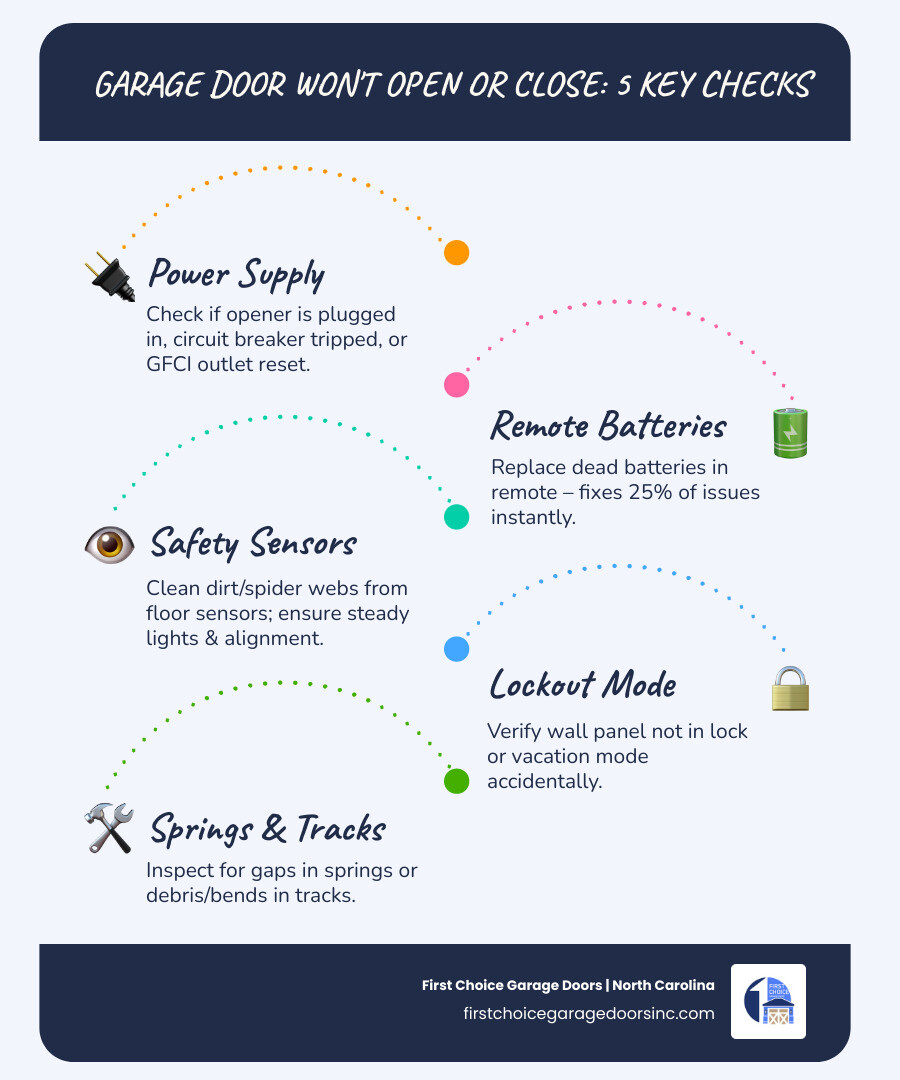
- Power supply – Is the opener plugged in? Check your circuit breaker and any GFCI outlets in the garage.
- Remote batteries – Dead batteries are one of the most frequent culprits. Replace them and try again.
- Safety sensors – Look at the small sensors near the floor on each side of the door. Are their indicator lights steady? Are they blocked or dirty?
- Lockout mode – Check your wall control panel for an accidentally activated lock or vacation mode.
- Broken spring or cable – Look above the door for a visible gap in the torsion spring coil, or check for slack in the cables.
- Track obstructions – Scan the tracks on both sides for debris, bends, or anything blocking the rollers.
- Limit switch settings – If the door reverses before fully closing or opening, the limit or force settings may need adjustment.
These seven checks alone resolve the vast majority of garage door problems homeowners encounter. In fact, research shows that dead remote batteries, a tripped circuit breaker, misaligned safety sensors, and an accidentally locked opener account for roughly 80% of all opener failures — and most are free to fix in under five minutes.
Still, a garage door that won’t move can mean something more serious is going on underneath the surface. Whether it’s a worn spring that’s reached the end of its roughly 7-year lifespan, a logic board on the fritz, or tracks that have shifted out of alignment, knowing exactly what to look for makes all the difference between a quick fix and an expensive mistake.
I’m Tony Aguilar, founder of First Choice Garage Doors with over 30 years of hands-on experience diagnosing exactly the kind of garage door wont open or close what to check situations that leave homeowners frustrated in their driveways. In this guide, I’ll walk you through every checkpoint — from the simple stuff you can handle yourself to the repairs that genuinely require a professional.
Initial Steps: Power and Remote Troubleshooting

When your garage door refuses to budge, the first instinct is often to worry about a major mechanical failure. However, many Why a Garage Door Might Not Work scenarios are actually rooted in simple electrical or control issues. Before you start looking for broken steel, look for a glowing light or a loose plug.
Checking the Power Source
It sounds basic, but we see it all the time in Fayetteville and beyond: the motor unit has simply come unplugged. Vibrations from thousands of cycles can gradually wiggle a plug out of its socket. If your motor unit is silent and the lights on the unit aren’t on, check the power cord first.
Next, investigate your circuit breaker. If the breaker has tripped, your opener won’t receive a drop of electricity. Additionally, many modern garages are equipped with GFCI (Ground Fault Circuit Interrupter) outlets. If the GFCI trips—perhaps due to a power surge or moisture—it will cut power to the opener. Press the “Reset” button on the outlet to see if that restores life to the unit. If you’re still hearing nothing, you might be dealing with Problems Garage Door Opener Experience like a blown logic board, but power is always the square one of troubleshooting.
Remote and Wall Switch Issues
If the wall button works but your remote doesn’t, you’ve narrowed the problem down significantly. There are several Why a Garage Door Remote Might Not Function As It Should, and the number one reason is a dead battery. Most remotes use a CR2032 coin cell battery that typically lasts 2 to 3 years. Knowing When Your Garage Door Opener Needs A New Battery can save you a lot of morning stress; if the range is getting shorter or the LED on the remote is dim, swap it out.
Another common “gotcha” is the Lockout Mode. Many wall consoles have a “Lock” or “Vacation” button. If this is accidentally pressed (often by a child or while cleaning), it disables all remote signals while still allowing the wall button to work. If your remotes are suddenly dead but the wall button is fine, check for a blinking light on your wall station. Finally, ensure your opener’s antenna—that little wire hanging from the motor—is pointing straight down and isn’t tucked up where the signal can’t reach it.
Garage Door Wont Open or Close What to Check: Safety Sensors and Alignment
If your door starts to close and then immediately reverses—often accompanied by the opener lights flashing—you are likely dealing with a safety sensor issue. These “photo eyes” are required by law and are designed to prevent the door from crushing anything in its path. Understanding Reasons Your Garage Door Isn’t Closing usually starts right here at the bottom of your tracks.
Safety sensor problems are responsible for about 80% of cases where a door won’t close. These sensors sit about 6 inches off the ground and must “see” each other to complete an invisible infrared circuit. If that circuit is broken, the door will not close for safety reasons. Using The Easton Guide To Fixing Garage Door Sensors And Tracks as a reference, you can often realign these by hand until the indicator lights on both sensors stay solid.
Troubleshooting Sensor Obstructions
It doesn’t take much to trick a sensor. We’ve found that common household nuisances like spider webs, dirt buildup on the lenses, or even a wayward leaf can block the signal. Gently wipe the lenses with a microfiber cloth to ensure they are clear.
In some cases, the “obstruction” is actually the sun. If your garage faces west, the afternoon sun can be bright enough to “blind” the receiving sensor. If your door only refuses to close at a specific time of day, try shielding the sensor with a small piece of cardboard or a dedicated sunshade.
| Sensor Light Pattern | Meaning | Action Required |
|---|---|---|
| Both Lights Steady | Sensors aligned and clear | No action; sensors are working |
| One Light Flashing | Sensors misaligned | Gently nudge sensor until light is solid |
| Both Lights Off | No power to sensors | Check wiring connections at motor |
| Lights Flashing (Door Reverses) | Obstruction detected | Clear debris or check for sunlight interference |
Manual Operation and Emergency Release
When the power goes out in April 2026, or if the opener motor fails, you need to know how to move the door manually. Every opener has a red emergency release cord. Pulling this cord disengages the trolley from the motor’s drive system, allowing you to lift the door by hand.
However, a word of caution: never pull the release cord if the door is open. If a spring is broken, the door could come crashing down with its full weight—anywhere from 150 to 400 pounds. If you are Troubleshooting A Garage Door That Won’t Open In Easton Md, only use the manual release when the door is fully closed to safely check the balance and mechanical health of the system.
Mechanical Failures: Inspecting Springs, Cables, and Tracks
Once you’ve ruled out power and sensors, it’s time to look at the “muscles” of the door. The most critical component is the spring system. Many homeowners believe the motor does the heavy lifting, but it’s actually the springs that counterbalance the door’s weight. When you’re considering garage door wont open or close what to check, the springs should be high on your list.
Knowing When Your Garage Door Springs Are Broken is usually easy if you know where to look. Most springs are rated for 5,000 to 10,000 cycles, which averages out to about a 7-year lifespan for the typical family using their door 3-4 times daily. If you see a visible 2-inch gap in the coil of the spring above your door, it has snapped.
Signs of Broken Springs and Snapped Cables
A broken spring is a major safety risk. Because a properly balanced torsion spring counterbalances about 90% of the door’s weight, a broken one leaves the motor trying to lift a “dead” weight of 200 to 400 pounds. This is one of the top 5 Reasons Your Garage Door Won’t Open or Close. You might hear a loud “bang” like a gunshot when the spring snaps, even if you aren’t in the garage.
Cables work in tandem with the springs. If a cable snaps or comes off the drum, the door will often sit crooked in the opening. These are More Reasons A Garage Door Will Not Function Properly, and because they are under extreme tension, they should never be handled by anyone without professional training and tools.
Track Obstructions and Roller Maintenance
The tracks are the “highway” your door travels on. If the tracks are bent, rusted, or filled with hardened grease, the door will struggle to move. Knowing When Your Garage Door Has Come Off Track is vital; if the door looks uneven or you see rollers popping out of the rails, stop operation immediately to prevent the door from falling.
For smooth operation, we recommend cleaning the tracks with a damp cloth and lubricating the rollers and hinges every six months. Always use a silicone-based or white lithium grease—never WD-40, which can actually attract more grit and grime. If you’re Stuck In The Driveway Diagnosing Common Garage Door Issues In Easton, a simple cleaning and lubrication session can often quiet a noisy door and prevent future hang-ups.
Advanced Troubleshooting: Blink Codes and Limit Settings
If the mechanical parts look sound but the opener is still acting up, it’s time to look at the “brain” of the system. Determining If You Have a Broken Garage Door Opener often involves looking at the diagnostic lights on the motor unit itself. Modern openers from brands like LiftMaster and Chamberlain (post-2012) use flashing arrow lights to tell you exactly what is wrong.
These error codes can indicate everything from a communication error with the travel module to a failure in the logic board. These are some of the more technical Problems Your Garage Door May Face, and they often require a technician to swap out internal circuit boards.
Interpreting Blink Codes: Garage Door Wont Open or Close What to Check
When the opener lights flash, pay attention to the pattern. For example, in many modern units:
- 1 Up, 1 Down: Sensor wires are disconnected or cut.
- 1 Up, 4 Down: Sensors are misaligned or obstructed.
- 1 Up, 5 Down: The door moved, but the logic board lost track of its position (often due to a broken spring or binding).
- 4 Up, 6 Down: The sensors are blinded by sunlight or misaligned.
Openers with Security+ 2.0 or MyQ technology are particularly good at self-diagnosing. If you have a smart wall console, it may even display the error code in plain English, saving you the trouble of counting flashes.
Adjusting Limit Switches and Force
Sometimes the door “forgets” where the floor is. If your door closes, touches the ground, and then immediately pops back up, your close-limit switch may need adjustment. This tells the motor when to stop. If the limit is set too “deep,” the door thinks it hit an obstruction when it actually just hit the floor.
Similarly, the force settings control how much muscle the motor uses. If the tracks are slightly sticky (common in Fayetteville winters), the motor might think it hit a person and reverse. You can usually find adjustment screws on the back of the motor unit to fine-tune these settings. However, be careful—setting the force too high can be dangerous. This is one of the clear Signs You Need A Garage Door Repair if the door becomes erratic and won’t stay closed.
Frequently Asked Questions
Why does my garage door move a few inches and then reverse?
This is almost always a sign of excessive resistance. The motor’s safety system detects that it’s working too hard and reverses to prevent damage or injury. Common causes include a broken spring (making the door too heavy), binding tracks, or rollers that are seized up. When Comparing A Diy Vs Professional Garage Door Repair, checking for obstructions is a safe DIY task, but adjusting the springs to fix the balance is a job for us.
Quick Summary: Garage Door Wont Open or Close What to Check
If you are in a hurry, run through this rapid-fire list:
- Power: Is the motor plugged in? Reset the GFCI and check the breaker.
- Sensors: Are the lights solid? Wipe the lenses and clear any cobwebs.
- Remote: Try the wall button. If it works, change your remote batteries.
- Lock: Ensure the “Lock” button on your wall panel hasn’t been activated.
- Springs: Look for a gap in the coil above the door.
Can I fix a broken garage door spring myself?
We strongly advise against it. Garage door springs are under enough tension to lift a 400-pound door; if that tension is released improperly, it can cause severe injury or property damage. Professional technicians use specialized winding bars and have the experience to handle this safely. Why A Garage Door Repair Should Always Be Done By A Professional comes down to one word: safety.
Conclusion
A garage door that won’t cooperate is more than an inconvenience—it’s a disruption to your security and your daily routine. By following this guide on garage door wont open or close what to check, you can handle the simple fixes like battery replacements and sensor alignments in just a few minutes.
However, when the problem involves high-tension springs, snapped cables, or complex logic board failures, you need a team you can trust. At First Choice Garage Doors, our expert technicians serve Fayetteville, NC, and the surrounding regions with unmatched expertise. We prioritize your safety and provide prompt, professional service to get your home back in motion. Don’t let a stuck door ruin your day—Schedule your professional garage door repair today and let us handle the heavy lifting.