
When Your Garage Opening Doesn’t Fit the Mold: Custom Garage Door Solutions in Fayetteville, NC

Custom garage door sizes for non standard openings are purpose-built doors manufactured to exact dimensions that fall outside the typical range of stock sizes — and they’re often the smartest solution when your garage simply won’t cooperate with a one-size-fits-all approach.
Quick answer: What counts as a non-standard opening?
- Too wide: Wider than 18–20 feet for residential, or beyond 24 feet for commercial
- Too narrow: Less than 8 feet wide (including accessory buildings or converted spaces)
- Too tall: Heights exceeding the standard 7–8 feet, up to 16 feet or more
- Irregular shape: Arched headers, sloped floors, or angled framing
- Fractional dimensions: Openings like 17’3″ wide or 8’1″ tall that don’t match any stock size
If your opening fits any of these descriptions, a custom door is likely your best path forward — and often more practical than reframing your garage to accommodate a standard door.
Most homes in Fayetteville and across North Carolina were built with common garage dimensions in mind. But older properties, custom builds, converted carriage houses, and garages designed around oversized vehicles frequently tell a different story. When the opening doesn’t match what’s sitting on a manufacturer’s shelf, homeowners are left with a choice: modify the structure, or order a door built specifically for the space. As any experienced installer will tell you, forcing a standard door into a non-standard opening creates gaps, poor sealing, uneven wear on hardware, and ongoing headaches that a properly fitted custom door simply avoids.
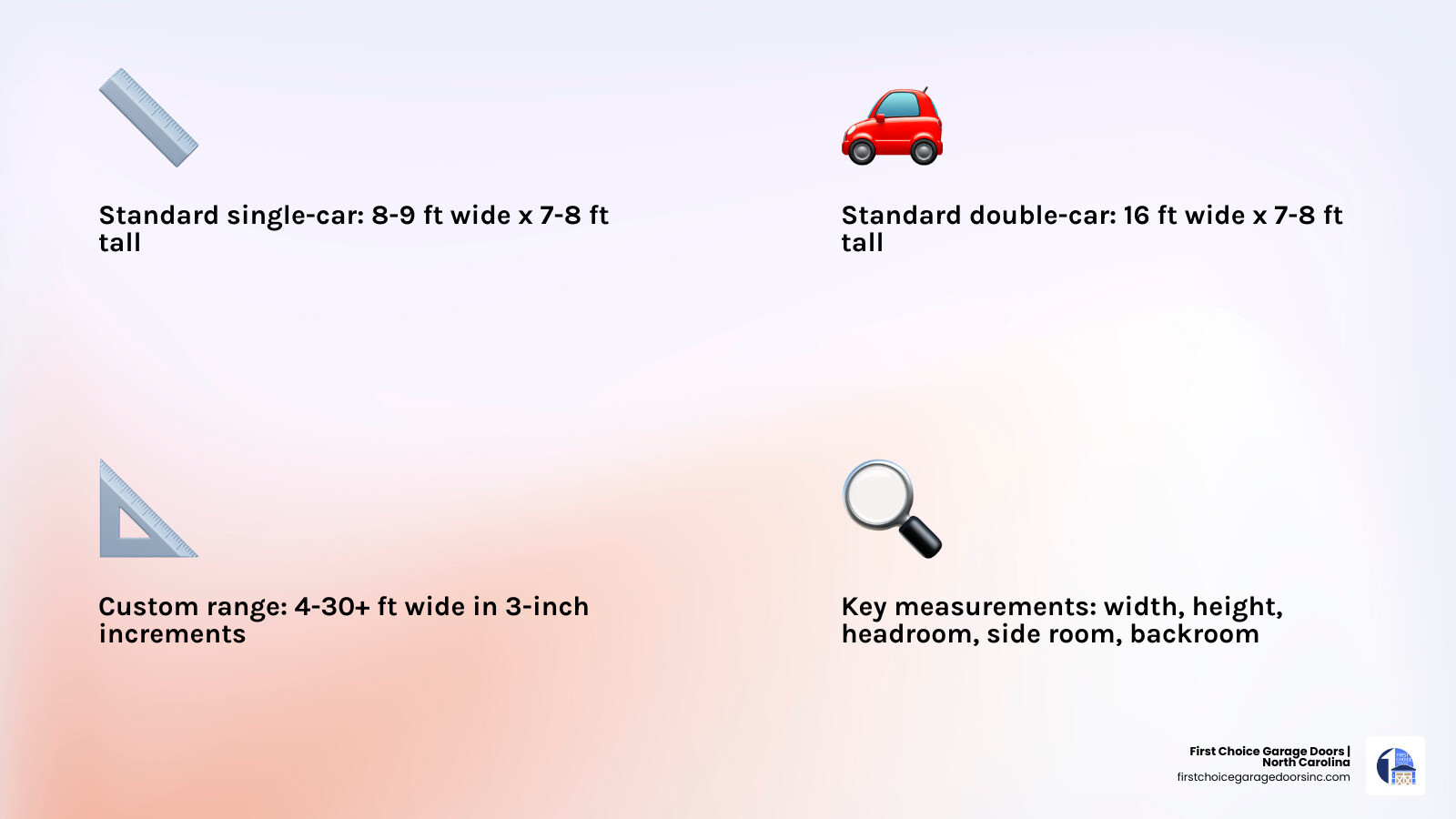
The good news is that today’s custom garage door manufacturing has come a long way. Doors can be fabricated in widths from as narrow as 4 feet up to 30 feet or more, and heights are typically available in 3-inch increments beyond standard sizes — meaning there’s virtually no residential or commercial opening that can’t be fitted with a door built precisely to its measurements.
I’m Tony Aguilar, founder of First Choice Garage Doors, Inc., with over 30 years of hands-on experience helping homeowners and businesses find the right fit for their garage openings — including some of the most challenging custom garage door sizes for non standard openings in the region. In the sections below, I’ll walk you through everything you need to know to make a confident, well-informed decision for your property.
“My garage opening isn’t a standard size. What defines a non-standard opening in Fayetteville?”

When we talk about a “standard” opening, we are usually referring to the sizes that builders have used most frequently over the last few decades. For a single-car garage, that’s typically 8 or 9 feet wide and 7 or 8 feet tall. For a double-car garage, the standard is usually 16 feet wide. However, Fayetteville is a city with a rich architectural history, and many of our homes don’t follow these modern rules.
A non-standard opening is essentially any “rough opening” — the structural frame of the garage — that doesn’t align with these stock dimensions. Whether it was built that way 100 years ago or was a result of a modern renovation, these openings require a more nuanced approach. Understanding Determining The Best Garage Door Size is the first step in realizing that your home might need something a bit more “bespoke” than what you’d find in a big-box store.
Finding custom garage door sizes for non standard openings in historic homes
Fayetteville features many beautiful pre-1970s builds that predate the standardization of the garage door industry. In these older homes, we often encounter:
- Arched Headers: Many historic carriage houses feature curved or arched tops. A standard rectangular door won’t fit these without leaving massive gaps or requiring a complete structural remodel of the home’s facade.
- Sloped Floors: Over time, foundations can settle. If your garage floor is out of level by two inches or more, a standard door will never seal properly. We can solve this with custom bottom wedges or scribed sections.
- Converted Spaces: Many older outbuildings were never intended for modern SUVs. They might be extremely narrow (7 feet wide) or have very low ceiling clearances that require specialized track configurations.
For a deeper dive into how these older structures compare to modern standards, check out our Sizing Up Fayetteville Single And Double Car Garage Door Installation Guide.
Identifying irregular dimensions for modern custom builds
Even in newer construction, homeowners often want something unique. Modern architectural styles often call for fractional widths to maintain perfect symmetry with the rest of the house. You might have a garage opening that is 17 feet 3 inches wide — a size that would leave a standard 16-foot door looking like a high-water pair of pants.
| Feature | Standard Residential Sizes | Custom Range Capabilities |
|---|---|---|
| Width | 8′, 9′, 16′, 18′ | 4′ to 30’+ |
| Height | 7′, 8′ | 3′ to 16’+ (in 3″ increments) |
| Increments | Whole feet | Fractional inches available |
| Special Shapes | Rectangular only | Arched, clipped corners, sloped bottoms |
Whether you are building a narrow accessory building for a motorcycle or a massive workshop for a boat, custom garage door sizes for non standard openings ensure the door fits the vision, rather than the vision being limited by the door.
“Why should I choose custom garage door sizes for non standard openings for my home?”
Choosing a custom door is about more than just filling a hole in the wall; it’s about performance and protection. When a door is built to the exact specifications of your opening, every component works in harmony. This leads to a tighter seal, which is crucial for energy efficiency. In the humid North Carolina summers, a perfectly fitted door keeps the heat and moisture out, reducing the strain on your home’s cooling system.
Furthermore, a custom fit enhances security. Standard doors forced into non-standard openings often leave weak points — gaps that can be pried or sections that don’t lock flush. By opting for a custom build, you eliminate these vulnerabilities. You also have to consider the layout of your space; sometimes Deciding Between A Single Or Double Garage Door comes down to the custom dimensions available for your specific driveway width.
The advantages of custom garage door sizes for non standard openings for oversized vehicles
We see a lot of lifted trucks and large SUVs in our service area. If you’ve added a lift kit to your pickup or a storage rack to your SUV, a standard 7-foot door might be a recipe for a crushed roof.
- Lifted Trucks: Custom heights (up to 10 or 12 feet) allow you to park your truck inside without removing the antenna or worrying about clearance.
- RV and Boat Storage: These vehicles often require “oversized” doors, typically 10–14 feet wide and 12–14 feet tall.
- Maneuverability: If your driveway has a tight approach, a custom-width door (like an 18-footer) can give you that extra foot of “wiggle room” to prevent clipping your mirrors.
When planning for multiple vehicles, it’s worth asking: Should You Install Two Single Garage Doors Or A Double Garage Door? Custom sizing makes either option possible, regardless of the rough opening’s original intent.
Maximizing property value through architectural personalization
In 2026, curb appeal is king. A garage door can make up nearly 30% of your home’s front facade. A custom door allows you to match the traditional, contemporary, or rustic style of your home perfectly.
You aren’t limited to the standard “white raised panel” look. Custom options include:
- Exotic Woods: African Mahogany, Spanish Cedar, or reclaimed barn wood.
- Full-View Glass: Perfect for modern homes or workshops that need natural light.
- Bespoke Finishes: Custom powder coating to match your window trim or a specific paint color from your favorite brand.
Investing in a door that looks like it was designed with the house, rather than added as an afterthought, significantly boosts your property’s resale value.
“How does the process of ordering a custom door work for North Carolina residents?”
The process of getting custom garage door sizes for non standard openings is more involved than buying a stock door, but we handle the heavy lifting for you. It all starts with Making Measurements Before Installing A New Garage Door. We don’t just measure the width and height; we look at the entire “envelope” of the garage.
Our technicians perform a detailed site inspection, checking for obstructions like pipes, water heaters, or low-hanging joists. We then create a design specification that goes to the manufacturer. This ensures that when the door arrives, it doesn’t just “fit” — it operates flawlessly.
The timeline for manufacturing custom garage door sizes for non standard openings
Because these doors are built to order, they don’t arrive overnight. However, the wait is shorter than most people think.
- Build Time: Typically ranges from three to six weeks.
- Complexity: A simple custom-sized steel door might be on the shorter end, while a handcrafted wood door with custom window inserts may take longer.
- Installation: Once the door is manufactured and delivered to our local warehouse, the actual installation usually takes just one day.
We recommend starting the process early, especially if you are coordinating with a larger home renovation or a move-in date.
Material and design options available in 2026
As of April 2026, the technology behind garage door materials has reached new heights. We offer a variety of options tailored to the North Carolina climate:
- Insulated Steel: The “gold standard” for durability and low maintenance. High-density polyurethane insulation provides excellent R-values.
- Sustainable Wood: Handcrafted from responsibly sourced timber, these doors offer a warmth and texture that synthetic materials can’t replicate.
- Full-View Aluminum & Glass: Sleek, modern, and surprisingly durable. These are popular for homeowners who use their garage as a gym or home office.
- Space-Age Composites: These materials offer the look of real wood but are impervious to rot, moisture, and termites — a major plus in the SE PA and NC regions.
“What technical requirements should I consider for a custom garage door installation?”
A custom door is often heavier or requires different geometry than a standard one. This means the supporting hardware — the “skeleton” of the system — must be just as custom as the door itself. When we install these doors, we pay close attention to the headroom (the space above the door), the side room (space for the tracks), and the backroom (the depth of the garage).
For businesses, the stakes are even higher. Picking The Right Size For Your Commercial Garage Door involves calculating cycle counts and ensuring the tracks can handle the rigors of daily industrial use.
Structural modifications vs. custom fabrication
Sometimes, a homeowner asks if they should just “reframe the garage” to fit a standard door. While technically possible, this is almost always more expensive and invasive than simply ordering a custom door. Reframing involves:
- Tearing out siding and interior drywall.
- Potentially replacing the structural header (which supports the weight of the roof).
- Roofer involvement if the structural changes affect the eaves.
Custom fabrication allows us to work with your existing structure, preserving its integrity and saving you from a major construction project.
Ensuring safety and long-term reliability
A custom door is a precision instrument. If the track is off by even a quarter-inch, a heavy custom wood door can bind, causing the motor to burn out or, worse, the cables to snap.
- Opener Compatibility: Heavy custom doors require high-horsepower openers (often 3/4 HP or higher) or side-mount “jackshaft” openers if headroom is limited.
- Spring Tension: We use high-cycle torsion springs specifically calibrated to the exact weight of your custom door.
- Safety Sensors: All our installations meet the latest 2026 safety standards, ensuring that your custom investment is safe for your family and pets.
Frequently Asked Questions
Can I install a standard door in a non-standard opening?
Technically, you could try to “overlap” a standard door on a slightly smaller opening, but it’s a bad idea. It creates huge gaps where rodents, insects, and drafts can enter. It also looks unprofessional and can void the manufacturer’s warranty. A custom door is always the better long-term investment.
How do custom doors improve energy efficiency?
Because they are built to the exact fractional inch of your opening, the weatherstripping creates a near-perfect seal. This prevents “air exchange” — the process where your expensive air conditioning leaks out and hot Fayetteville air leaks in. Many custom doors also feature superior insulation layers (up to R-18 or higher).
Are custom sizes available for commercial properties in Fayetteville?
Absolutely. We specialize in custom solutions for warehouses, auto shops, and loading docks. Whether you need a 30-foot-wide door for heavy machinery or a high-lift track system that keeps the door out of the way of forklifts, we have the commercial expertise to handle it.
Conclusion
At First Choice Garage Doors, we believe that your home shouldn’t have to compromise on style or safety just because it has a unique layout. Whether you are dealing with a historic carriage house in Fayetteville or a modern custom build in Manassas, our team has the tools and the 30+ years of experience to “fit the unfittable.”
From professional laser measurements to selecting the perfect sustainable wood or insulated steel, we guide you through every step of the process. Don’t settle for a door that “almost” fits. Contact us for a residential garage door consultation today, and let’s find a custom solution that brings your vision to life.