
Why Homeowners Are Making the Switch to Belt Drive Openers
Converting chain drive garage door opener to belt drive is not about replacing just the chainit requires installing a complete new belt drive opener system. Here’s what you need to know:
Quick Answer: The Conversion Process
- You cannot simply swap the chain for a belt on your existing opener
- A full replacement is required because chain and belt systems use different rails, sprockets, and motor designs
- The process involves removing your entire chain drive unit and installing a brand new belt drive opener kit
- Professional installation typically takes 2-4 hours, while DIY can take 3-6 hours depending on experience
- You’ll need the new opener kit, basic tools, and careful attention to safety procedures throughout the installation
If you have a bedroom above your garage or living space nearby, you’ve probably dealt with the rattling, clanking noise of a chain drive opener for years. Many homeowners assume they’re stuck with that sound, but the truth is simpler than you might think: upgrading to a belt drive system dramatically reduces noise and vibration while providing smoother, more reliable operation. Based on forum discussions and real user experiences, the conversion process involves replacing your entire opener unit rather than retrofitting partswhich actually makes the job more straightforward than many people expect.
I’m Tony Aguilar, and in my 30+ years working with garage door systems across Maryland, Delaware, Northern VA, and SE PA, I’ve helped countless homeowners through the process of converting chain drive garage door opener to belt drive, especially those with attached garages who value peace and quiet. This guide will walk you through exactly what’s involved, what to expect, and how to decide whether to tackle it yourself or call in a professional.
Why Upgrade from a Chain Drive to a Belt Drive?
Imagine a garage door opener that glides open and closed with barely a whisper, instead of sounding like a freight train rumbling through your home. That’s the primary allure of a belt drive system, and why many homeowners across our service areas are making the switch. The difference in noise level alone is often enough to warrant the upgrade, especially if your garage is beneath a living area.
Belt drive openers offer significantly quieter operation compared to chain drives, with noise levels often below 75 decibels, whereas chain drives can easily exceed this. This reduction in noise is a major benefit, contributing to a more peaceful home environment.
But it’s not just about sound; there are several compelling reasons why homeowners choose to replace their chain drive opener with a belt drive system:
- Noise Reduction: This is often the number one reason. Chain drives use a metal chain running along a metal rail, which creates considerable noise and vibration. Belt drives, on the other hand, use a rubber or steel-reinforced belt, leading to a much quieter and smoother operation. If you’ve ever heard the distinctive clanking of a chain drive, you’ll appreciate the near-silent hum of a belt drive.
- Smoother Operation: The belt mechanism provides a more fluid movement, reducing jerks and vibrations that can strain the garage door and its components over time. This gentle operation can contribute to the longevity of your entire garage door system.
- Less Maintenance: Chain drives often require periodic lubrication to keep them running smoothly and quietly. Belt drives generally require less frequent maintenance, as the belt material is designed for durability without constant greasing.
- Durability: While both types are built to last, the robust design of modern belt drives, often featuring steel-reinforced rubber, offers excellent long-term durability. Some manufacturers even offer lifetime warranties on the motor and belt for their belt drive models, a testament to their expected lifespan.
- Modern Features: Many new belt drive openers come packed with advanced features that improve convenience and security. These can include Wi-Fi connectivity for smartphone control, battery backup for operation during power outages, and advanced safety sensors.
| Feature | Chain Drive Opener | Belt Drive Opener |
|---|---|---|
| Noise Level | Loud (metal-on-metal clanking) | Very Quiet (smooth, rubber or steel-reinforced belt) |
| Operation | Can be jerky, more vibration | Smooth, fluid movement |
| Maintenance | Requires periodic lubrication | Less frequent maintenance |
| Durability | Robust, but chain can stretch over time | Excellent, often with longer warranties |
| Cost | Generally more affordable | Higher initial cost |
| Typical Use | Detached garages, budget-conscious | Attached garages, noise-sensitive areas |
| Modern Features | Available, but often on newer models | Commonly integrated (Wi-Fi, battery backup) |
While the initial cost of a new belt drive opener might be slightly higher than a chain drive, the long-term benefits of reduced noise, smoother operation, and advanced features often make it a worthwhile investment for homeowners.
Your Step-by-Step Guide to Converting Chain Drive Garage Door Opener to Belt Drive
So, you’re ready to accept the quiet life! As we’ve established, converting chain drive garage door opener to belt drive isn’t a simple component swap. It involves a full replacement of your existing chain drive unit with a brand new belt drive opener system. This might sound like a big undertaking, but with the right preparation and attention to detail, it’s a manageable project.
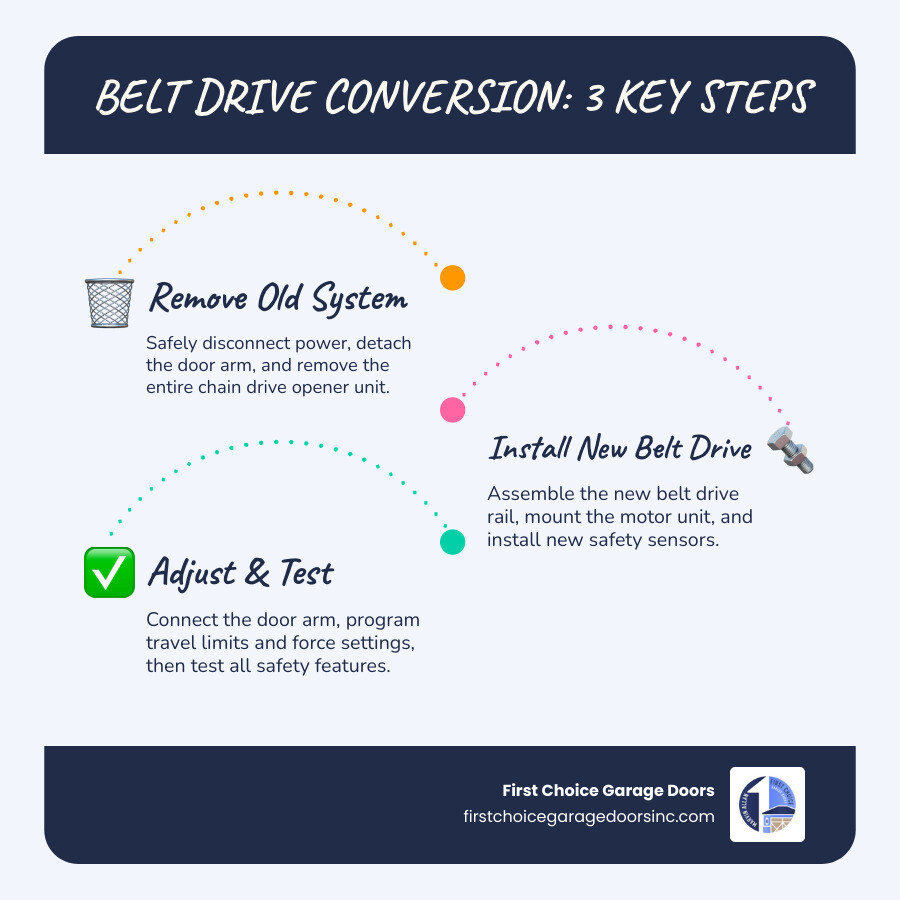
Is this a feasible DIY project, or should you call in the pros? Many homeowners with a good grasp of basic tools and some mechanical aptitude can successfully install a new garage door opener. However, it’s crucial to understand that garage door systems involve heavy components, electrical wiring, and high-tension springs (though the opener itself doesn’t directly interact with these springs, they are part of the overall door system). Improper installation can lead to serious injury or damage to your home.
For those who are less confident or prefer peace of mind, professional installation is always a wise choice. The expert technicians at First Choice Garage Doors are well-versed in garage door opener installations and can ensure your new belt drive system is installed correctly and safely, often in a shorter timeframe than a DIY attempt. Professional installation can typically be completed in 2 to 4 hours, whereas a DIY conversion can take anywhere from 3 to 6 hours, depending on your experience.
Regardless of whether you choose DIY or professional, safety must always be your top priority.
Important Compatibility and Safety Checks
When starting on converting chain drive garage door opener to belt drive, it’s not just about the installation steps; it’s also about ensuring compatibility and maintaining rigorous safety standards.
Key Compatibility Factors to Consider
While most new belt drive openers are designed for standard residential garage doors, a few factors require attention:
- Door Height: Most standard garage door openers are designed for 7-foot tall doors. If your garage door is 8 feet or taller, you will likely need an extension kit for the rail assembly. This is a common requirement, so be sure to check your door’s height and purchase the appropriate kit if necessary.
- Door Weight: Modern openers are powerful, but it’s important that your garage door itself is balanced and moves freely. The opener’s motor strength (horsepower, e.g., 1/2 HP, 3/4 HP) should be adequate for your door’s weight and dimensions. A heavier or oversized door might require a more powerful opener.
- Existing Brackets: As discussed, while you might reuse some existing mounting points for the header bracket or ceiling supports, it’s generally recommended to use all new hardware provided with your belt drive opener kit. Old brackets might not align perfectly or be designed for the new unit’s weight or mounting points. Discussion threads from homeowners often highlight that none of the old parts will match up, reinforcing the need for a complete kit.
- Rail Length: The rail that comes with your new belt drive opener is specifically designed for that unit and its belt. You cannot reuse your old chain drive rail. Ensure the new rail’s length matches your door’s height, using an extension kit if needed.
Critical Safety Precautions for Converting Chain Drive Garage Door Opener to Belt Drive
Safety is not just a suggestion; it’s a requirement. Garage doors are the largest moving objects in most homes, and they can exert deadly force.
- Electrical Safety: Always, always disconnect power at the circuit breaker before touching any electrical components or working on the opener. Never work on the opener while it’s plugged in.
- Spring Tension Warning: Garage door springs are under extreme tension and can cause severe injury if mishandled. Never attempt to adjust, repair, or remove garage door springs yourself. If you suspect an issue with your springs or your door is unbalanced, contact a trained door systems technician.
- Proper Sensor Placement: The safety reversing sensors are a critical safety feature. They must be installed correctly, no higher than 6 inches from the floor, and aligned so their beam is uninterrupted. Test them regularly.
- Secure Mounting: Ensure the opener motor unit and rail are securely fastened to structural supports in your garage ceiling and header. Loose mounting can lead to the opener falling, causing damage or injury.
- Following Manufacturer Instructions: Every opener model has specific installation, adjustment, and safety guidelines. Read your new belt drive opener’s manual thoroughly and follow all instructions to the letter. This includes proper belt tensioning (for example, some models specify about 1-1/4 inch of slack) and travel limit adjustments.
- No Watches, Rings, or Loose Clothing: These items can get caught in moving parts, leading to serious injury.
- Keep Clear: Never stand or walk under a moving garage door. Keep children and pets away from the door’s path during operation and installation.
Frequently Asked Questions about Garage Door Opener Conversion
We often get questions from homeowners considering converting chain drive garage door opener to belt drive. Here are some of the most common ones we hear:
Can I just replace the chain with a belt on my existing opener?
No, unfortunately, it’s not that simple. This is one of the biggest misconceptions about converting chain drive garage door opener to belt drive. You cannot simply swap the chain for a belt on your existing chain drive opener. The internal mechanisms, such as the sprockets and drive gears, are designed specifically for either a chain or a belt. The rails themselves are also different. Attempting to retrofit a belt onto a chain drive system would require extensive modifications that are not only impractical but also unsafe and could void your warranty.
When you’re “converting,” you’re actually replacing the entire chain drive opener unit with a new, complete belt drive opener system. This new system comes with its own motor head, rail, belt, and hardware, all designed to work together seamlessly for optimal performance and safety. As one user on a forum aptly put it, “It is not possible to simply replace the chain with a belt. The entire unit is different.”
Can I reuse the existing wiring and safety sensors?
In most cases, you can reuse the existing electrical wiring that powers the opener unit, assuming it’s up to code and in good condition. However, it’s always a good idea to inspect the wiring for any signs of damage or wear and replace it if necessary.
Regarding safety sensors and wall controls, it’s highly recommended to use the new ones that come with your belt drive opener kit.
- Safety Sensors: While your old sensors might physically fit, they may not be compatible with the new opener’s electronic system or meet current safety standards. Newer openers often have more advanced safety features that rely on their specific sensors. Always install the new safety sensors provided with your belt drive opener and ensure they are properly aligned and tested.
- Wall Control: Similarly, the new wall control included with your belt drive opener is designed to work with its specific features and programming. Reusing an old one might limit functionality or cause compatibility issues.
When in doubt, always default to using the new components provided by the manufacturer to ensure full compatibility, optimal performance, and adherence to all safety regulations.
How long does a typical garage door opener conversion take?
The time it takes to complete a converting chain drive garage door opener to belt drive project can vary depending on your experience level and whether you choose to DIY or hire a professional.
- DIY Conversion: For a homeowner with some mechanical and electrical experience, the process typically takes anywhere from 3 to 6 hours. This includes disassembling the old unit, assembling the new rail, installing the new opener, wiring, and crucially, performing all the necessary adjustments and safety tests. Unexpected issues, like needing an extension kit for a taller door or dealing with unexpected structural challenges, can add to this time.
- Professional Installation: Our experienced technicians at First Choice Garage Doors can usually complete the installation of a new belt drive opener in 2 to 4 hours. This efficiency comes from their specialized tools, extensive experience, and familiarity with various models and installation scenarios. Hiring a professional also ensures that all safety standards are met and the opener is properly calibrated for long-term, reliable operation.
Enjoy a Quieter, Smoother Garage Door Experience
Converting chain drive garage door opener to belt drive is an investment in your home’s comfort and convenience. The difference in noise level alone can be transformative, especially for attached garages or homes with living spaces above. Beyond the quiet operation, you’ll benefit from smoother movement, reduced maintenance, and often, a suite of modern features like smartphone control and battery backup that improve your daily life.
We understand the importance of a reliable and quiet garage door system, which is why we’re dedicated to providing expert garage door repair, maintenance, installation, and accessories across Maryland, Delaware, Northern VA, and SE PA. Our best expertise, prioritizing quality and safety, ensures you receive prompt, professional service every time.
Ready to experience the peace and quiet of a belt drive opener? Whether you’re considering a DIY project or seeking professional assistance, understanding the process is the first step. For more information on enhancing your garage door system, including various accessories that can complement your new belt drive opener, explore our garage door accessories.