
Your Garage Door Can Last 30 Years — But Only If You Do This
How to extend the life of your garage door starts with one surprisingly simple commitment: consistent, proactive maintenance.
Here’s a quick answer if you’re in a hurry:
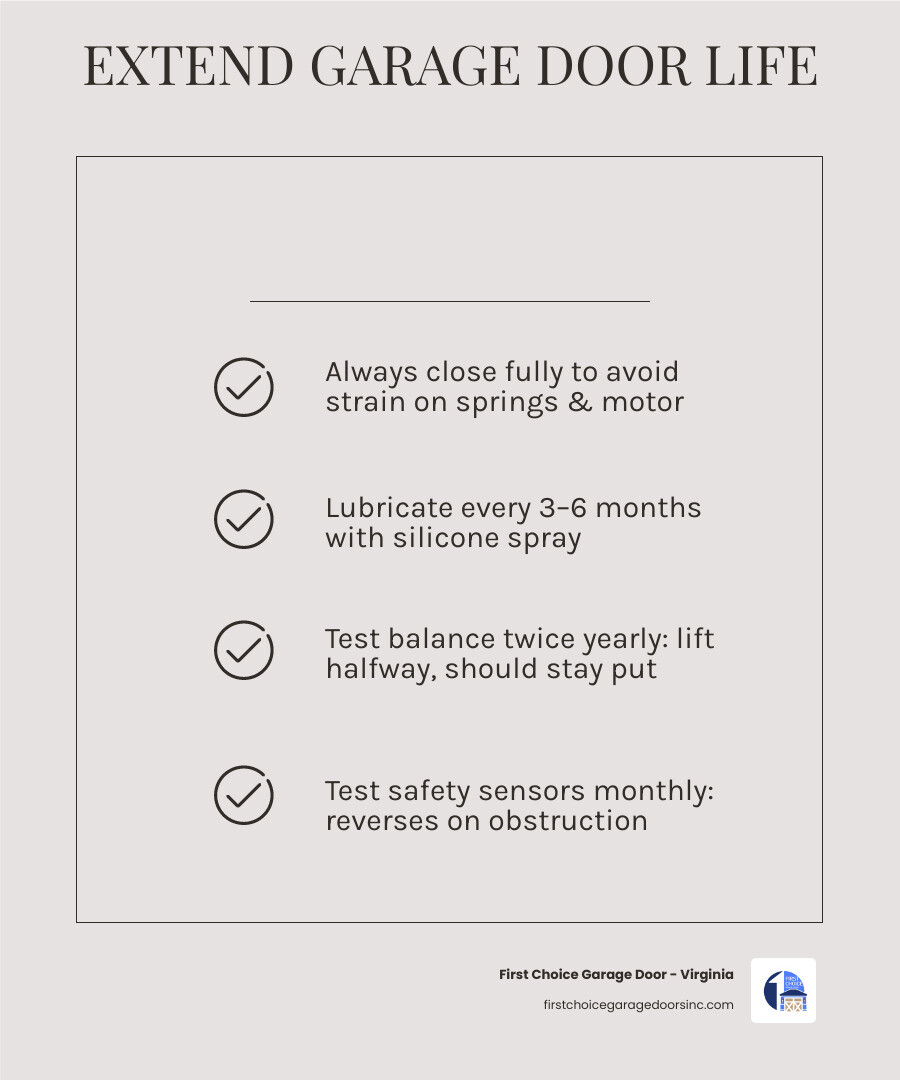
Top ways to extend your garage door’s lifespan:
- Always close it fully — partial closure strains springs, cables, and the motor
- Lubricate moving parts every 3–6 months — use silicone spray or white lithium grease
- Test the balance twice a year — disconnect the opener and lift the door halfway; it should stay put
- Test safety sensors monthly — place an object under the door and confirm it reverses
- Clean tracks and tighten hardware regularly — vibration from daily use loosens bolts over time
- Replace weatherstripping when worn — it can affect garage temperature by 20°F or more
- Schedule a professional tune-up once a year — 68% of failures are preventable with yearly service
Your garage door is the largest moving part of your home. It opens and closes roughly 1,500 times a year — and with that kind of workload, small problems compound fast.
The good news? A well-maintained garage door can last up to 30 years. Ignore it, and you’re looking at avoidable repairs and a much shorter lifespan.
For homeowners and property managers in Northern Virginia, understanding what keeps a garage door running smoothly isn’t just about convenience — it’s about safety, security, and protecting your investment.
The One Simple Trick: Why Full Closure Matters
If we had to pick the single most overlooked habit that destroys garage doors, it’s leaving the door partially open. We see it all the time in Manassas and throughout Northern Virginia: a homeowner leaves the door cracked a foot or two to “let the garage air out” or to let a pet slip in and out.
While it seems harmless, this is a mechanical nightmare. When a garage door is fully closed and resting on the ground, it is in its least stressful position. The weight is supported by the floor, and the tension in the springs is at its designated “resting” state for a closed door.
When you leave it partially open, you are forcing the springs, cables, and motor to hold a heavy weight (anywhere from 130 to 400 pounds) in a state of constant suspension. Think of it like a weightlifter holding a barbell halfway up instead of setting it down; eventually, the muscles—or in this case, the steel components—will fatigue and snap. This constant strain accelerates metal fatigue in your springs and places unnecessary wear on the opener’s internal gears.
Beyond the mechanical toll, a partially open door is a security risk. A small gap is often all a determined intruder needs to reach the manual release cord. Plus, Northern Virginia wildlife like squirrels, birds, and even skunks view that gap as a formal invitation to nest in your storage bins. To keep your system healthy and your home secure, always ensure the door completes its full cycle. For more details on avoiding these pitfalls, check out our guide on How to Prevent Garage Door Damage.
Essential Maintenance: Cleaning and Hardware Care
In April 2026, as we head into the busier spring season, it’s the perfect time to give your door a thorough cleaning. It sounds simple, but dirt is a silent killer of mechanical parts.
Your garage door is a victim of “vibration loosening.” Because it moves 1,500 times a year, the nuts and bolts that hold the tracks and roller brackets together will inevitably wiggle loose. We recommend a “wrench test” every six months. Take a socket wrench and gently ensure all hardware is snug. Don’t over-tighten, but make sure there’s no “play” in the brackets.
Cleaning the tracks is equally vital. Use a damp cloth to wipe out the interior of the vertical and horizontal rails. Expert Tip: Never use grease or heavy oil inside the tracks. While it seems like it would help things slide, grease actually acts as a magnet for dust and hair, creating a sticky “grime” that can eventually cause the rollers to slide rather than roll, leading to flat spots. If the tracks are particularly dirty, a shot of brake cleaner or a mild detergent can help break up the gunk. For a deeper dive into these routine tasks, see our article on Keeping Up With Garage Door Maintenance.
How to extend the life of your garage door through proper lubrication
Lubrication is the “oil change” of the garage door world. Neglecting this simple task is the leading cause of major repair bills that could have been avoided.
You should aim to lubricate all moving metal parts every 3 to 6 months. However, the type of lubricant matters immensely. Do not reach for the standard blue-and-yellow can of WD-40; that is a degreaser and rust preventative, not a long-term lubricant. Instead, use a silicone-based spray or white lithium grease. These products stay “wet” longer and won’t thicken up when the Northern Virginia winter hits.
What to lubricate:
- Rollers: Spray the bearings (the center part of the wheel). If you have nylon rollers without bearings, don’t lubricate the wheel itself.
- Hinges: Apply a small amount to the pivot points where the door sections bend.
- Springs: A light coat of lubricant on the entire length of the torsion spring helps reduce friction between the coils as they expand and contract. This can significantly dampen that “clanging” noise.
- Bearing Plates: These are located on both ends of the spring bar.
Wipe off any excess to prevent drips on your car or the floor. Consistent lubrication can literally double the life of your rollers and hinges. You can find more specific tips in our post on Lubrication and Adjustments for a Happier Annapolis Garage.
How to Extend the Life of Your Garage Door with Safety Testing
Safety and longevity go hand-in-hand. A door that is hitting the floor too hard or failing to reverse when it hits an obstruction is a door that is damaging itself. We recommend testing your safety features monthly.
First, check the photo-eye sensors. These are the small “eyes” located about six inches off the ground on either side of the track. If they are misaligned, your door won’t close. Wipe the lenses with a soft cloth to remove cobwebs or dust. If the indicator lights are flickering, gently nudge the brackets until the lights stay solid.
Next, perform the auto-reverse test. Place a solid object, like a roll of paper towels or a 2×4 piece of wood, flat on the ground in the door’s path. Close the door. When it touches the object, it should immediately reverse and go back up. If it tries to crush the object, your “down limit” or “force” settings are off, which puts massive strain on the motor and the door panels.
Finally, check the manual release cord (the red handle). Pull it to ensure you can manually operate the door in case of a power outage. This ensures the disconnect mechanism isn’t seized up from disuse. Regular checks like these are why we emphasize Why You Need to Perform Garage Door Inspections.
How to extend the life of your garage door with regular balance testing
An imbalanced door is the #1 reason garage door openers fail prematurely. The motor is designed to push and pull the door, not to lift its full weight. That’s what the springs are for.
To test the balance:
- Close the door and pull the red emergency release cord to disconnect the opener.
- Manually lift the door halfway up and let go.
- The Result: A perfectly balanced door should stay suspended in place or move only a few inches.
If the door slams shut or shoots upward, your springs are out of adjustment. This means every time you use the door, your motor is working twice as hard as it should, which will lead to a burnt-out motor long before its 10-year expected lifespan. Warning: Never attempt to adjust torsion springs yourself. They are under extreme tension and can cause severe injury. If your door fails the balance test, it’s time to call in the pros. For more on this, read our Garage Door Maintenance Tips to Ensure a Long-Lasting Door.
Seasonal Protection and Component Upgrades
Living in Northern Virginia means dealing with humid summers and freezing winters. This climate can be tough on door materials, especially wood and thin steel.
One of the most cost-effective ways to extend the life of the entire system is to maintain the weatherstripping. The rubber seal at the bottom of the door and the vinyl trim around the sides do more than just stop drafts; they prevent moisture from rotting wood panels or rusting steel ones. Did you know that good weatherstripping can change your garage’s internal temperature by 20 degrees? This protects the electronics in your opener and prevents the metal parts from expanding and contracting too violently. Check out these Weatherproofing Tips That Can Help Keep Your Garage Door Insulated.
If you have an older door, consider a small upgrade to high-quality rollers. Most builder-grade doors come with basic plastic rollers that only last 2–3 years before they start to wobble and stick. Upgrading to nylon rollers with sealed ball bearings can make your door whisper-quiet and last for over a decade.
| Feature | Basic Plastic Rollers | High-Quality Nylon Rollers |
|---|---|---|
| Lifespan | 2–3 Years | 10–15+ Years |
| Noise Level | High (Grinding/Squeaking) | Very Low (Whisper Quiet) |
| Maintenance | Frequent replacement | Minimal (Sealed Bearings) |
| Impact on Door | Can cause track wear | Smooth movement reduces vibration |
Frequently Asked Questions about Garage Door Longevity
What is the typical lifespan of a garage door and motor?
With proper care, a high-quality garage door can last 30 years. The automatic opener (the motor) typically has a lifespan of 10 to 15 years. Factors that influence this include how often you use it (the average is 1,500 cycles a year), the quality of the installation, and whether you live in a high-humidity area like Virginia, which can accelerate rust if the door isn’t cleaned.
How often should I perform garage door maintenance?
We recommend a “seasonal” approach. Perform a visual inspection and safety test monthly. Every 3 to 6 months, you should lubricate the moving parts and check the door’s balance. Finally, we strongly suggest an annual professional tune-up. Statistics show that 68% of garage door failures could be avoided with a yearly service visit from a technician who can spot frayed cables or spring fatigue before they break.
What are the signs that my springs or cables need professional replacement?
Springs and cables are the “muscles” of your door, and they usually last about 10,000 cycles (7–10 years for most families). Watch for these red flags:
- Frayed Cables: If the steel cables look “fuzzy” or have loose strands, they are about to snap.
- Visible Gaps: If you have a torsion spring (above the door) and see a 2-inch gap in the coils, the spring is already broken.
- Loud Noises: A loud “bang” from the garage is often the sound of a spring breaking.
- Uneven Lifting: If the door looks crooked as it moves, one cable may be slipping or a spring may be failing. Never attempt to fix these yourself; the tension involved is enough to be life-threatening.
Conclusion
How to extend the life of your garage door isn’t about expensive overhauls; it’s about the small, consistent habits we’ve discussed. From ensuring the door is always fully closed to spending ten minutes with a can of silicone spray twice a year, these actions save you from significant expenses over the life of your home.
At First Choice Garage Doors, we’ve seen how a little preventative care goes a long way. Whether you’re in Manassas or anywhere in Northern Virginia, our team is dedicated to ensuring your garage door remains a safe, reliable, and long-lasting part of your home. If your door is making strange noises, feels heavy, or you just realized it hasn’t been serviced in years, don’t wait for a breakdown.
If you’re worried about the state of your current system, read more about the Concerns with having an older garage door. Contact us today or fill out our online form to schedule an annual tune-up. Let’s make sure your garage door lasts for decades to come!