
Why Choosing the Right Garage Door Material for Your Home Matters More Than You Think
Choosing the right garage door material for your home is one of the most important decisions you’ll make about your property’s exterior — and one of the most overlooked.
Here’s the quick answer most homeowners need:
| Material | Best For | Maintenance Level |
|---|---|---|
| Steel | Most homes; cold climates; security | Low |
| Wood | High-end curb appeal; custom looks | High |
| Aluminum | Coastal areas; modern designs; large doors | Low |
| Vinyl | Families with kids; humid climates | Very Low |
| Fiberglass | Coastal or damp environments | Low |
| Composite (Faux Wood) | Wood look without the upkeep | Low |
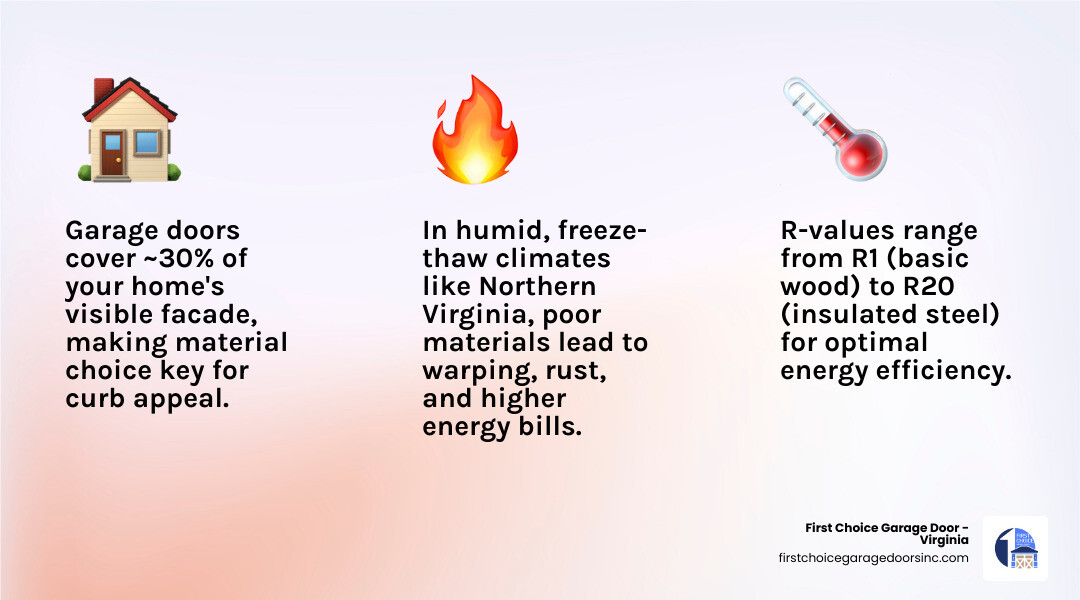
Your garage door covers roughly 30% of your home’s visible facade. That’s not a small detail — it’s one of the first things anyone sees.
Beyond looks, the material you choose affects:
- Energy efficiency (R-values range from R1 for basic wood up to R20 for insulated steel)
- Security and impact resistance
- How much time and money you’ll spend on upkeep
- How well the door holds up in your local climate
In Northern Virginia, where summers are humid, winters bring freeze-thaw cycles, and homes range from classic colonials to modern builds, material choice matters even more. The wrong pick can mean warped panels, rust, or rising energy bills within just a few years.
This guide breaks down every major material — what it’s good at, where it falls short, and which homeowners it’s best suited for.
Comparing Common Options for Choosing the Right Garage Door Material for Your Home
When we talk about some of the more common garage door materials, we aren’t just looking at what looks pretty in a brochure. We are looking at the backbone of your home’s daily operation. Every material has a “personality.” Some are low-maintenance workhorses, while others are high-fashion divas that require a bit more pampering.

Finding the right fit involves steel vs wood vs vinyl: finding the best material for your budget. While some homeowners prioritize the initial purchase price, others focus on the long-term ROI and energy savings.
Steel: The Versatile Standard
Steel is the undisputed heavyweight champion of the garage door world. It is the most common material used in residential manufacturing today, and for good reason. It offers a balance of strength, security, and versatility that is hard to beat.
When shopping for steel, you’ll hear us talk about “gauge.” In metal, a lower number means thicker steel. We typically recommend 24-gauge steel as the standard for long-lasting durability. It’s thick enough to resist most “oops” moments with the lawnmower or a stray basketball. Most modern steel doors are hot-dipped galvanized and finished with a baked-on polyester coating, providing excellent rust resistance.
There are plenty of reasons why to use a steel garage door. They can be painted any color, embossed with wood-grain textures, and heavily insulated to keep your Manassas garage comfortable year-round. If you’re wondering why get a steel garage door, the answer usually comes down to its incredible reliability and the fact that it’s generally the most affordable option for the level of protection it provides.
Natural Wood: The Aesthetic Premium
There is simply no substitute for the warmth and character of real timber. Whether it’s Western Red Cedar, Mahogany, or Fir, a natural wood door screams luxury and architectural authenticity. If you own a historic home in Northern Virginia, wood might be the only material that truly honors the building’s soul.
However, beauty comes with a “to-do” list. There are significant wood garage door pros and cons. On the plus side, wood has natural insulating properties and unmatched curb appeal. On the downside, it is heavy and sensitive to moisture. To prevent warping, rotting, or insect damage, wood doors require regular maintenance, including sanding and restaining every few years.
If you are prepared for the upkeep, there are many reasons to get a wood garage door, primarily the massive boost to your home’s resale value and the ability to have a door custom-built to your exact specifications.
Aluminum and Glass: The Modern Choice
If your home leans toward a contemporary or industrial aesthetic, aluminum and glass doors are the way to go. These doors are the “talk of the neighborhood” because they look like something out of a high-end design magazine.
One of the biggest perks of aluminum is its natural corrosion resistance. Unlike steel, aluminum does not contain iron, so it won’t rust. This makes it a great candidate for humid environments. It’s also incredibly lightweight, which puts less strain on your garage door opener and hardware.
When choosing between steel and aluminum garage doors, consider your privacy and insulation needs. Aluminum is a poor natural insulator, though modern versions feature thermal breaks in the frame. If you’re asking yourself, “Should I install a steel or aluminum garage door?” consider the size of the opening. For oversized doors, aluminum’s light weight makes it the superior choice for mechanical longevity.
Specialized Materials for Durability and Low Maintenance
Sometimes, the standard options don’t quite fit your lifestyle. Maybe you have three kids who treat the driveway like a hockey rink, or maybe you’re tired of painting things. That’s where specialized garage door materials to consider when replacing your door come into play.
Vinyl and Fiberglass Performance
Vinyl is the “indestructible” option. It is highly resilient and specifically designed to handle impacts. If you have active children, vinyl is a dream because it resists dings and scratches that would leave a permanent mark on a steel door. There are many reasons a vinyl garage door is a good investment, including the fact that it’s virtually maintenance-free — just a quick hose-down with soap and water keeps it looking new.
Fiberglass is another high-performance contender. It’s often used in coastal or damp environments because it won’t rot, warp, or corrode. It’s usually constructed with a steel core for strength and a fiberglass “skin” that can be molded to look exactly like wood. When weighing the benefits and drawbacks of a vinyl garage door or fiberglass, while they are tough, they can become brittle in extreme, sub-zero cold, though they perform beautifully in the typical Northern Virginia climate.
Composite Faux Wood Benefits
If you love the look of wood but hate the idea of spending your Saturday with a paintbrush, composite (or faux wood) is your best friend. These doors typically use a moisture-resistant overlay made from recycled wood fibers and resins, bonded to an insulated steel base.
When you see how vinyl garage doors compare with other garage doors, composite often sits at the top for those wanting “the best of both worlds.” You get the realistic texture and deep grain of real wood with the strength and thermal efficiency of steel. It won’t rot, it won’t crack, and it won’t invite termites to dinner.
Environmental Factors and Climate Suitability
In Northern Virginia, our garage doors have to be tough. We deal with sweltering, humid summers and winters that can bounce between freezing rain and snow. This constant “weather seesaw” is a major factor in selecting the best garage door material for where you live.
How Climate Influences Choosing the Right Garage Door Material for Your Home
Freeze-thaw cycles are the enemy of many building materials. When moisture gets into small cracks and freezes, it expands, causing materials like cheap wood to warp or split. This is why thermal efficiency is so critical. A door that resists temperature-related expansion and contraction will last years longer.
When picking your portal: a guide to garage door materials, we always look at how the material handles humidity. In our region, high humidity can lead to rust on untreated steel or rot on unsealed wood. Insulated steel or high-quality composites are usually the “goldilocks” choices for Virginia homeowners — they handle the heat, the cold, and the dampness without breaking a sweat.
Coastal and High-Humidity Solutions
Even if you aren’t right on the ocean, salt-air and high moisture levels can migrate inland. Aluminum is a standout here because it naturally forms an oxide layer that protects it from corrosion. Fiberglass is another “salt-proof” option that won’t corrode like metal.
When comparing vinyl garage doors with steel garage doors for humid areas, vinyl often wins on durability because it is completely waterproof. It doesn’t have a finish that can peel or a metal core that can rust if the surface gets scratched.
Key Performance Factors Beyond Aesthetics
A garage door is a mechanical system, not just a wall. You have to think about how it works, not just how it looks. This is why not to install garage doors made from cheap materials — a thin, flimsy door will be noisy, shaky, and a drain on your energy bill.
Insulation and Energy Efficiency
If your garage is attached to your home, it’s essentially a giant “fourth wall.” If that wall isn’t insulated, your HVAC system has to work twice as hard to keep the rooms above or next to the garage comfortable.
There are two main types of insulation:
- Polystyrene: Similar to the material in a cooler. It’s effective and affordable.
- Polyurethane: This is a foam that is injected into the door, expanding to fill every nook and cranny. It provides the highest R-values (up to 18.4 or higher) and makes the door incredibly rigid and quiet.
Another reason to why install a steel garage door is the ability to get these high-performance insulation packages. Look for doors with “thermal breaks” — these are separators that prevent heat or cold from traveling from the outside metal skin to the inside metal skin.
Final Steps in Choosing the Right Garage Door Material for Your Home
Before you pull the trigger on a new door, consider the weight. A solid mahogany door can weigh several hundred pounds more than an aluminum one. You need to ensure your garage door opener and springs are rated for that weight.
When comparing steel vs wood garage door installation, heavier doors might require more robust tracks and higher-tension springs. Security is another factor; steel and thick vinyl offer excellent resistance against forced entry, keeping your home and family safe.
Frequently Asked Questions
What is the most durable garage door material for families?
For families with active kids and pets, vinyl is usually the winner. Its ability to “bounce back” from impacts without denting is a lifesaver. If you prefer a metal look, a thick 24-gauge steel door with a wood-grain texture is also very resilient and hides minor scratches well.
Which material is best for cold Northern Virginia winters?
Insulated steel is the top choice. It offers the best thermal efficiency (highest R-values) and won’t warp or crack during the freeze-thaw cycles we experience in Manassas and the surrounding areas. Make sure to pair it with high-quality weather-stripping and a bottom seal to keep the drafts out.
Does wood require more maintenance than other materials?
Yes. To keep a wood door from warping or rotting, it needs to be sealed on all six sides of every section. You should plan on inspecting the finish annually and restaining or painting it every 2 to 5 years, depending on how much direct sunlight and rain it receives.
Conclusion
Choosing the right garage door material for your home doesn’t have to be a headache. Whether you’re looking for the low-maintenance reliability of steel, the modern flair of aluminum, or the timeless beauty of natural wood, the key is matching the material to your lifestyle and the Virginia climate.
At First Choice Garage Doors, we bring unmatched expertise and a commitment to safety to every project. We don’t just hang doors; we ensure your home is secure, energy-efficient, and looking its absolute best. From professional installation to long-term maintenance, we are here to make the process stress-free.
Ready to upgrade your home’s curb appeal? Request a consultation for residential garage doors today and let us help you find the perfect portal for your home!