
Do You Need a Permit to Replace Your Garage Door in Maryland? Here’s the Quick Answer
Do I need a permit to replace my garage door in Maryland depends mainly on one thing: whether you’re changing the size of the opening or just swapping the door itself.
Quick Answer by Project Type:
| Project Type | Permit Required? |
|---|---|
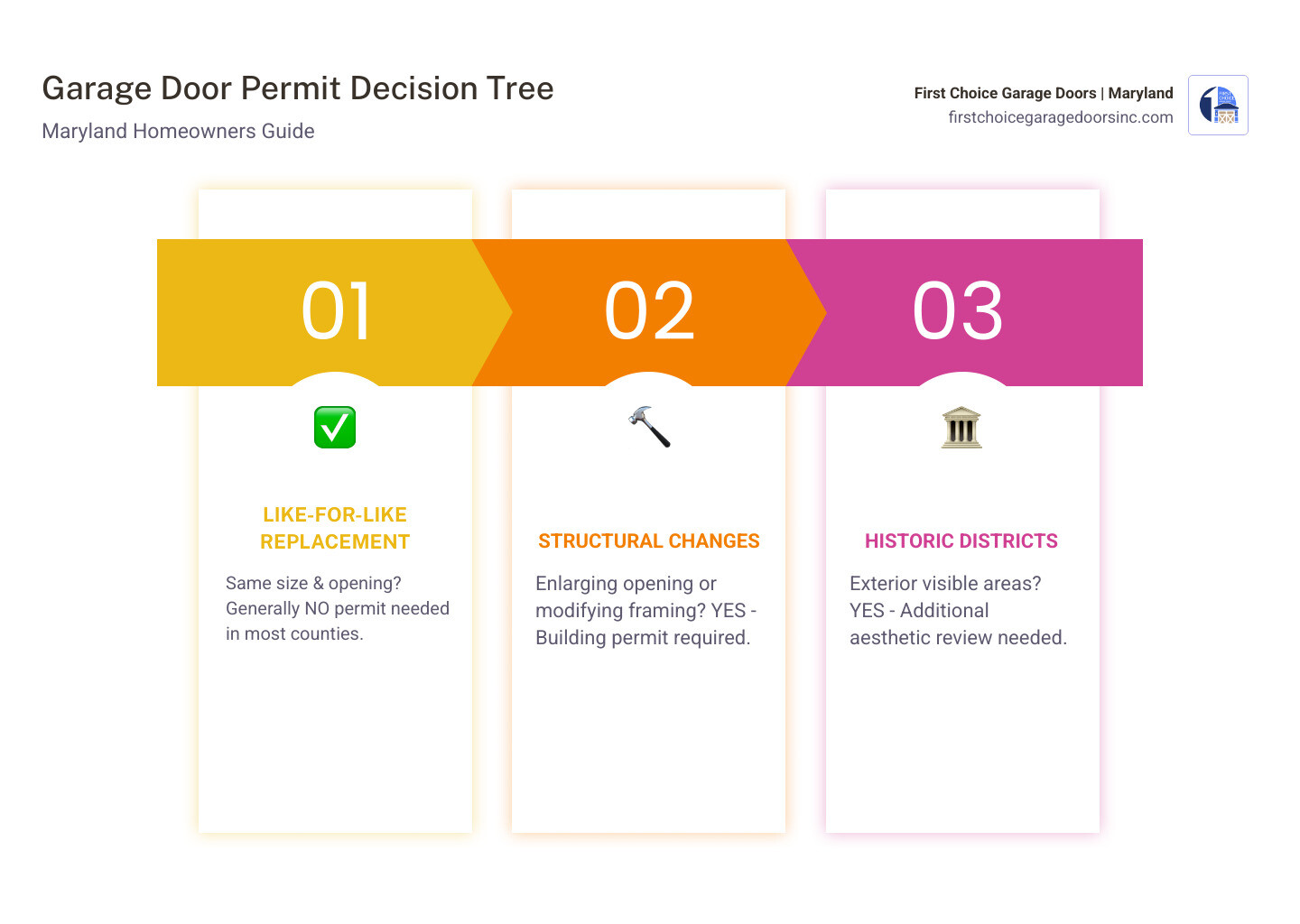
| Same-size garage door replacement (no structural changes) | Generally No in most Maryland counties |
| Enlarging or modifying the garage door opening | Yes – Building permit required |
| Replacing door in a historic district | Yes – Additional review required |
| Installing a new automatic opener with a new dedicated circuit | Yes – Electrical permit required |
| Like-for-like replacement in Prince George’s County | No – Explicitly exempt |
| Any exterior change in Baltimore County historic/landmark zones | Yes – Permit required regardless of scope |
So if you’re doing a straight swap — same size, same opening, no structural work — you can likely skip the permit in most Central Maryland jurisdictions. But the moment you touch the framing, widen the opening, or add new electrical, the rules change fast.
Maryland is not a one-size-fits-all state when it comes to building permits. Rules vary county by county, and some areas — like historic districts in Baltimore — have strict requirements that catch homeowners off guard. Getting this wrong can mean fines, stop-work orders, or problems when you sell your home.
This guide breaks down exactly what’s required across Central Maryland so you can move forward with confidence.
Do I Need a Permit to Replace My Garage Door in Maryland?
When we talk about whether you need a permit to replace your garage door in Maryland, we are looking at the “Like-for-Like” rule. In most jurisdictions, if you are removing a 16×7 steel door and replacing it with a new 16×7 steel door, it is considered a repair or maintenance task rather than a major structural alteration.
However, Maryland adheres to the Maryland Building Performance Standards, which are currently based on the International Residential Code (IRC). These standards dictate how structures must be maintained for safety. Even if a permit isn’t required for the paperwork, the installation must still meet code. For example, if you live in a coastal area near the Chesapeake Bay, your new door might need to meet specific wind-load ratings to ensure it doesn’t blow in during a storm.
The threshold for a building permit usually triggers when you perform “structural alterations.” This includes:
- Cutting into the wall to make the door wider or taller.
- Replacing the header (the heavy beam above the door that supports the weight of the wall).
- Changing the “net clear opening” dimensions, which can affect emergency access.
If your project involves these changes, you can explore our locations in Columbia, MD for garage door replacement to see how our experts handle the heavy lifting and code compliance for you.
| Feature | Exact Replacement | Structural Modification |
|---|---|---|
| Permit Required | Generally No | Yes |
| Plans Required | No | Yes (Header/Framing details) |
| Inspection Required | No | Yes (Framing & Final) |
| IRC 2021 Compliance | Yes | Yes |
Understanding Jurisdictional Rules Across Central Maryland
Maryland is a “Home Rule” state, meaning each county and many cities have their own specific departments of permitting and inspections. What flies in Frederick might be a “no-go” in Annapolis without a stack of paperwork.
In Baltimore City, the Department of Housing and Community Development (DHCD) oversees permits. While they generally allow same-size replacements without a permit, any project that involves enlarging an opening will require a permit and usually takes about two weeks for approval.
In Anne Arundel County, the rules distinguish between attached and detached garages. A structure is legally considered “attached” if it is within 3 feet of your house. If you are modifying an attached garage, it falls under a Single Family Dwelling Permit. If it’s detached, it’s a Residential Accessory Structure permit.
For those in Howard County, our garage door company in Columbia, MD stays up to date with local Land Use and Zoning regulations to ensure your project doesn’t hit a snag.
Why Prince George’s County rules differ
In Prince George’s County, the Department of Permitting, Inspections, and Enforcement (DPIE) provides very clear guidance. They use a symbol system where “N” stands for “No Permit Required.” Currently, an exact exterior door replacement—including garage doors—is exempt from permits as long as no structural members (like that header we mentioned) are cut or removed.
If you are doing more than a simple swap, you’ll likely use the DPIE Momentum portal to submit your application. For residents near the county line, our guide for garage door installation services in Columbia offers more localized insights into how these rules intersect.
Historic district mandates
This is where many Maryland homeowners get into trouble. If your home is in a designated Historic District—such as parts of Annapolis, Frederick, or Baltimore—the “no permit” rule for same-size replacements often disappears.
In Baltimore County, if a property is on the Landmarks List or within a Historical District, a building permit is required for any work that affects the exterior appearance. This includes the style, color, and material of your garage door. The Commission on Historical and Architectural Preservation (CHAP) or local historic boards must often approve the design before you even order the door. For those in the state capital, check out our local guide for garage door installation in Annapolis to understand how to navigate these aesthetic requirements.
Technical Requirements and Safety Inspections
Even if the door itself doesn’t require a building permit, the components that make it move might.
Do I need a separate permit for a garage door opener?
The short answer is: it depends on your existing electrical setup. If we are simply plugging a new opener into an existing, dedicated outlet, you generally do not need a permit. However, if you are installing a motorized opener for the first time or need to run a new dedicated circuit from your breaker panel to the garage, Maryland law requires an electrical permit.
Electrical work in Maryland must be performed by a licensed electrician (or a homeowner on their primary residence, in some counties). This ensures that the wiring is sized correctly and that the opener is properly grounded. You can view our full range of garage door installation products and services to see the modern, energy-efficient openers we provide.
Documentation and Product Specifications
When a permit is required (like when enlarging the opening), the county will ask for specific documentation. This typically includes:
- Site Plans: A “bird’s-eye view” of your property showing where the garage sits in relation to property lines.
- Construction Drawings: Details on the new header size. Under IRC R602.7, headers must be sized specifically to the span of the opening to prevent the roof from sagging.
- Safety Glazing: If your new garage door has windows (lites) and those windows are near a walkway or within a certain distance of the floor, they may be required to have tempered glass (safety glazing) to prevent injury if broken.
- NFRC Labels: For final inspections in some jurisdictions, the inspector will look for the National Fenestration Rating Council labels to verify the door meets energy code requirements.
Understanding why professional garage door installation matters in Columbia becomes clear when you realize we handle these technical specifications for you, ensuring your home remains safe and compliant.
Consequences of Unpermitted Garage Door Work
It might be tempting to skip the permit process to save a few dollars or a week of time, but the risks in Maryland are substantial.
- Stop-Work Orders: If a county inspector sees a service truck and a half-installed door without a posted permit (where one is required), they can shut down the job immediately.
- Fines: In places like Baltimore City, fines for working without a permit can be double or even ten times the original permit fee.
- Resale Complications: This is the most common issue. When you go to sell your home in Easton or Frederick, the buyer’s home inspector or the title company may look for permits for major improvements. If they find unpermitted structural work, it can delay the sale or force you to pay for “after-the-fact” permits and potentially tear out work to show the inspector the framing.
- Insurance Denials: If a non-permitted door fails during a windstorm and causes damage to your home, your insurance company could potentially deny the claim because the installation was not “legal” or inspected.
Always ensure your contractor has a valid Maryland Home Improvement Commission (MHIC) license. This is your primary protection as a homeowner. You can find more about our credentials as a top garage door company in Annapolis to see how we prioritize legal and safe installations.
Frequently Asked Questions about Maryland Garage Door Permits
Who is responsible for obtaining the permit?
Legally, the property owner is responsible for ensuring a permit is obtained. However, most professional contractors—like us—will handle the application process for you as part of our service. If a contractor asks you to pull the permit, it can sometimes be a red flag that they aren’t properly licensed or insured in that specific jurisdiction. Always verify their MHIC license before signing a contract. Our Columbia garage door team handles the red tape so you don’t have to.
Do I need a separate permit for a garage door opener?
As mentioned earlier, if you are adding a new electrical circuit, yes. Most Maryland counties require a trade-specific electrical permit for this. If you are simply replacing an old motor with a new one using the existing outlet, a permit is typically not required. Check our Columbia installation services page for more details on opener upgrades.
Are safety inspections required after installation?
If a permit was issued, an inspection is mandatory. For a structural change, you might need a “framing inspection” (before the trim goes on) and a “final inspection.” The inspector will check the spring tension, the auto-reverse safety sensors, and the fire separation. In Maryland, if your garage is attached to the house, the wall between them must be fire-rated (usually 1/2-inch or 5/8-inch Type X drywall), and the door must be self-closing. While our Manassas guide covers Virginia specifics, many of these safety principles are identical across the Potomac.
Conclusion
Navigating Maryland building codes doesn’t have to be a headache. While the answer to “do i need a permit to replace my garage door in maryland” is often “no” for simple replacements, the exceptions for historic districts, structural changes, and electrical work are critical to follow.
At First Choice Garage Doors, we pride ourselves on being more than just installers; we are your local experts in safety and compliance. Whether you are in Easton, Frederick, or Columbia, we ensure your new garage door is beautiful, durable, and—most importantly—legal.
Don’t get shut out by local code violations or safety risks. Contact First Choice Garage Doors today for a professional consultation and let us handle your Maryland garage door installation with the expertise you deserve.