
Why Code Compliance Matters for Every Garage Door Installation in Fayetteville, NC
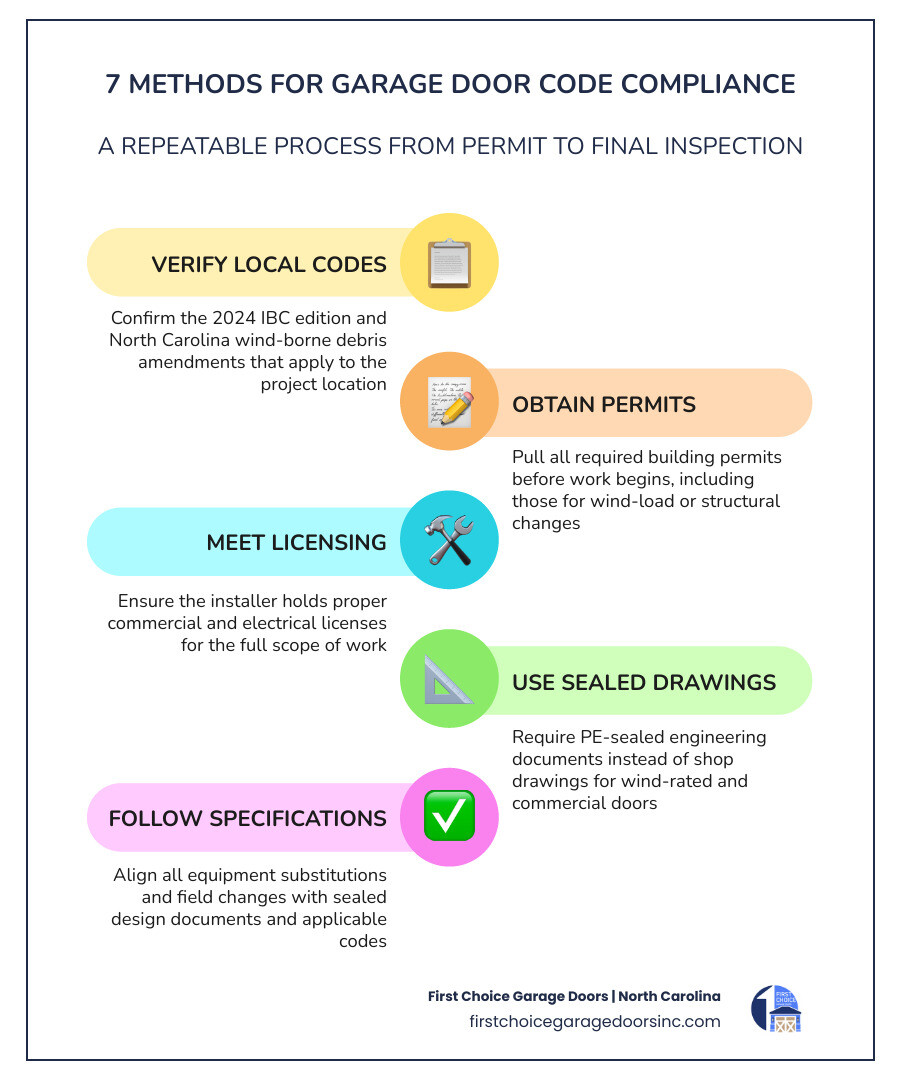
Understanding how a professional installer ensures code compliance comes down to a clear, repeatable process — and here’s the short version:
- Verify local codes and amendments — Confirm which edition of the International Building Code (IBC) and any North Carolina-specific amendments apply to the project location.
- Obtain required permits — Pull all necessary building permits before work begins, including those triggered by wind-load or structural requirements.
- Meet licensing and registration requirements — Confirm the installer holds the appropriate licenses for the scope of work, including commercial or electrical components.
- Use sealed engineering documents — Wind-rated and commercial installations require PE-sealed drawings; shop drawings alone are never a substitute.
- Follow manufacturer specifications — Equipment substitutions or field changes must align with the sealed design documents and applicable codes.
- Perform pre-inspection verification — Test all safety systems, including auto-reverse mechanisms and photo-eye sensors, before requesting final inspection.
- Maintain defensible records — Document every step, from permit approval to inspection sign-off, to protect the client and installer in the event of an audit or insurance claim.
A garage door weighs anywhere from 100 to 400 pounds and is one of the most frequently used moving components in a home. When installation shortcuts bypass local building codes or wind-load requirements, the consequences can range from failed inspections and insurance claim denials to genuine safety hazards for the people who use that door every day. The 2024 International Building Code and its associated standards exist precisely because past failures — including structural collapses and fire-safety lapses — demonstrated what happens when compliance is treated as optional.
In North Carolina, those stakes are especially real. Coastal and inland wind-borne debris regions impose specific structural requirements that go well beyond a standard installation checklist. Getting them right requires more than experience — it requires a disciplined, documented process.
I’m Tony Aguilar, founder of First Choice Garage Doors with over 30 years in the industry, and I’ve built our company’s reputation on understanding exactly how a professional installer ensures code compliance from the permit stage through final inspection. In the sections below, I’ll walk you through the seven methods we rely on to guarantee every installation meets — and where possible, exceeds — the applicable standards.
How a professional installer ensures code compliance glossary:
- I’m looking for quotes for a garage gate installation in Fayetteville, NC.
- do i need a permit to replace my garage door in north carolina
- garage door building codes for north carolina
How a Professional Installer Ensures Code Compliance Through Local Regulations

Building codes are not static; they are dynamic frameworks that evolve to protect communities from regional hazards like hurricanes, high winds, and fire. In places like Fayetteville, NC, as well as our other service areas in Maryland, Virginia, and Pennsylvania, local municipalities frequently adopt national model codes but append their own local amendments.
To navigate this regulatory landscape, we must coordinate with local building departments and the authority having jurisdiction (AHJ). A professional installer does not rely on guesswork or memory. We verify the exact code requirements for each municipality before ordering materials or scheduling labor. Navigating these rules is the first line of defense against costly project delays and safety hazards. To learn more about this process, read our guide on Permit or No Permit: Navigating North Carolina Garage Door Rules.
Verifying Code Editions and Local Amendments
The foundation of any regulatory compliance strategy starts with verifying which code editions are currently active. In May 2026, many jurisdictions rely on the 2024 International Building Code (IBC) and the International Residential Code (IRC) as their primary regulatory baselines. However, local amendments can drastically alter structural and wind-load calculations.
For instance, in North Carolina, the building code mandates specific wind-resistant designs depending on your exact distance from the coast. To ensure compliance, a professional installer:
- Consults the local building department to verify adopted code editions (such as the National Electrical Code or specific state building codes).
- Determines if the project falls within a wind-borne debris region, which requires impact-resistant glazing or structural reinforcement.
- Cross-references manufacturers’ wind-load ratings with the local design wind speed requirements.
For a comprehensive breakdown of these rules, check out our Ultimate Checklist for North Carolina Garage Door Building Codes.
Meeting Licensing and Registration Requirements
Performing structural or commercial installation work legally requires proper licensing and professional registration. In commercial and institutional buildings, the structural integrity of the wall-opening system is paramount. A professional installer must hold the correct classification of contractor license to pull permits and perform structural or electrical work.
For example, when installing a commercial overhead door with an integrated electric operator, the electrical hookup must conform to the National Electrical Code (NEC). A professional installer ensures that all electrical connections, grounding, and control wiring are handled by licensed professionals who understand the limits of their licensing scope. Operating outside of one’s licensed scope can result in severe penalties, including license suspension or hefty regulatory fines. To understand why these qualifications are non-negotiable, explore our article on Why a Garage Door Installation Should Be Done by a Pro.
Managing Technical Submissions, Engineering Seals, and Structural Interfaces
On commercial projects or in high-wind zones, the physical garage door is only one part of a larger structural system. The tracks, brackets, fasteners, and framing must all work together to transfer extreme wind loads directly to the building’s main windforce-resisting system. This structural interface requires careful coordination with architects, structural engineers, and other licensed design professionals.
Attempting to bypass this engineering phase is a recipe for disaster. Homeowners who try to tackle these complex systems on their own often make critical errors in track alignment, spring calibration, or fastener selection. Read more about these risks in our article on Mistakes That Can Happen During a DIY Garage Door Installation.
How a Professional Installer Ensures Code Compliance with Sealed Drawings
When a building code requires technical submissions to be sealed by a licensed Professional Engineer (PE) or architect, a professional installer knows that standard manufacturer brochures or simple shop drawings are not enough.
- Verifying PE Seals: We ensure that all technical submissions, including wind-load calculations and mounting details, bear the physical or digital seal, signature, and license expiration date of a currently registered design professional.
- Preventing Unauthorized Substitutions: Contractors or suppliers sometimes suggest equipment substitutions to save time. However, a professional installer never implements a substitution or field change that deviates from the sealed design documents without written authorization from the responsible design professional.
- Integrating Shop Drawings: Shop drawings are treated strictly as support documents. They must never replace the sealed technical submissions required by the AHJ.
How a Professional Installer Ensures Code Compliance During Construction Modifications
During the construction phase of a commercial project, changes are often inevitable. Whether due to structural conflicts, ductwork routing, or material shortages, modifications to the original design can occur.
To maintain strict compliance during these modifications, a professional installer follows a formal change-management protocol:
- Coordinate with Design Professionals: If a garage door track must be relocated or a mounting surface modified, we coordinate with the structural engineer of record.
- Submit Formal Addenda: Any modifications to the sealed design documents are submitted as formal addenda to the building department for review and approval before construction proceeds.
- Document Structural Interfaces: When our work interfaces with fire-protection, life-safety, or structural systems (such as fire-rated walls or emergency exit paths), we verify that the modifications do not compromise those systems’ ratings.
Verification, Inspection, and Due Diligence Protocols
Before we ever call a local building inspector for a final walkthrough, we perform our own exhaustive verification and testing protocols. This ensures that the installed work matches the approved plans perfectly and functions safely. For our clients in Maryland, we discuss these standards in detail in our article on Why Professional Garage Door Installation in Columbia MD Matters.
Our internal verification checklist includes:
- Visual Inspection: Confirming all horizontal and vertical tracks are perfectly plumb, level, and securely fastened to the structural framing using code-compliant fasteners.
- Balance Testing: Disengaging the electric operator and manually lifting the door halfway. A properly balanced door must remain in place; if it falls or shoots upward, the torsion springs require precise, professional adjustment.
- Safety Sensor Calibration: Verifying that the photo-eye safety sensors are mounted no higher than six inches above the garage floor and align perfectly to detect obstructions.
- Auto-Reverse Testing: Placing a 1-1/2-inch object (like a 2×4 block of wood) flat on the floor under the path of the door. When the door descends and strikes the object, it must automatically reverse within two seconds.
Documenting Code Violations and Maintaining Defensible Records
In the construction and home services industries, maintaining a paper trail is essential. If we discover an unsafe structural condition or an existing code violation during our initial site assessment—such as rotted wood framing or compromised fire-rated drywall—we document it immediately.
We provide a written report to the property owner and, if necessary, coordinate with the local AHJ to ensure the structural issues are resolved before we mount a new door. This level of due diligence creates defensible records that protect both the property owner and our company in the event of an insurance claim, municipal audit, or regulatory inquiry.
Furthermore, we keep a comprehensive compliance archive for every project, containing:
- Approved building permits and local compliance certificates.
- Sealed engineering drawings and manufacturer spec sheets.
- Signed pre-inspection and post-installation testing logs.
- Photographic evidence of completed safety testing (such as the auto-reverse test).
Frequently Asked Questions About Garage Door Code Compliance
Do I need a permit to replace my garage door in North Carolina?
Yes, in almost all jurisdictions across North Carolina, replacing a garage door requires a local building permit. Because garage doors represent a large opening in the building envelope, they are highly susceptible to wind pressures. The local building department must verify that the replacement door meets the specific wind-load and structural requirements of your zone to prevent structural failures during severe storms.
What happens if a garage door installation does not meet local codes?
If an installation fails to meet local codes, the consequences can be severe. The local building inspector can issue a stop-work order or deny a Certificate of Occupancy. Additionally, if a non-compliant door is damaged during a windstorm or causes property damage, your homeowners’ insurance company may deny the claim due to unpermitted or non-compliant work. Most importantly, bypassing safety codes (such as skipping the auto-reverse system) poses a direct physical threat to children, pets, and vehicles.
How do wind-load ratings affect garage door compliance in coastal regions?
In coastal and high-velocity hurricane zones, wind-load ratings are a critical safety requirement. When high winds hit a building, they exert massive positive (pushing) and negative (pulling) pressures on the garage door. If the door buckles or blows out, wind can enter the garage, pressurizing the interior of the home and potentially blowing the roof off the structure. To comply with these codes, wind-rated doors feature heavy-duty tracks, reinforced steel struts, and robust hardware designed to withstand specific wind speeds (often ranging from 115 to 150+ mph depending on the exact location).
Conclusion
At First Choice Garage Doors, we believe that code compliance is not a bureaucratic hurdle—it is a safety-first approach to protecting your home, business, and family. By adhering to a rigorous, seven-step compliance methodology, we ensure that every residential and commercial overhead door we install is fully permitted, structurally sound, and engineered to withstand local weather demands.
Whether you need a new wind-rated residential door in Fayetteville or a robust commercial system, our team of experienced professionals is here to help. For dependable service and expert installation you can trust, contact us today to schedule your professional Fayetteville NC Garage Door Installation and protect your property with confidence.