
Why Choosing the Right Commercial Door for Your Facility Matters More Than You Think
Choosing the right commercial door for your facility is one of the most practical decisions you’ll make as a property owner or facility manager — and it affects everything from daily security to energy bills to how smoothly your operation runs.
Here’s a quick breakdown of the key factors to evaluate:
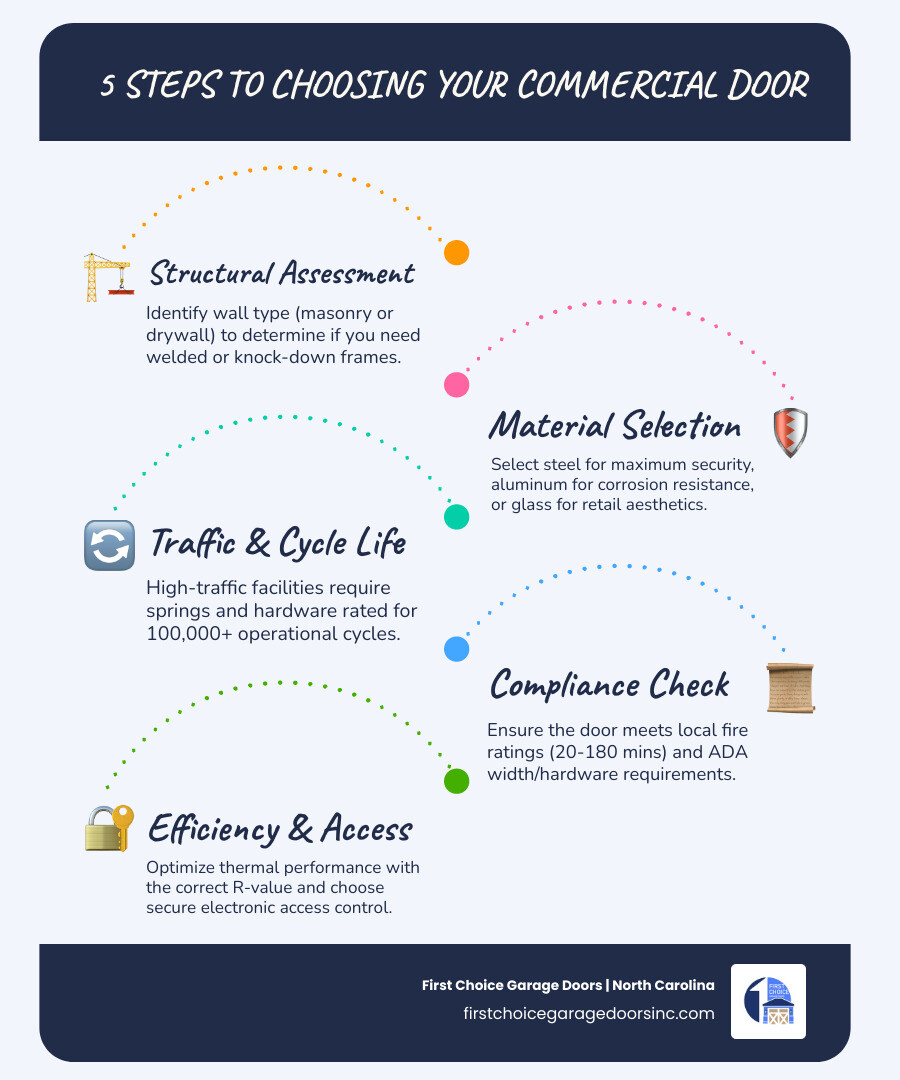
- Wall type – Masonry walls need welded frames; drywall openings use knock-down frames
- Door material – Steel for durability, aluminum for corrosion resistance, glass for aesthetics, wood for interior spaces
- Traffic volume – High-cycle environments need heavy-duty springs rated for 100,000+ cycles
- Fire rating – Required ratings range from 20 to 180 minutes depending on your building zone
- ADA compliance – Minimum 32-inch clear width, lever hardware, and correct vision lite heights
- Configuration – Sectional, rolling, or high-speed based on headroom and side clearance
- Insulation (R-value) – Match thermal performance to your climate and facility use
- Access control – Choose manual, electronic, or biometric systems based on your security needs
Most people think of a commercial door as just an entry point. But a poorly chosen door creates real problems — drafty interiors, failed inspections, jammed hardware, and security gaps that cost you time and money down the road. One industry superintendent put it well: you only notice a door when it’s installed wrong. That rings true whether it’s a rolling steel door on a loading dock or a fire-rated hollow metal door separating two building zones.
I’m Tony Aguilar, founder of First Choice Garage Doors with over 30 years of hands-on experience helping commercial facilities in North Carolina get the right door for their specific needs. Choosing the right commercial door for your facility is something I’ve guided hundreds of business owners through, and in this article I’ll walk you through every key decision — simply and clearly.
Assessing Structural and Operational Requirements
Before you even look at a catalog of door styles, we have to talk about the “skeleton” of your opening. The structural environment of your facility dictates what kind of frame we can use, which in turn determines the stability of the entire entryway.
Wall Types and Frame Construction
The two most common scenarios we encounter in Fayetteville are masonry and drywall.
- Masonry Walls: If your facility is built with brick or concrete block, we typically use welded frames. These are heavy-duty frames that are often installed as the wall is being built, or secured later with expansion bolts. They offer maximum security and are the standard for exterior industrial openings.
- Drywall/Stud Walls: For interior office spaces or retail partitions, “knock-down” (KD) frames are the go-to. These come in three pieces (the hinge jamb, the strike jamb, and the header) and are designed to slide over the finished drywall and snap together.
Getting the dimensions right is non-negotiable. Even a tiny error of 1/8 of an inch can cause a door to drag on the floor or fail to latch properly. To avoid these headaches, we recommend picking the right size for your commercial garage door by measuring the clear opening width and height, rather than just the rough framing.
Determining Door Handing and Swing for Space Functionality
“Handing” refers to the direction the door swings. It sounds simple, but it’s one of the most common points of confusion. Is it a right-hand inward swing or a right-hand reverse outward swing?
Correct handing ensures that your door doesn’t block a narrow hallway when opened or interfere with the flow of people during a busy shift. We also have to consider egress requirements; in many commercial settings, doors must swing outward in the direction of travel to allow for a safe exit during an emergency. Proper hinge placement and space optimization ensure that your door is a tool for productivity, not a physical obstacle.
Evaluating Traffic Frequency and Cycle Life
How often is that door going to move? This is where many businesses try to save money, only to pay for it later in repairs.
- Standard Traffic: A typical commercial door might use torsion springs rated for 25,000 cycles.
- High Traffic: For a busy warehouse or a 24-hour distribution center, you need high-cycle springs. These can be rated for 50,000 to 100,000 cycles or more.
If you’re wondering why you should get a commercial garage door instead of a heavy-duty residential model, the answer lies in these cycle counts. Residential doors simply aren’t built to handle the constant “up-and-down” of a professional facility.
Choosing the Right Commercial Door for Your Facility Based on Material
The material you choose is the primary line of defense against the elements, intruders, and daily wear and tear. There are several materials you could use for your commercial garage door, each with its own set of strengths.
- Galvanized Steel: This is the gold standard for security and fire resistance. A well-maintained galvanized steel door can last over 50 years. It’s dent-resistant and stands up to the fluctuating North Carolina weather.
- Aluminum: Ideal for high-traffic automated entrances or coastal environments where salt-air corrosion is a concern. It’s lighter than steel, which can reduce wear on your motor and spring systems.
- Glass and Aluminum Storefronts: These are perfect for retail and professional offices. They provide a “luxurious look” and allow for natural light, though they require reinforced or tempered glass for security.
- Wood: Best suited for interior office environments where aesthetics and sound absorption are more important than brute strength.
Insulation and Energy Efficiency (R-Value)
In May 2026, energy efficiency isn’t just a trend; it’s a major part of your overhead costs. A drafty warehouse can feel like an oven in the summer and a freezer in the winter.
When choosing the right commercial door for your facility, look at the R-value. This measures the door’s thermal resistance.
- Polystyrene Core: A common and effective insulation for hollow metal doors.
- Polyurethane (Spray-foam): Offers even higher R-values and better structural rigidity because the foam bonds to the door’s skin.
For businesses in our region, understanding everything you need to know about business garage doors in Northern Virginia and North Carolina means prioritizing temperature control to protect your inventory and keep your employees comfortable.
Hardware and Access Control
The door is only as secure as the hardware holding it shut.
- Cylindrical vs. Mortise Locks: Cylindrical (161 prep) is standard for many offices, but high-security facilities like hospitals often prefer Mortise (86 prep) locks for their durability.
- Panic Hardware: Essential for emergency exits to allow for quick, “one-motion” egress.
- Smart Technology: Sensor-based technology accounted for roughly 60% of the market in 2024. Today, in 2026, we see even more facilities integrating biometric scanners and electronic access control.
Knowing what you’ll want with your commercial garage door in terms of tech can save you money by avoiding retrofitting costs later.
Navigating Compliance: Fire Ratings and ADA Standards
Safety isn’t just a best practice; it’s the law. Commercial doors are strictly regulated to ensure they protect people during fires and provide access for everyone.
Fire-Rated Doors
Commercial fire doors are tested under UL 10B, UL 10C, and NFPA 252 standards. They are designed to compartmentalize a building, stopping the spread of flames and smoke.
| Fire Rating Duration | Common Application |
|---|---|
| 20 Minutes | Interior partitions and office corridors |
| 45 – 60 Minutes | Room separations and stairwell enclosures |
| 90 Minutes | Fire walls and exterior openings near other buildings |
| 180 Minutes | High-hazard industrial zones and major fire walls |
ADA Compliance and Accessibility
The Americans with Disabilities Act (ADA) requires that all public-facing doors provide a minimum clear width of 32 inches. You’ll also need to use lever-style handles instead of knobs, as they are easier to operate for those with limited mobility. If your door has glass (vision lites), ADA standards often dictate that the glass must be no lower than 10 inches from the floor, while stairwell vision panels are usually set at 43 inches for safety.
Safety Standards and Egress Requirements
Every commercial facility must have a clear path of egress. This means your doors must be easy to open from the inside without a key or special knowledge during an emergency. We often refer to top commercial overhead doors in Annapolis MD a buyers guide for insights that apply across the Mid-Atlantic, emphasizing that life safety always comes before aesthetics.
Selecting the Best Configuration for Your Space
How your door opens is just as important as what it’s made of. There are different kinds of commercial garage doors designed to solve specific spatial challenges.
Sectional Overhead Doors
These are the most common. They consist of large panels that travel on tracks, moving vertically and then resting horizontally along the ceiling. They offer great insulation and are easy to repair because you can replace a single damaged panel instead of the whole door.
Rolling Steel Doors
If you have very little ceiling space (low headroom), rolling steel doors are the answer. They are made of interlocking metal slats that coil up into a compact drum above the opening. They are incredibly secure and great for loading docks.
High-Speed Doors
In facilities where “time is money,” high-speed doors are essential. They open and close rapidly to maintain climate control and keep forklift traffic moving without delay.
Explore the various kinds of commercial garage doors you could get to see which configuration fits your facility’s footprint.
Space-Saving Solutions for Limited Clearance
- Low-Headroom Hardware: Can reduce the required ceiling clearance to as little as 2 inches.
- Side-Room Clearance: Rolling doors typically need about 3 to 6 inches on either side for the guides.
- Vertical Lift: If you have very high ceilings, the door can travel straight up the wall, keeping the ceiling area clear for lighting or fire sprinklers.
Frequently Asked Questions about Choosing the Right Commercial Door for Your Facility
How do I know if my facility needs a fire-rated door?
Generally, if a door is installed in a fire wall (a wall designed to stop the spread of fire), the door must also be fire-rated. Local building codes and your occupancy type (e.g., school, hospital, warehouse) will dictate the specific rating required.
What is the difference between a sectional and a rolling door?
A sectional door uses large panels that slide back along the ceiling on tracks. A rolling door uses small slats that roll into a coil above the header. Rolling doors save ceiling space, while sectional doors usually offer better insulation.
How often should commercial doors be serviced?
For most facilities, we recommend quarterly or semi-annual inspections. High-traffic doors (like those in a distribution center) may need monthly check-ups to lubricate moving parts, test spring tension, and ensure safety sensors are working correctly.
Conclusion
Choosing the right commercial door for your facility is a strategic investment in your business’s future. Whether you are in Fayetteville, NC, or across our service areas in Maryland and Virginia, the right choice ensures your operations remain secure, efficient, and compliant with all safety codes.
At First Choice Garage Doors, we pride ourselves on providing the unmatched expertise you need to make this decision easy. From the initial measurement to the final safety check, our team is here to ensure your facility is equipped with a door that works as hard as you do.
Don’t leave your facility’s security and efficiency to chance. Explore our full range of commercial garage doors and let us help you find the perfect fit today.