
The Chain Drive vs Belt Drive Garage Door Opener Decision Most Homeowners Get Wrong
Chain drive vs belt drive garage door opener is one of the most common questions homeowners face when replacing or upgrading their garage system — and the right answer depends on a few key factors specific to your home.
Here’s a quick breakdown to help you decide:
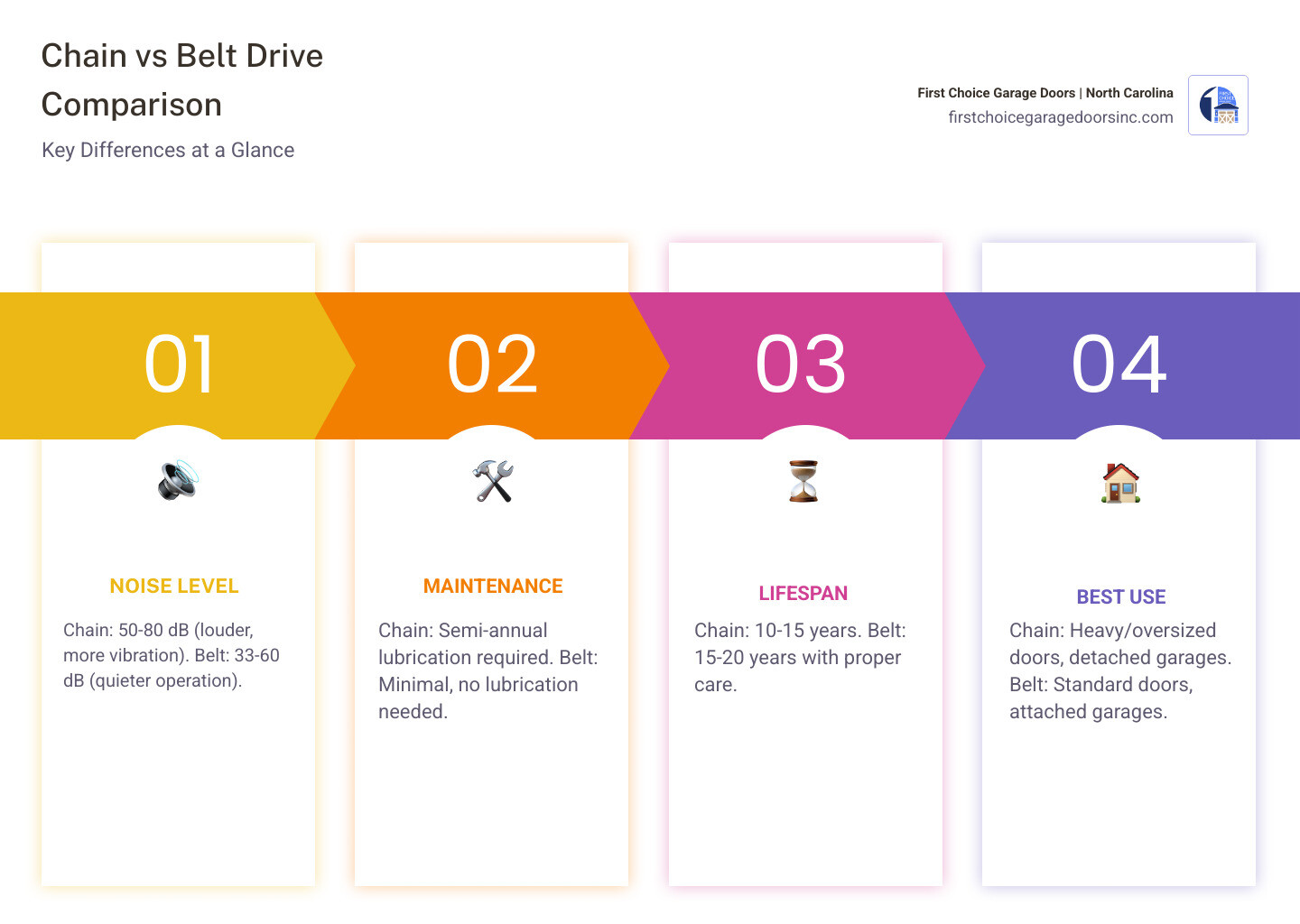
| Feature | Chain Drive | Belt Drive |
|---|---|---|
| Noise Level | 50-80 decibels (louder) | 33-60 decibels (quieter) |
| Best For | Heavy or oversized doors | Standard residential doors |
| Maintenance | Semi-annual lubrication required | Minimal — no lubrication needed |
| Lifespan | 10-15 years | 15-20 years |
| Door Weight Capacity | 500+ lbs | 150-250 lbs (standard) |
| Ideal Location | Detached garages, workshops | Attached garages, near bedrooms |
The short answer: if your garage shares a wall with living spaces or sits below a bedroom, a belt drive is the quieter, lower-maintenance choice. If you have a heavy wooden door, an oversized opening, or you’re working with a detached garage, a chain drive delivers the raw lifting power you need.
But most homeowners need a little more context before making the call — and that’s exactly what this guide covers.
I’m Tony Aguilar, founder of First Choice Garage Doors, Inc., with over 30 years of hands-on experience helping homeowners navigate decisions like the chain drive vs belt drive garage door opener question every single day. I’ll walk you through everything you need to know to make a confident, informed choice for your home.
Understanding the Mechanics of a Chain Drive vs Belt Drive Garage Door Opener
To choose the right system, we first need to look under the hood. While there are actually 3 types of garage door openers commonly used in residential settings, the “battle of the drives” almost always comes down to chain vs. belt.
Both systems are “trolley-style” openers. This means a motor sits in a power unit mounted to your ceiling, and it moves a trolley along a rail. The trolley is connected to your garage door. The “drive” is simply the medium used to pull that trolley back and forth.
The Chain Drive Mechanic
A chain drive utilizes a metal chain—very similar to what you’d see on a bicycle—to move the trolley. The motor turns a sprocket, which pulls the chain in a loop. Because it is made of interlocking steel links, it provides a very rigid, strong connection. This “raw power” is why chain drives have been the industry standard for decades. However, metal-on-metal contact naturally creates more friction and vibration.
The Belt Drive Mechanic
A belt drive replaces the steel chain with a reinforced rubber belt. These belts are usually made of high-grade materials like polyurethane, reinforced with internal steel or fiberglass cords for strength. Instead of the “clinking” of metal links, the belt slides smoothly over the sprocket. This design was specifically engineered to solve the noise issues associated with older chain models.
Comparing Performance: Noise Levels and Smoothness
In April 2026, as more homeowners in Fayetteville convert garages into home gyms or offices, noise has become the number one factor in the chain drive vs belt drive garage door opener debate.
The difference in sound is significant. Chain drives typically operate between 50 and 80 decibels. To put that in perspective, 80 decibels is roughly equivalent to a garbage disposal or a loud alarm clock. If your garage is attached to your home, that vibration travels through the wooden framing (ceiling joists) and can be heard clearly in the rooms above or beside the garage.
Belt drives, on the other hand, run at a whisper-quiet 33 to 60 decibels. A rating of 33 decibels is about as loud as a quiet library or a soft hum. For many families, this is the difference between waking up a sleeping infant or letting them sleep through a late-night arrival.
When asking should you get a belt or chain garage door opener, we always tell our customers to consider the “vibration factor.” Because rubber absorbs vibration while metal transmits it, a belt drive offers a much smoother start and stop, reducing the “jerking” motion often seen with older chain systems.
Why a belt drive garage door opener is the quietest choice
The secret to the belt drive is the lack of metal-on-metal friction. Modern belts are designed with a “teeth” system that grips the drive gear securely without the clatter of a chain hitting a rail. This makes them the gold standard for any home where the garage is located directly under a master bedroom or nursery.
Durability and Maintenance for North Carolina Climates
Living in Fayetteville, NC, means dealing with high humidity in the summer and occasional freezing dips in the winter. These environmental factors impact your opener choice more than you might think.
Chain Drive Durability
The chain is a workhorse. It is largely unaffected by humidity and can withstand extreme heat without stretching or slipping. However, metal is prone to rust in humid North Carolina air if it isn’t properly maintained.
Belt Drive Durability
Modern belts are rated to handle temperatures as low as -20°F and can withstand the intense heat of an uninsulated garage. While older rubber belts might have slipped in high humidity, today’s steel-reinforced versions are much more stable. However, a belt drive generally has a shorter track record in “extreme” industrial use compared to the brute strength of a chain.
| Maintenance Task | Chain Drive | Belt Drive |
|---|---|---|
| Lubrication | Required 2x per year | Not required |
| Tension Check | Annual adjustment often needed | Rarely needed |
| Cleaning | Wipe down to prevent grease buildup | Visual inspection for wear |
| Lifespan | 10-15 years | 15-20 years |
Knowing the garage door opener features you’ll want to have includes understanding the long-term commitment. Chain drives require a bit of “elbow grease” to keep them quiet and functional.
Maintaining your chain drive vs belt drive garage door opener
If you choose a chain drive, you must be prepared for semi-annual lubrication. Using a high-quality lithium-based grease on the chain and sprockets prevents the metal from grinding down. Without this, the chain will eventually stretch, become noisy, and could even jump the sprocket.
Belt drives are virtually maintenance-free. Because there is no metal-on-metal friction, you don’t need to apply messy lubricants to the belt itself. You simply need to keep the rail clean and perform a standard safety balance test on your door once or twice a year.
Choosing the Right Drive for Your Door Weight and Style
While noise is a major factor, the weight of your door is the “hard limit” for the chain drive vs belt drive garage door opener decision.
Most standard residential garage doors weigh between 150 and 250 pounds. Both drive types handle this range with ease. However, if you have a custom solid wood door, a triple-layer insulated steel door, or an oversized door for an RV, the drive chain belt drive doors comparison shifts in favor of the chain.
Chain drives have superior tensile strength. They are less likely to slip or “give” under the massive weight of a 500+ pound door. In commercial settings or for very large carriage-house style doors, we almost always recommend a heavy-duty chain drive or a side-mount (jackshaft) opener.
Frequently Asked Questions about Drive Systems
Can I convert my chain drive vs belt drive garage door opener?
We often get asked if you can simply swap a chain for a belt on an existing motor. The answer is usually no. Because the sprockets and rail configurations are different, converting a chain drive garage door opener to a belt drive typically requires replacing the entire rail and sprocket assembly. In many cases, it is more cost-effective to replace the entire unit to ensure you get the full benefits of a modern, quiet motor.
Which type lasts longer in Fayetteville?
In our local experience across North Carolina, belt drives actually tend to outlast chain drives by about 5 years. This is because the belt drive creates less vibration, which means less wear and tear on the motor’s internal gears and the garage door’s hardware (like rollers and hinges). While a well-maintained chain can last 15 years, a belt drive frequently reaches the 20-year mark.
Are both types compatible with smart home features?
Absolutely. Whether you choose a chain or a belt, modern units come equipped with Wi-Fi connectivity. There are many perks a garage door opener offers you today, including:
- Smartphone alerts if the door is left open.
- Remote closing from anywhere in the world.
- Integration with Amazon Key for secure in-garage deliveries.
- Battery backup systems that work during Fayetteville power outages.
Conclusion: Which Drive Wins for Your Home?
The “winner” of the chain drive vs belt drive garage door opener battle depends entirely on your priorities.
- Choose a Belt Drive if: Your garage is attached to your home, you have bedrooms nearby, you prefer a “set it and forget it” maintenance schedule, and you want the smoothest operation possible.
- Choose a Chain Drive if: You have a detached garage or workshop, you are lifting an exceptionally heavy or oversized door, or you are looking for the most budget-friendly upfront option.
At First Choice Garage Doors, we specialize in helping Fayetteville homeowners find the perfect balance between power, noise, and reliability. Whether you need a rugged chain drive for your workshop or a whisper-quiet belt drive for your attached garage, our expert technicians are here to ensure a professional, safe installation.
More info about garage door opener services is just a click away. If you’re ready to upgrade your home’s entryway, give us a call today for a free estimate!