
Do I Need a Permit to Replace My Garage Door in North Carolina?
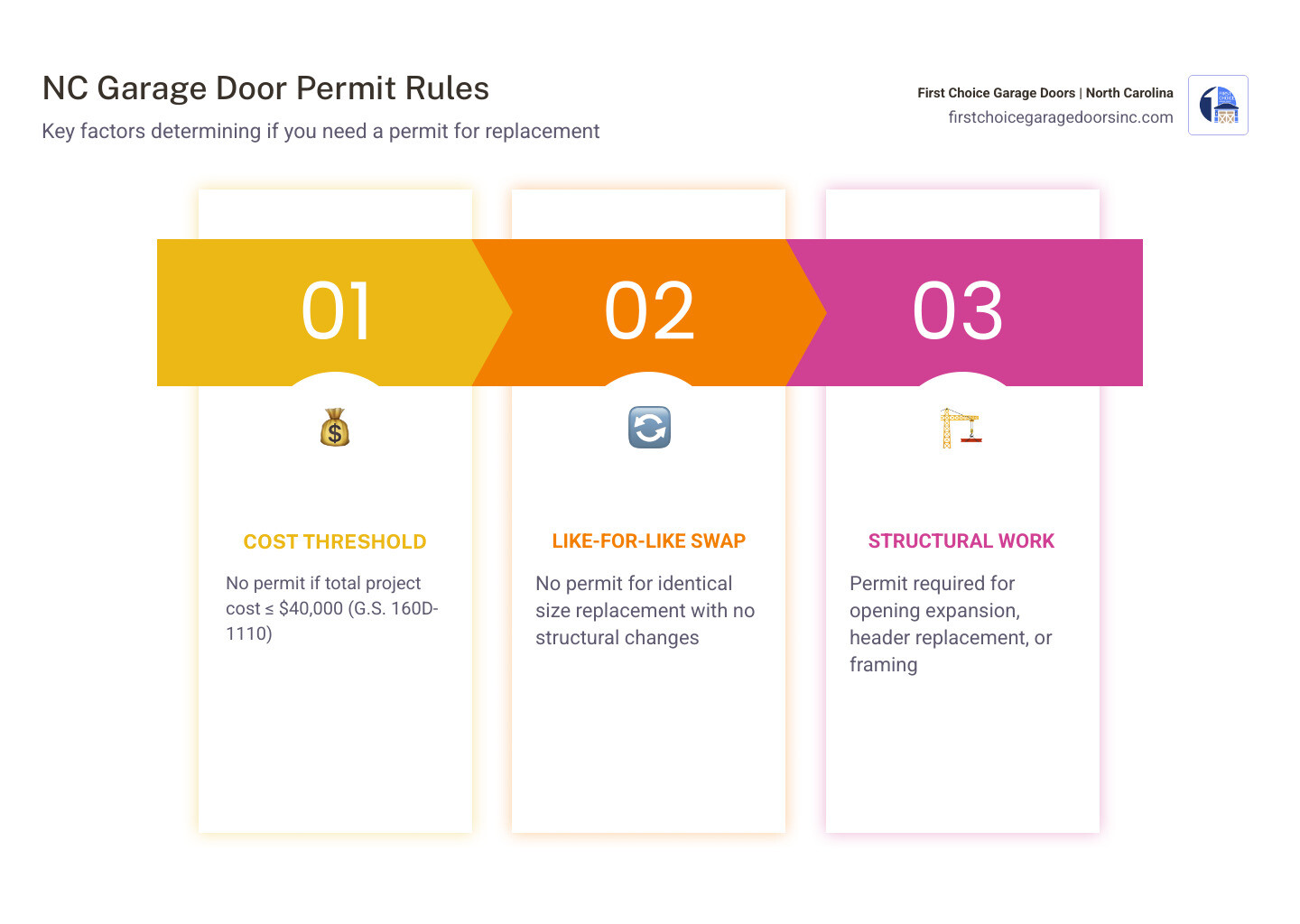
Do I need a permit to replace my garage door in North Carolina? For most homeowners, the answer is no — but it depends on a few key factors:
- No permit required if the total project cost is $40,000 or less, the replacement is like-for-like, and no structural changes are made to the door opening or surrounding framing
- Permit required if the project involves expanding the opening, replacing a load-bearing header, or making other structural alterations — regardless of cost
- Separate trade permit required if the project includes new electrical wiring for a garage door opener
- Local rules may vary — some counties like Johnston County apply a lower $15,000 threshold for non-structural work exemptions
That said, even a “simple” garage door swap can trigger additional approvals if your property sits in a historic district, a flood zone, or an HOA community. Knowing exactly where your project falls on that spectrum can save you time, money, and serious headaches down the road.
I’m Tony Aguilar, founder of First Choice Garage Doors with over 30 years of hands-on experience in the garage door industry — and questions about do I need a permit to replace my garage door in North Carolina come up constantly among homeowners navigating their first replacement. In the sections below, I’ll walk you through everything you need to know to make a confident, code-compliant decision.
Do I need a permit to replace my garage door in North Carolina?
When you’re looking at a frayed cable or a dented panel, your first thought is usually about the cost of the door, not the paperwork at City Hall. In North Carolina, the “Gold Standard” for whether you need a permit is found in G.S. 160D-1110. This state statute is actually quite generous compared to other parts of the country.
Under this law, a building permit is generally not required for residential projects—including door replacements—if the total cost is $40,000 or less. However, there is a major catch: the work must be non-structural. This means if we are pulling out your old 16×7 door and sliding in a brand-new, insulated 16×7 door without touching the “bones” of your garage, you are likely in the clear.
This exemption covers what we call “like-for-like” replacements. If the size stays the same and the location stays the same, the state views it as a minor repair or maintenance task. We often help customers through the process of knowing when you need a garage door replacement to ensure they aren’t spending money on repairs that won’t last, and usually, these swaps happen without a single trip to the permit office.

However, keep in mind that “cost” includes both labor and materials. In the current 2026 market, it is rare for a standard residential garage door to exceed that $40,000 mark, but for high-end custom wood doors or massive commercial bay doors, it’s a figure to keep in mind.
Understanding State-Level Rules and Structural Exceptions
The $40,000 rule is a great baseline, but the North Carolina Residential Code cares much more about the “bones” of your home than the price tag. The moment you decide to change the shape or size of your garage opening, the permit exemption disappears.
Your garage door sits under a “header”—a heavy load-bearing beam that supports the weight of the roof or the floor above the garage. If we have to cut into that header, replace it, or move the vertical studs (the “jack” and “king” studs) that hold it up, we are performing structural work.
In the debate of professional vs. DIY garage door installation, this is where the pros really shine. A DIYer might not realize that widening a door by just six inches requires a completely new, engineered header to prevent the garage ceiling from sagging or collapsing.
When a permit is required for garage door replacement in North Carolina
You will absolutely need to file for a permit if your project includes:
- Opening Expansion: Turning two single doors into one double door, or widening an existing door.
- Header Replacement: Swapping out a rotted or undersized load-bearing beam.
- Safety Glazing: If your new door has windows located in “hazardous locations” (like right next to a walkway or very close to the floor), specific tempered glass requirements must be met and inspected.
- Change of Use: If you are converting the garage into a bedroom or a “man cave,” the permit requirements change drastically to include insulation, egress windows, and fire separation.
If your project involves these shifts, our team specializing in garage door installation in Fayetteville, NC can help ensure the structural work meets local safety codes.
Compliance standards for a garage door replacement in North Carolina
Even if you don’t need a permit, your door must still meet the North Carolina State Building Code. In our state, wind is a big deal. Depending on where you live, your door may need to be rated for 90+ mph wind gusts.
Coastal regions or high-wind zones require specific “wind-load” reinforced doors. These doors have extra U-bars (struts) and heavy-duty hardware to keep the door from blowing in—or being sucked out—during a hurricane. Additionally, look for NFRC labels if you are buying an insulated door; these verify the energy efficiency ratings that help keep your NC home comfortable during those humid summers. For those near the coast, we provide specialized garage door replacement in Fayetteville, NC that focuses on these high-durability standards.
Local Regulations and County-Specific Variations
While state law sets the ceiling, local municipalities often set their own floors. This can get confusing because a rule in Raleigh might not apply in Durham or Fayetteville.
For example, the Town of Cary and the City of Raleigh offer “SPOT” (Small Project One-Day) reviews for things like interior alterations, but they are very strict about setbacks. A setback is the distance your garage must be from the property line. If you are building a new detached garage or extending an existing one, you could be in violation of zoning laws even if the building itself is “up to code.”
| City/County | Permit Threshold (Non-Structural) | Typical Timeline | Online Portal |
|---|---|---|---|
| Raleigh / Wake Co. | $40,000 | 2 Weeks | Permit & Development Portal |
| Durham | $40,000 | 5-10 Days | Durham City-County Inspections |
| Johnston County | $15,000 | 1 Week | Johnston Co. ViewPoint |
| Fayetteville | $40,000 | 1-2 Weeks | City of Fayetteville Portal |
As a leading garage door company in Raleigh, NC, we’ve seen how Wake County’s specific impervious surface rules (how much of your lot can be covered by concrete or roofing) can affect even small garage additions.
Navigating local rules to replace my garage door in North Carolina
There are “invisible” factors that can trigger permit needs even for a standard door swap:
- Historic Districts: Places like Old Wilmington or Fayetteville’s historic neighborhoods often require a “Certificate of Appropriateness.” This means the color, material, and style of your door must be approved by a board to ensure it fits the 19th-century vibe.
- Flood Hazard Zones: If you are in a flood zone (common for our customers using a garage door company in Wilmington, NC), you might need an elevation certificate or “hydrostatic vents” in the bottom panels of the garage door to allow water to flow through without knocking the building off its foundation.
Electrical Requirements and Safety Standards
One of the most common “gotchas” in North Carolina is the garage door opener. While the door itself might be exempt from a permit, the electrical work often isn’t.
If we are simply plugging a new opener into an existing outlet, you usually don’t need a trade permit. However, if you are installing a brand-new opener where there wasn’t one before—and you need to run a new circuit or install a new outlet on the ceiling—North Carolina law requires a licensed electrician and an electrical permit.
All automated systems must comply with UL 325 standards and the National Electrical Code (NEC). This includes:
- Photo-eye Sensors: These must be installed no higher than six inches off the garage floor. They send an invisible beam across the opening; if anything breaks that beam, the door stops.
- Auto-Reverse Mechanisms: If the door touches an object (like a trash can or, heaven forbid, a pet), it must automatically reverse within two seconds.
- GFCI Protection: All outlets in a garage must be Ground Fault Circuit Interrupter protected to prevent shocks in damp environments.
Statistically, code-compliant installations reduce future service calls by up to 30%, simply because the components are aligned correctly and the safety systems aren’t “short-cutted.”
Frequently Asked Questions about NC Garage Door Permits
Can I perform the installation myself without a contractor license?
Yes, North Carolina allows for an “Owner-Builder” exemption. If the home is your primary residence and you intend to live there for at least one year after the work is completed, you can pull your own permits and do the work yourself. You will still have to sign an Owner License Exemption Form and pass all the same inspections that a pro would.
However, be warned: garage doors are under immense tension. Torsion springs carry enough energy to cause severe injury or death if handled incorrectly. Most homeowners find that the peace of mind of a professional install far outweighs the small savings of a DIY attempt.
What are the penalties for replacing a garage door without a required permit?
If you skip a required permit, the consequences can be a major headache:
- Class 1 Misdemeanor: Technically, violating building permit laws is a crime in NC, though most cities prefer fines over handcuffs.
- Stop-Work Orders: An inspector can shut down your project mid-day, leaving your garage open to the elements.
- Retroactive Fees: Many counties charge double or triple the original permit fee if they catch you working without one.
- Home Sale Delays: This is the big one. When you go to sell your home, the buyer’s inspector or the bank may check permit records. If they see a new garage or structural change with no permit, they can block the loan until you “permit the unpermitted,” which often involves tearing down drywall to show an inspector the wiring or framing.
How long does the permit application process typically take?
In major areas like Raleigh or Durham, expect about a 2-week timeline for residential permits. Some smaller projects qualify for “SPOT” reviews which can happen in just a couple of days. Most counties now use online portals (like Accela or GeoCivix), which has reduced project delays by as much as 50% compared to the old paper-filing days.
Conclusion
So, do i need a permit to replace my garage door in north carolina? If you are doing a standard, non-structural swap under $40,000, you are likely ready to go without a permit. But the moment you start talking about widening the opening, adding new electrical circuits, or working in a historic district, the rules change.
At First Choice Garage Doors, we believe that North Carolina bound: why proven companies are the best bet is more than just a slogan. It’s about having a partner who knows the local Raleigh, Durham, and Fayetteville codes inside and out. We take the guesswork out of compliance so you can focus on how great your home looks with its new upgrade.
Don’t let a “simple” DIY project turn into a legal or safety nightmare. Contact our Fayetteville team for expert garage door installation today, and let’s make sure your next garage door is safe, legal, and built to last.