
Why the Right Garage Door Size Matters More Than You Think
The single vs double garage door size guide every Northern Virginia homeowner needs comes down to a few key numbers — and the right choice depends on your vehicles, your garage width, and how you use the space.
Here’s a quick comparison to help you decide at a glance:
| Feature | Single Garage Door | Double Garage Door |
|---|---|---|
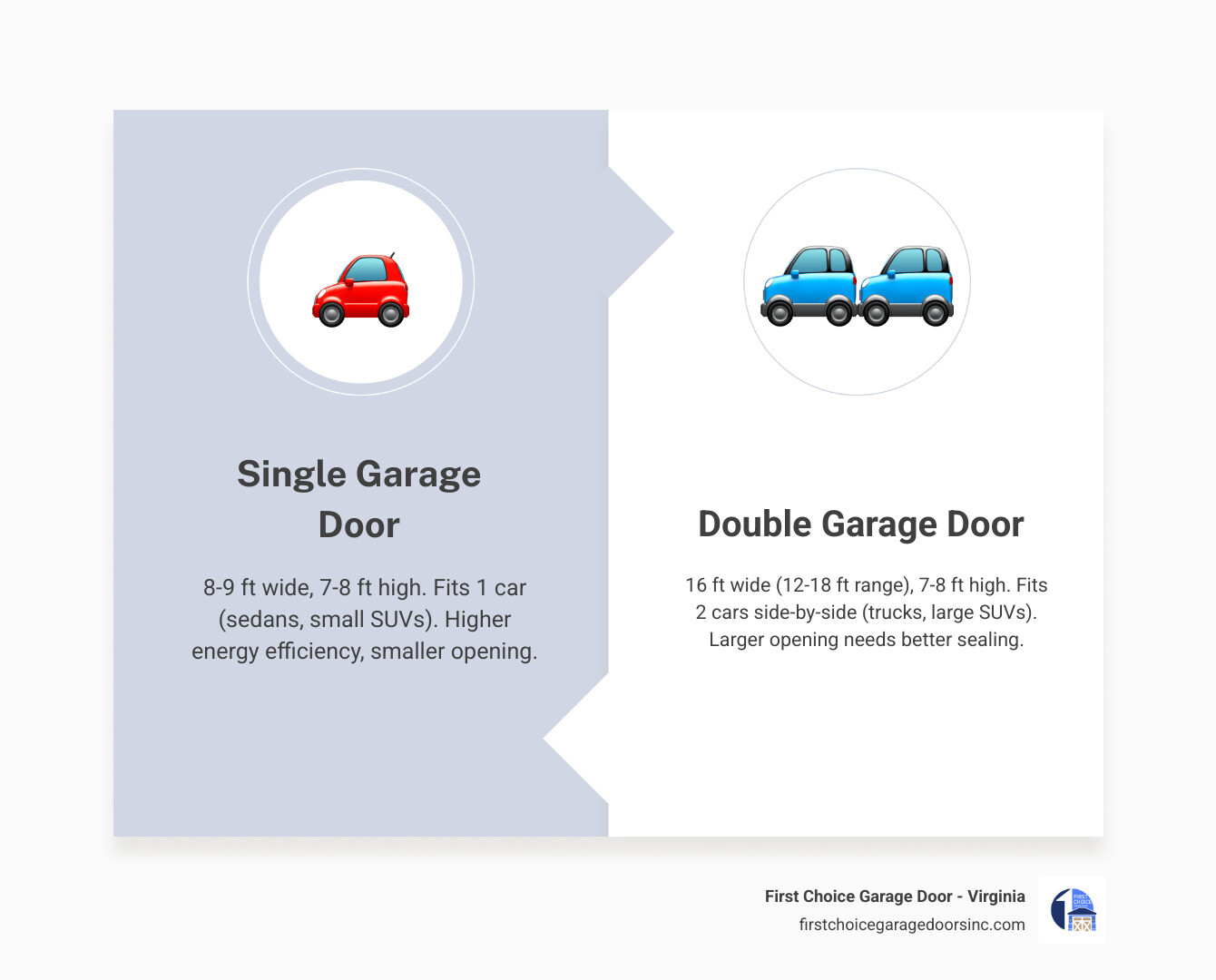
| Standard width | 8 ft or 9 ft | 16 ft (12–18 ft range) |
| Standard height | 7 ft or 8 ft | 7 ft or 8 ft |
| Vehicles | 1 car | 2 cars (side by side) |
| Best for | Compact cars, sedans, small SUVs | Two vehicles, trucks, large SUVs |
| Opener needed | 1 opener | 1 opener (or 2 for dual singles) |
| Energy efficiency | Higher (smaller opening) | Lower (larger opening to seal) |
Most homes in Virginia fall into one of two camps: a single-car garage with an 8- or 9-foot door, or a two-car garage with a 16-foot double door. But there’s more nuance than just width — height, vehicle type, storage needs, and even your HOA rules all play a role.
Picking the wrong size isn’t just inconvenient. It can mean re-framing your opening, delaying installation, and paying significantly more in labor costs — problems that are entirely avoidable with the right information upfront.
This guide walks you through everything: standard dimensions, vehicle fit, installation clearances, and how to choose between two single doors versus one wide double door for your Northern Virginia home in 2026.
Standard Dimensions: A Single vs Double Garage Door Size Guide
When we talk about “standard” sizes in the garage door industry, we are referring to the dimensions that manufacturers mass-produce. Choosing a standard size is usually the most efficient path for homeowners because these doors are readily available and fit the majority of residential rough openings.
Standard Widths for Single and Double Doors
For a single-car garage, the most common widths are 8 feet and 9 feet. While 8 feet was the “classic” standard for decades, modern vehicle trends have pushed the 9-foot-wide door into the spotlight. If you are driving a modern SUV or a mid-sized truck, that extra foot of width provides a much-needed buffer for side mirrors and comfortable entry.
For double-car garages, the 16-foot-wide door is the undisputed king of suburban Virginia. It is designed to allow two standard vehicles to park side-by-side. However, if you own two large SUVs or a pair of pickup trucks, you might consider an 18-foot-wide door to avoid “parking anxiety” every time you pull in.
Height Standards: 7-Foot vs. 8-Foot Options
In April 2026, we are seeing more homeowners opt for 8-foot-tall doors than ever before. While 7 feet remains the baseline standard for most residential builds, the rise of “adventure vehicles” equipped with roof racks, storage bins, and lift kits has made the 8-foot height a practical necessity. If you have a tall SUV or a truck with a slight lift, sticking with a 7-foot door could lead to a very expensive roof repair.
To help you visualize these differences, we’ve put together a reference table for standard sizing:
| Door Type | Common Widths | Common Heights | Best Vehicle Match |
|---|---|---|---|
| Compact Single | 8 ft | 7 ft | Sedans, compact cars |
| Standard Single | 9 ft | 7 ft – 8 ft | SUVs, crossovers, trucks |
| Wide Single | 10 ft | 7 ft – 8 ft | Large trucks, work vans |
| Standard Double | 16 ft | 7 ft – 8 ft | Two sedans or small SUVs |
| Premium Double | 18 ft | 7 ft – 8 ft | Two large SUVs or trucks |
For a deeper dive into how these sizes affect your specific home layout, check out our Sizing Up Fayetteville Single and Double Car Garage Door Installation Guide.

Vehicle Fit and Clearance in a Single vs Double Garage Door Size Guide
Choosing a door size isn’t just about the width of the car; it’s about the width of the car with the mirrors out. A standard sedan is usually about 6 to 6.5 feet wide, but once you add mirrors, you’re looking at nearly 8 feet of total width.
- Sedans and Compacts: These fit comfortably through an 8-foot door, though a 9-foot door feels much more spacious.
- SUVs and Crossovers: We almost always recommend a minimum of 9 feet for a single door or 16 feet for a double door. If you have a roof rack, you should strongly consider an 8-foot height.
- Pickup Trucks: Full-sized trucks often require a 10-foot single door or an 18-foot double door to allow for easy maneuvering, especially if the truck is an extended cab or has large towing mirrors.
- RV and Boat Clearance: Standard residential doors won’t cut it here. RV doors typically start at 10–12 feet wide and can reach 14 feet in height to accommodate specialized tracks and clearance for AC units on top.
Understanding these nuances is the first step in The Ultimate Guide to Choosing the Right Garage Door Size for Your Needs.
Custom Sizing for Unique Northern Virginia Homes
Northern Virginia is home to a beautiful mix of modern developments and historic properties. In places like Old Town Manassas or historic districts in Leesburg, garage openings are rarely “standard.”
If your home has a non-standard opening, or if you’ve modified your vehicle with a significant lift kit, custom sizing becomes necessary. Custom doors can be manufactured in almost any increment, allowing us to fit a door perfectly to a historic carriage house or an oversized workshop. While custom doors require more precise planning, they ensure that your home’s architectural integrity remains intact. You can learn more about this process in our guide on Determining the Best Garage Door Size.
Two Single Doors vs. One Double Door: Which is Better?
If you have a two-car garage, you face a classic architectural dilemma: Should you install one large 16-foot double door, or two separate 8- or 9-foot single doors with a center pillar (mullion) between them?
The Case for Two Single Doors
Many homeowners prefer the look of two single doors because it creates a symmetrical, high-end facade. Beyond aesthetics, there are practical benefits:
- Operational Redundancy: If one garage door opener fails or a spring breaks, you still have a second door to get your other vehicle out.
- Reduced Visual Exposure: When you open a single door, you aren’t showing the entire neighborhood the contents of your garage—just the bay you’re using.
- Climate Control: If you use your garage as a workshop, opening a smaller door lets out less conditioned air than opening a massive double door.
The Case for One Double Door
One large double door is often the more modern choice. It offers:
- Easier Maneuverability: There is no center pillar to worry about hitting. This is a huge advantage for teen drivers or anyone who finds backing out of a tight space stressful.
- Flexibility: You can park a single vehicle right in the middle if you need extra room to work on a project or unload groceries from both sides of the car.
- Efficiency: You only have one opener to maintain and one set of tracks to keep clean.
Deciding which path to take is a major step in Should You Install Two Single Garage Doors or a Double Garage Door and Deciding Between a Single or Double Garage Door.
Energy Efficiency in a Single vs Double Garage Door Size Guide
Energy efficiency is a hot topic in Northern Virginia, where our winters can be biting and our summers humid. The single vs double garage door size guide wouldn’t be complete without discussing heat loss.
A double garage door creates a much larger “hole” in your home’s thermal envelope every time it opens. If your garage is attached to your home, this can lead to significant energy transfer. To combat this, we recommend looking at the R-value of the door.
- Insulated Doors: Modern doors use polyurethane or polystyrene foam sandwiched between steel panels. A well-insulated door (R-value of 12 to 18) can keep your garage significantly warmer in the winter.
- Thermal Breaks: High-quality doors include a thermal break that prevents heat from conducting through the steel frame itself.
For more information on high-efficiency options, explore our Residential Garage Doors page.
Installation Requirements and Measuring Your Space
Before you fall in love with a specific door style, we need to ensure it actually fits the physical constraints of your garage. It’s not just about the “hole” in the wall—it’s about the space inside where the hardware lives.
The Four Critical Measurements
- Rough Opening: This is the width and height of the finished door frame. We always measure in three places (top, middle, bottom) and use the smallest number to ensure a snug fit.
- Headroom: This is the space between the top of the door opening and the ceiling. A standard torsion spring system usually requires 12 inches of headroom. If you have less, we may need a “low-headroom kit.”
- Side Room: You need about 3.75 to 4 inches on each side of the opening to mount the vertical tracks.
- Backroom: This is the depth of the garage. You need the height of the door plus at least 18 inches (more if you are installing an electric opener) to allow the door to retract fully.
Getting these right is vital, which is why we created The Easy 4 Step Guide to Measuring Your Garage Door Opening and detailed Considerations Before a Garage Door Installation.
Measuring for Your Single vs Double Garage Door Size Guide
When we come out to your home in Manassas or across Northern Virginia, we look for more than just inches. We check for:
- Level Floors: If your garage floor has settled or shifted, the door won’t seal correctly. We can often fix this with oversized bottom weatherstripping or custom-scribed wedges.
- Header Reinforcement: A double garage door is heavy. The header (the beam above the door) must be structurally sound to support the weight and the tension of the springs.
- Obstructions: We check for water pipes, electrical conduits, or low-hanging beams that might interfere with the tracks.
Don’t guess on these! Check out our guide on Making Measurements Before Installing a New Garage Door to see how the pros do it.
Factors Influencing Your Garage Door Choice
Beyond the tape measure, several “soft” factors should influence your decision.
Building Codes and HOA Rules
Northern Virginia is known for its active Homeowners Associations (HOAs). Before you decide to swap your two single doors for one large double door, you must check your HOA bylaws. Many communities have strict rules about the appearance and configuration of garage doors to maintain neighborhood character. Additionally, local building codes in Virginia may have specific wind-load requirements that dictate the type of reinforcement your door needs.
Storage and Workshop Needs
Is your garage just for cars, or is it your woodshop, gym, or seasonal storage hub?
- The “1.5 Car” Strategy: If you only have one car but lots of gear, a 12-foot or 14-foot door can bridge the gap, giving you plenty of room to park while leaving your workbench accessible.
- Ceiling Space: If you plan to install overhead storage racks, you need to ensure your garage door tracks won’t interfere with them when the door is open.
Asking the right questions early can save you a lot of headache. We suggest reviewing 5 Questions to Ask Yourself Before Your Garage Door Installation and 4 Factors to Consider When Choosing a Garage Door.
Frequently Asked Questions about Garage Door Sizes
Can I fit two cars through a 16-foot double door?
Yes, a 16-foot door is the standard for two-car garages. However, it can be a tight squeeze for two large SUVs. If you have the space in your driveway and garage framing, upgrading to an 18-foot door provides a much more comfortable “no-stress” parking experience.
What is the standard height for modern SUVs and trucks?
While 7 feet is the residential standard, many modern trucks and SUVs (especially those with roof racks or lift kits) are pushing that limit. We increasingly recommend 8-foot-tall doors for new installations in Northern Virginia to “future-proof” the home for larger vehicles.
Are custom sizes necessary for RVs or boats?
Almost always. Standard residential doors are too short and often too narrow for Class A motorhomes or large boats on trailers. For these, you’ll typically need a door that is 10–12 feet wide and 12–14 feet tall. If you’re planning an RV garage, be sure to check out When Buying a Garage Door Consider the Following.
Conclusion
Choosing the right garage door is one of the most impactful decisions you can make for your home’s curb appeal and functionality. Whether you’re leaning toward the classic look of dual single doors or the wide-open convenience of a double door, getting the size right is the foundation of a successful project.
At First Choice Garage Doors, we’ve spent years helping our neighbors in Manassas and throughout Northern Virginia find the perfect fit. From expert repairs to precision installations, our goal is to make your home improvement journey stress-free and professional. We pride ourselves on unmatched expertise and quality, ensuring that every door we install is safe, beautiful, and built to last.
If you’re ready to upgrade your home’s exterior or need help measuring a tricky opening, we’re here to help. Explore our Residential services or contact us today to schedule your professional Garage Door Installation. Let’s make sure your garage is ready for whatever 2026 brings!