
Why Knowing the Signs Your Garage Door Needs Repair Can Save You Time, Money, and Stress
The signs your garage door needs repair are often easy to overlook — right up until the door refuses to open on a busy morning or makes a noise loud enough to wake the neighbors. Your garage door is one of the hardest-working parts of your home, cycling open and closed multiple times every day. Over time, that constant use adds up, and small warning signs can quickly turn into serious — and expensive — problems.
Here are the most common signs your garage door needs repair:
| Warning Sign | What It May Indicate |
|---|---|
| Grinding, squeaking, or rattling noises | Worn rollers, loose hardware, lack of lubrication |
| Popping or loud bang | Broken torsion spring |
| Slow or jerky movement | Track debris, worn springs, failing opener |
| Door won’t open or close fully | Broken springs, cable issues, sensor obstruction |
| Sagging or uneven sections | Imbalance, fatigued springs |
| Safety sensors blinking or not responding | Misalignment, dirty lenses, wiring issues |
| Frayed cables or visible spring gaps | High-tension component failure — call a pro immediately |
| Rising energy bills | Worn weatherstripping, insulation gaps |
Catching these red flags early is the difference between a straightforward repair and a full system breakdown. And when it comes to components like springs and cables — which are under extreme tension — the stakes go beyond convenience. A malfunctioning garage door is a safety hazard for your family and a vulnerability in your home’s security.
I’m Tony Aguilar, founder of First Choice Garage Doors, Inc., and with over 30 years of hands-on experience in the garage door industry since 1993, I’ve seen how quickly an ignored warning sign can escalate into a dangerous and costly failure. In the sections below, I’ll walk you through every major sign your garage door needs repair so you can act before a small issue becomes a big one.
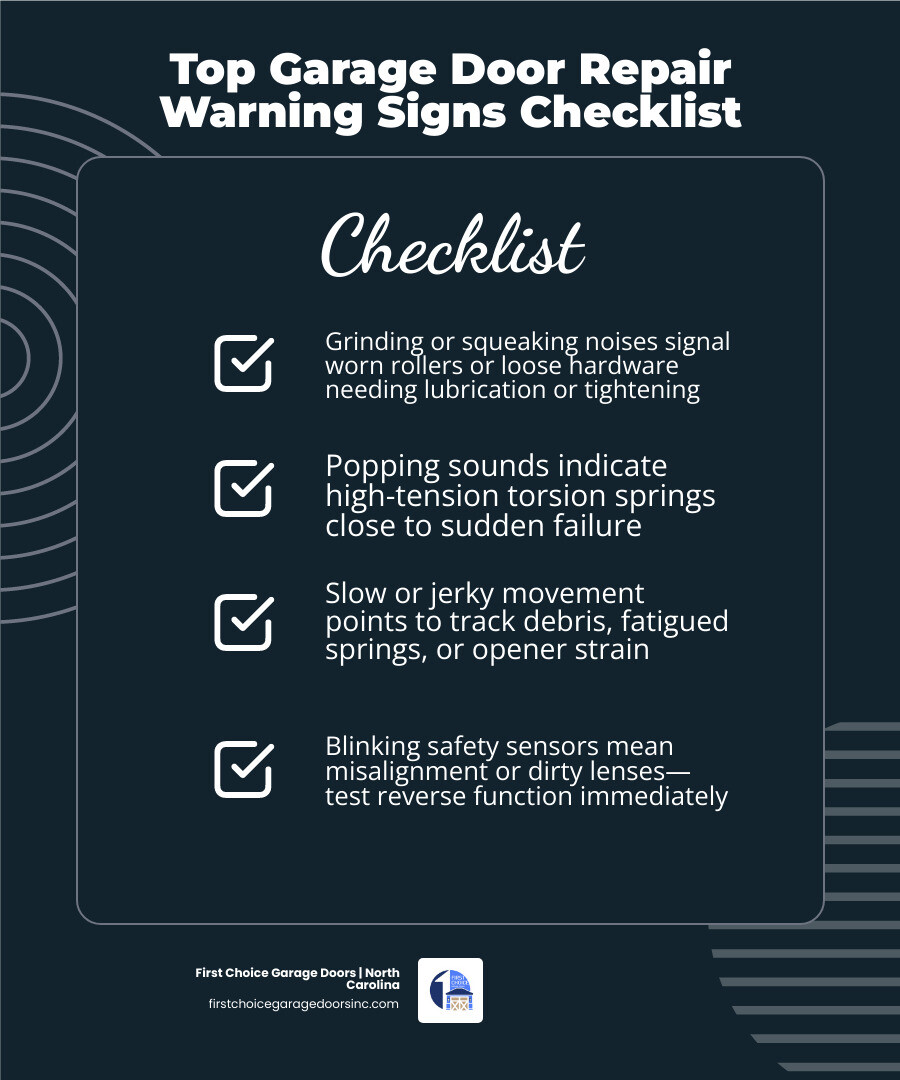
Common Auditory Signs Your Garage Door Needs Repair
As we move through April 2026, home maintenance trends are shifting toward proactive care. One of the easiest ways to monitor your door’s health is simply by listening. A healthy garage door should operate with a relatively consistent, rhythmic hum. If it starts “auditioning for a metal band,” as some homeowners joke, it’s trying to tell you something is wrong.
Unusual sounds are often the very first signs your garage door needs repair. While some noises might just require a bit of specialized lubricant, others point to structural failures that could lead to the door becoming stuck or falling. Ignoring these sounds can lead to a chain reaction where one worn part causes several others to fail. You can learn more about these sounds in our guide on more reasons a garage door could become noisy.
Unusual Noises as Signs Your Garage Door Needs Repair
Different sounds point to different culprits:
- Grinding: This often indicates that your metal rollers are worn out or that the tracks are misaligned. When the rollers can’t spin freely, they slide against the track, creating a harsh metal-on-metal friction.
- Squeaking: High-pitched squeaks usually mean the hinges, rollers, or springs are thirsty for lubrication. In our experience from Fayetteville to Easton, the humid climate can cause grease to dry out faster than you’d expect.
- Rattling: If you hear a persistent vibration or rattling, it’s likely that hardware, such as nuts and bolts, has vibrated loose over time. If left untightened, these components can fall out, causing the door to lose its stability.
Understanding why your garage door is noisy is the first step toward restoring the peace and quiet of your home.
Popping and Snapping Sounds
Perhaps the most alarming sound a homeowner can hear is a loud bang—similar to a gunshot or a heavy object hitting the floor—coming from the garage. This almost always signifies that a torsion spring has snapped.
Garage door springs are the “muscles” of the system. They are under incredible tension to counterbalance the weight of a door that can weigh several hundred pounds. When they break, the energy released is violent. If you hear this sound, do not attempt to operate the door, as the opener is not designed to lift the full weight of the door without spring assistance. Recognizing the signs you have damaged garage door springs is vital for your safety.
Visual and Operational Red Flags
Sometimes the signs your garage door needs repair aren’t heard—they are seen. By 2026 standards, modern garage doors are expected to be smooth and responsive. If your door is shuddering, hesitating, or looking lopsided, it has moved from “mostly working” to “potentially unsafe.” These visual cues are your early warning system. Staying vigilant can help you identify signs you need a garage door repair before the door becomes completely immobilized.
Sluggish Movement as Signs Your Garage Door Needs Repair
Does your door move with a heavy, labored effort? A door that used to zip open but now seems to struggle may be suffering from several issues. It could be that the springs are losing their tension, forcing the motor to work at its absolute limit. Alternatively, the tracks could be clogged with debris, or the rollers might be “gummy” with old, dirty grease.
In many cases, slow response times are the main way to tell if a garage door motor is beginning to fail. If you’re troubleshooting a garage door that won’t open in Easton, MD, checking for track obstructions is a great first step, but persistent sluggishness usually requires a professional look at the opener and springs.
Sagging and Uneven Sections
When you look at your door from the driveway, does one side appear lower than the other? This is often called the “Crooked Climb.” It happens when the cables are unevenly tensioned or when one spring is weaker than the other.
Sagging sections are particularly common in older wood doors that have absorbed moisture over the years, but they can happen to any door that is out of balance. This structural pressure doesn’t just look bad; it puts immense strain on the door’s hinges and the opener’s gears. Understanding why a bowing garage door is a problem and how you can fix it can prevent the door from eventually cracking or coming off its tracks entirely.
Safety Sensor and Reverse Mechanism Failures
Since the early 1990s, all residential garage doors have been required to have safety sensors (photo-eyes). These are the small sensors located near the floor on either side of the door. If the door refuses to close and the opener light blinks, the sensors are likely the cause.
Common issues include:
- Misalignment: A trash can or car tire might have bumped a sensor out of place.
- Dirty Lenses: Dust, spiderwebs, or North Carolina dirt can coat the lens, blocking the invisible beam.
- Wiring Issues: Frayed wires can lead to intermittent failure.
Testing your reverse mechanism is a critical safety task. You can do this by placing a 2×4 piece of wood on the ground in the door’s path. If the door doesn’t reverse immediately upon touching the wood, the force settings or sensors need immediate professional attention. For more help, see The Easton Guide to Fixing Garage Door Sensors and Tracks.
When to Call a Professional for High-Tension Repairs
While tightening a loose bolt or cleaning a sensor lens is a safe DIY task, there are certain signs your garage door needs repair that should never be handled by a homeowner. The garage door is typically the heaviest moving object in your house, and the components that lift it are under enough force to cause severe injury.
We cannot stress this enough: never attempt to repair or replace springs, cables, or bottom brackets yourself. For your own protection, read more about why garage door springs should be replaced by professionals and the many reasons a DIY garage door repair can be dangerous.
The Dangers of Broken Springs and Frayed Cables
Most residential garage door springs are rated for about 10,000 cycles (one cycle is one open and one close). For a typical family in Columbia or Manassas using their door 3 to 5 times a day, this translates to about 7 to 10 years of life.
Frayed cables are another critical red flag. If you see “hairs” sticking out of the steel cables or notice they look unraveled, the cable is about to snap. If a cable breaks while the door is moving, the door can come crashing down like a “guillotine,” causing catastrophic damage or injury. This is why you need professional garage door cable repair in Annapolis, MD—our technicians have the specialized tools to lock the door in place safely while performing the repair.
Off-Track Doors and Bent Rails
If your door is hanging at a weird angle or if you see a visible gap between the rollers and the track, your door is “off-track.” This often happens after a vehicle impact or if a cable has snapped.
A door off its tracks is extremely unstable and could fall at any moment. Do not try to force it back into place or pull the emergency release cord, as this could cause the door to drop. Professional intervention is required to realign the rails and ensure the rollers are securely seated. Knowing when your garage door has come off track is the first step in preventing a total system collapse.
Frequently Asked Questions about Garage Door Repair
How often should I perform maintenance to prevent repairs?
We recommend a professional tune-up at least once a year. During a tune-up, our technicians perform a visual inspection of all working parts, lubricate the rollers and springs with garage door-specific silicone lubricant, and check the track alignment.
Between professional visits, you should perform a monthly visual inspection and a simple “balance test.” Keeping the tracks clear of debris and ensuring the safety sensors are clean are easy 3 ways to keep your garage door in good repair.
What are the risks of ignoring early warning signs?
Ignoring a small squeak or a slight jerk in movement is a gamble. Small issues rarely stay small; they usually lead to a cascade of failures. For example, a worn roller creates friction that strains the opener motor and wears out the gears. Eventually, you face a complete breakdown that could lock your car inside (or outside) at the worst possible time. Beyond the inconvenience, the risks that come with having a damaged garage door include serious safety hazards and compromised home security.
How can I tell if my garage door is unbalanced?
The easiest way is the manual lift test:
- Close the door completely.
- Pull the emergency release cord (the red handle) to disconnect the opener.
- Lift the door manually to about waist height and let go.
A perfectly balanced door will stay in place, supported by the springs. If it slams shut or shoots upward, the balance is off. A balanced door should feel like it weighs only 8 to 10 pounds, even if the actual weight is over 200 pounds. If it feels heavy, your springs are fatigued. This is one of the most reliable 5 signs you need a residential garage door repair.
Conclusion
Your garage door is more than just an entryway; it’s a critical component of your home’s safety, security, and curb appeal. Recognizing the signs your garage door needs repair—from the first strange grinding noise to a slight sag in the panels—is the best way to ensure your home remains protected and your daily routine stays on track.
At First Choice Garage Doors, we bring unmatched expertise and a safety-first approach to every job. Whether you are in Easton, Columbia, Manassas, Exton, or Fayetteville, NC, our team of expert technicians is ready to provide prompt, professional service you can trust. Don’t wait for a total failure to occur. If you’ve noticed any of the red flags mentioned today, explore our Garage Door Repair Products and Services and let us restore your door to peak performance.