
What Happens If You Skip Garage Door Maintenance (And Why It Matters)
What happens if you skip garage door maintenance is something most homeowners find out the hard way — usually when the door refuses to open on a cold Tuesday morning or drops without warning. Here’s a quick summary of what you’re risking:
- Sudden breakdowns – Worn springs, rollers, and cables fail without warning
- Safety hazards – Auto-reverse systems and sensors stop working correctly
- Security gaps – Faulty locks and seals make forced entry easier
- Higher energy bills – Cracked weatherstripping lets conditioned air escape
- Shortened door lifespan – Neglect can cut years off a system built to last 15-30 years
- Costly emergency repairs – Small fixes become major replacements
Your garage door is not a “set it and forget it” system. It’s the largest moving object in your home, operating under extreme tension from springs and cables. A typical household runs it through roughly 1,500 cycles every year — that’s a lot of stress on a lot of parts.
When one component starts to wear, others follow. A dry roller creates friction. That friction strains the opener motor. The motor overworks. Then something snaps — often at the worst possible time.
The good news? Most of this is entirely preventable with regular service. But first, it helps to understand exactly what goes wrong when maintenance gets skipped.
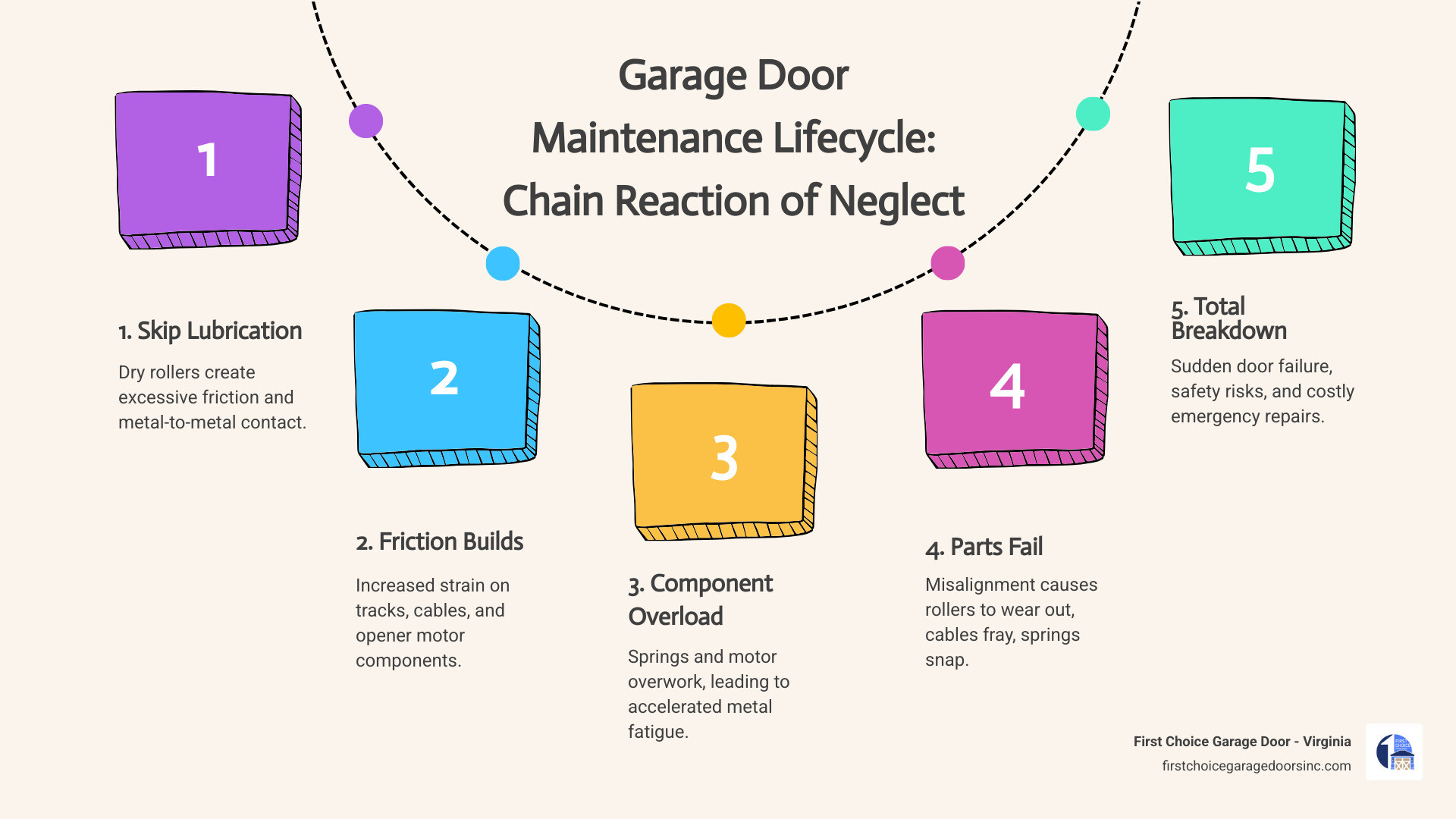
The Mechanical Chain Reaction of Neglect
Think of your garage door as a synchronized team. When one member stops pulling their weight, the rest of the team has to overcompensate. This is the “chain reaction of neglect.” It usually starts with something as simple as a lack of lubrication.

When moving parts aren’t lubricated, friction becomes the enemy. Metal-to-metal contact begins to grind down hinges and rollers. This resistance doesn’t just make the door heavy; it changes the sound of your home. There are more reasons a garage door could become noisy, but the most common is simply parts crying out for a little oil.
If you ignore these sounds, the strain spreads to the tracks. A door that struggles to move can vibrate the mounting hardware loose, leading to track misalignment. Once the tracks are out of plumb, the rollers can bind or even pop out entirely. This is why we emphasize the importance of professional Northern Virginia maintenance to keep everything rolling smoothly.
Parts most affected by poor lubrication include:
- Rollers: Bearings seize up, causing the wheel to slide rather than roll.
- Hinges: Pivot points grind down, leading to cracks in the metal.
- Springs: Coils can bind and develop surface rust, which acts like sandpaper.
- Pulleys and Bearings: These high-stress points can overheat and fail under load.
Why skipping garage door maintenance leads to sudden breakdowns
Most “sudden” breakdowns aren’t sudden at all; they are the finish line of a long race of wear and tear. When a door is neglected, the opener has to pull harder to overcome friction and imbalance. Eventually, a component reaches its breaking point.
There are 5 reasons your garage door won’t open or close, and nearly all of them are accelerated by a lack of service. When a part fails under load, it often damages adjacent components. For example, a snapped cable can cause the door to slam, bending the tracks and destroying the bottom panel. What could have been a simple adjustment turns into an expensive emergency repair.
Accelerated wear on high-tension springs
The springs are the “muscles” of your garage door. Most standard torsion springs are rated for about 10,000 cycles. However, skipping maintenance can significantly shorten this lifespan.
Without regular tension checks and lubrication, springs suffer from metal fatigue and surface corrosion. Why garage door springs are important cannot be overstated — they hold the entire weight of the door. When they snap, they do so with the force of a gunshot. A maintained counterbalance system ensures the door stays “weightless,” but a neglected one puts every ounce of that 100-400 pound door onto your opener and cables.
What Happens If You Skip Garage Door Maintenance: Safety Hazards
Safety is the biggest “hidden cost” of neglect. Modern garage doors are equipped with sophisticated safety features, but these are mechanical devices that require calibration.
If the photo-eye sensors become misaligned or dirty, the door might not detect an obstruction. Even worse is an auto-reverse failure. This system is designed to stop the door if it hits an object, but if the force settings are off due to a lack of maintenance, the door could continue to close, posing a major entrapment risk for children and pets.
There are serious risks that come with having a damaged garage door, ranging from property damage to life-threatening injuries. This is why you need to perform garage door inspections at least twice a year.
| Feature | Maintained Status | Neglected Status |
|---|---|---|
| Auto-Reverse | Stops/reverses on light contact | May fail to reverse, causing crushing |
| Photo-Eyes | Stops door if beam is broken | May be bypassed or fail to detect objects |
| Spring Tension | Door stays balanced and safe | Door may drop unexpectedly |
| Cables | Strong and flexible | Frayed and prone to snapping |
Understanding what happens if you skip garage door maintenance for your opener
Your opener is the “brain” of the operation, but it isn’t designed to lift a heavy, unbalanced door. When you skip maintenance, the motor has to work twice as hard. This leads to motor burnout, gear stripping (where the internal plastic gears literally shave off), and circuit board failure due to overheating.
Why your garage door opener needs repair in Manassas, VA often comes down to travel limit errors. As the door’s hardware shifts and loosens, the opener loses track of where “closed” is, leading to the door slamming into the floor or reversing because it thinks it hit something.
Environmental damage and local climate factors
Here in Northern Virginia, our climate is a major factor in garage door health. The high humidity in the summer can accelerate rust on metal components, while the freezing winters cause materials to contract and expand.
How weather can impact your garage door is especially evident in the wood and metal parts. Without regular cleaning and sealing, wooden doors can rot or warp, and metal doors can develop “spider rust” that eats through the finish. Seasonal shifts also affect the concrete floor, which can shift and prevent the door from creating a proper seal.
Security Vulnerabilities and Home Protection
A garage door is often the largest entry point into your home. If it doesn’t close perfectly, you’re leaving the “front door” wide open.
What happens if you skip garage door maintenance regarding security? For starters, worn-out locking mechanisms or a misaligned opener can make it easy for an intruder to manually force the door open. Furthermore, older, unmaintained openers might use static codes that are easy to hack, unlike modern rolling code technology.
Beyond human intruders, there’s the issue of pests. How a garage door could let bugs inside your house is usually through a cracked or missing bottom seal. In Manassas and the surrounding areas, we see everything from rodents to stinkbugs using these gaps as a highway into the home. Our Manassas, VA maintenance guide provides more details on keeping your home a secure barrier.
Impact on Energy Efficiency and Utility Bills
Many homeowners don’t realize that their garage acts as a giant thermal buffer for the rest of the house. If your garage door isn’t maintained, your HVAC system has to work harder.
The R-value of your door (its insulation rating) only matters if the door is properly sealed. When weatherstripping dries out and cracks, it creates a “thermal bridge,” allowing heat to escape in the winter and pour in during the summer. There are many weatherproofing tips that can help, but the most effective is simply replacing worn seals.
Using a high-quality garage door sealant prevents drafts that affect adjacent living spaces. If you’re wondering why your bonus room or kitchen is always drafty, you should check your garage door seal for light peeking through the edges.
Signs Your System Needs Urgent Professional Attention
You don’t always need to wait for a total failure to know something is wrong. Your door will usually give you warning signs:
- Jerky Movement: The door should move in one fluid motion. If it hitches or shudders, a track is likely misaligned or a roller is failing.
- Slow Response: If you press the remote and the door hesitates or moves significantly slower than it used to, the motor or springs are struggling.
- Sagging: When the door is halfway open, it should stay there. If it slides down, the springs have lost their tension.
- Frayed Cables: If you see “hairs” sticking out of your steel cables, they are about to snap.
There are five signs that you need a garage door repair that every homeowner should memorize. Knowing when you might need a garage door repair can save you from being trapped in your garage when you’re already running late for work.
Listen for these unusual noises:
- Grinding: Usually means metal-to-metal contact (needs lube).
- Squealing: Often indicates a bearing in a roller or pulley is failing.
- Banging: Could be the door panels hitting the track or a spring binding.
- Straining Motor: A high-pitched whine means the opener is overloaded.
Frequently Asked Questions about Garage Door Maintenance
How often should I service my garage door to avoid problems?
For most homes in Northern Virginia, we recommend a professional tune-up at least once a year. However, if you use your garage door as your primary entrance (opening it 4+ times a day), a semi-annual check-up is much better to catch wear on springs and rollers before they fail.
Can skipping lubrication cause permanent mechanical damage?
Yes. Friction is a destructive force. Without lubrication, hinges can snap, roller bearings can disintegrate, and the opener’s drive gear can be stripped of its teeth. Once these parts are physically damaged or deformed, they must be replaced; lubrication can no longer “fix” them.
Does neglecting maintenance affect the lifespan of my door?
Absolutely. A well-maintained garage door system can easily last 20 to 30 years. However, a neglected door often requires a full replacement in as little as 10 to 12 years because the cumulative damage to the panels, tracks, and opener becomes more expensive to fix than simply starting over.
Conclusion
At the end of the day, your garage door is a hardworking machine that deserves a little TLC. What happens if you skip garage door maintenance isn’t just a matter of convenience; it’s a matter of safety, security, and financial smarts.
By investing in preventative care, you ensure long-term reliability and avoid the stress of a sudden mechanical failure. At First Choice Garage Doors, we specialize in making this process easy for you. Our team brings unmatched expertise to every home in Manassas and across Northern Virginia, ensuring your door stays in peak condition year-round.
Don’t wait for the “bang” of a broken spring to call us. Experience our professional, stress-free garage door maintenance services today and keep your home moving smoothly.