
How Long Does a Garage Door Last? (Quick Answer for Virginia Homeowners)
How long does a garage door last is one of the most common questions homeowners ask — and the short answer is: most garage doors last between 15 and 30 years, depending on a few key factors.
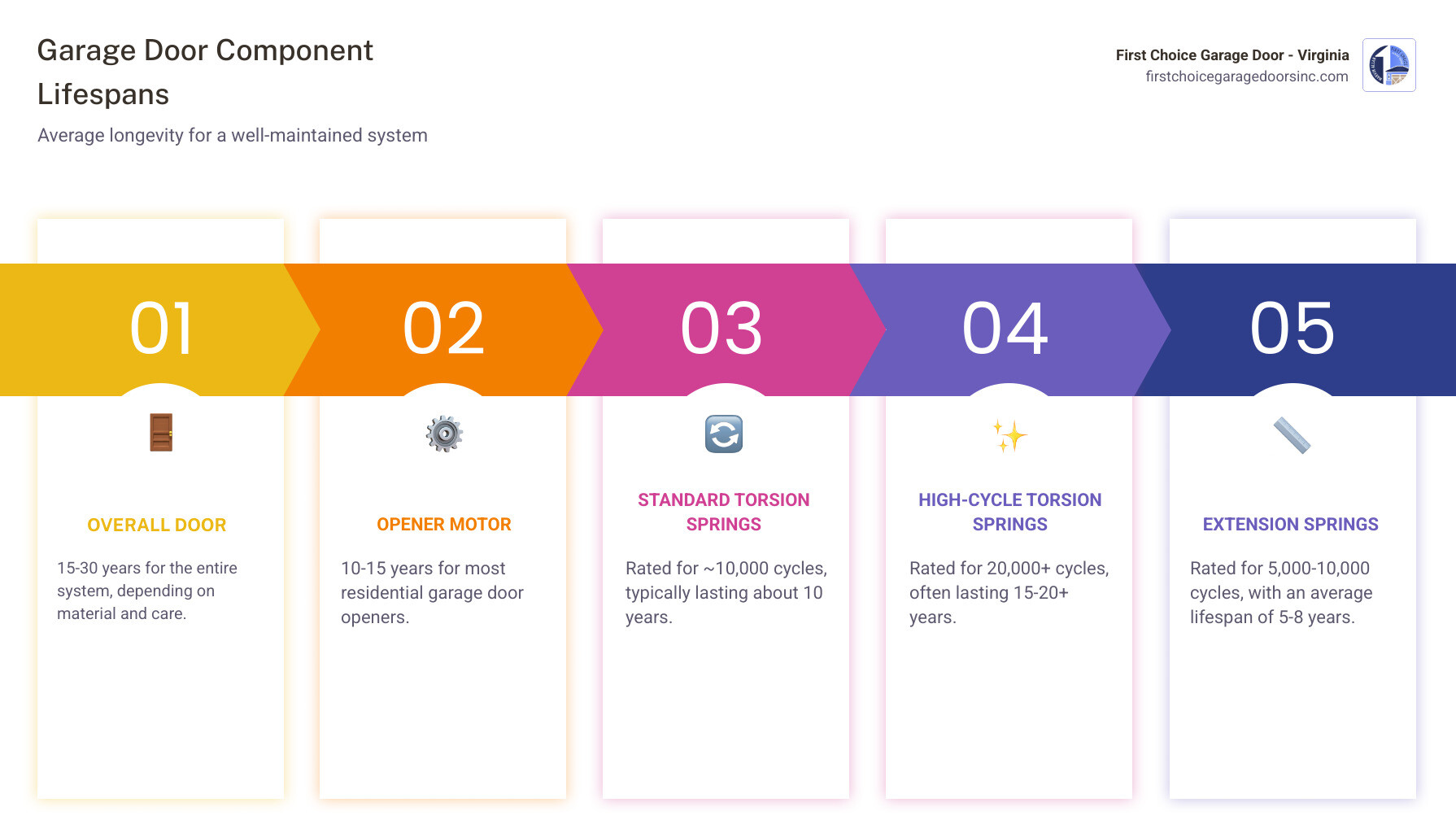
Here’s a fast breakdown by component:
| Component | Average Lifespan |
|---|---|
| Garage door (overall) | 15–30 years |
| Garage door opener | 10–15 years |
| Torsion springs (standard) | ~10,000 cycles (~10 years at 3 uses/day) |
| Torsion springs (high-cycle) | 20,000+ cycles (15–20+ years) |
| Extension springs | 5,000–10,000 cycles (~5–8 years) |
But those numbers aren’t guaranteed. A steel door in a humid Virginia climate with zero maintenance won’t last as long as a well-cared-for door in a moderate environment. Material choice, installation quality, how often you use it, and where you live all shape the real-world lifespan of your system.
Think of your garage door the way you think about your roof or your HVAC system. It’s a major home investment — and like those systems, it rewards attention and punishes neglect.
The good news? Most of the factors that shorten a garage door’s life are within your control.
This guide walks you through everything: what affects lifespan, how different materials compare, when to repair versus replace, and how to get the most years out of your door.
How Long Does a Garage Door Last?
When we talk about the lifespan of a garage door, we aren’t just talking about a single piece of equipment. We are talking about a complex system of moving parts, heavy panels, and sensitive electronics. What Is Able to Influence the Longevity of Your Garage Door? involves a combination of engineering and environment.
One of the most critical metrics we use to measure a door’s life is the “usage cycle.” Every time your door opens and closes, that is one cycle. Most residential doors are rated for a certain number of cycles—usually 10,000 to 20,000. If you use your door three times a day, you’re hitting about 1,000 cycles a year. If you have a busy household in Manassas where the garage acts as the main front door, you might be hitting 3,000 cycles a year, effectively cutting the mechanical lifespan in third.
The Role of Installation and Maintenance
Quality starts at day one. How to Tell Your Garage Door Wasn’t Installed Correctly is often visible in how the door moves. If the tracks aren’t perfectly aligned or the door is out of balance, the motor has to work twice as hard, and the panels undergo unnecessary stress. This “silent friction” can shave a decade off a door’s life before you even realize there’s a problem.
Furthermore, your maintenance habits (or lack thereof) are the biggest variable. A door that is never lubricated or inspected will likely fail closer to the 15-year mark, while a door that receives an annual tune-up can easily push toward 30 years.
How long does a garage door last based on material?
The material you choose is the foundation of your door’s durability. In Northern Virginia, where we deal with everything from summer humidity to winter slush, some materials hold up better than others.
| Material | Estimated Lifespan | Maintenance Level | Best For |
|---|---|---|---|
| Steel | 20–30 years | Low to Moderate | Durability & Insulation |
| Wood | 15–25 years | High | Curb Appeal & Aesthetics |
| Aluminum | 20–25 years | Low | Rust Resistance |
| Vinyl/Composite | 25–35 years | Very Low | Coastal/Humid Areas |
| Fiberglass | 20–25 years | Low | Salt Air Resistance |
When comparing Wood vs. Steel Garage Doors, the trade-off is usually beauty versus brawn. Steel is incredibly resilient and often comes in triple-layer insulated varieties that can last 30 years. However, if the paint is scratched, it can rust. Wood, while stunning, is susceptible to warping and rot if it isn’t sealed and painted every few years.
Composite materials have become a favorite for us in April 2026 because they offer the look of wood with the “set it and forget it” durability of vinyl. These can often last 30 years or more because they simply don’t rot or rust.
How long does a garage door last in Northern Virginia’s climate?
Geography plays a massive role in how your door ages. How Weather Can Impact Your Garage Door and How to Prepare It for the Cold is a major concern for our local customers.
- Humidity and Rain: Our humid summers can lead to moisture buildup. For those with natural materials, Protecting Your Wood Garage Door Against Rot is a seasonal necessity. Moisture can seep into the bottom panels, causing them to swell or decay.
- Temperature Swings: In Northern Virginia, we often see rapid shifts from freezing mornings to mild afternoons. This causes materials to expand and contract. Over time, this can loosen hardware like bolts and screws, leading to a “noisy” door.
- Winter Salt: If you use salt on your driveway to melt ice, that salt can kick up onto your garage door panels and tracks. Salt is highly corrosive to steel and aluminum. We always recommend rinsing the bottom of your door with fresh water after a snowstorm to prevent premature rusting.
Lifespan of Critical Components: Openers and Springs
While the door panels themselves might last 25 years, the “guts” of the system usually need attention much sooner.
The Springs: The Muscles of the Door

The springs do 95% of the heavy lifting. Standard torsion springs are typically rated for 10,000 cycles. Depending on how often you use your door, this usually means they will snap somewhere between year 7 and year 12. If you find yourself replacing springs frequently, we often recommend “high-cycle” springs, which are rated for 20,000 to 30,000 cycles and can last 20 years.
The Opener: The Brain of the System
A garage door opener typically lasts 10 to 15 years.
- Chain-Drive: These are the workhorses. They are loud but very durable.
- Belt-Drive: These use a rubber-reinforced belt. They are much quieter and often last just as long as chain drives, though the belt may eventually need tensioning.
- Smart Features: By 2026, many homeowners are replacing perfectly functional 15-year-old openers simply to get modern safety features, smartphone control, and battery backups.
Hardware fatigue is also real. Cables can fray, and rollers can develop flat spots. If your rollers are made of plastic, they might only last 5 years; nylon rollers with ball bearings can last 12 to 15 years and provide a much smoother, quieter ride.
Recognizing When Your System is Failing
Knowing the Signs You Need a Garage Door Replacement can save you from a morning where your car is trapped inside. It is often a gradual decline rather than a sudden break.
So, When Is It Time to Have a Garage Door Replacement? Look for these red flags:
- Sagging Panels: If you close the door halfway and see a “smile” or a dip in the middle, the structural integrity of the panels is compromised.
- Excessive Noise: Grinding, screeching, or banging often means the hardware is worn out or the door is severely out of balance.
- Jerky Movement: A healthy door should glide. If it hitches or jumps, it’s putting massive strain on the opener.
- Visible Damage: Widespread rust, rotted wood sections, or multiple deep dents from “oops” moments with the car are clear indicators.
When deciding When to Repair vs. Replace Your Garage Door, we usually use the “15-Year Rule.” If your door is over 15 years old and needs a major repair (like multiple panel replacements or a new motor), it is almost always more cost-effective to replace the entire system.
Proactive Care to Extend Longevity
You don’t have to be a mechanic to keep your door running well. How to Prevent Garage Door Damage often starts with simple observation.
Here are our top Six Preventive Residential Garage Door Maintenance Tips to help you hit that 30-year goal:
- The Balance Test: Once or twice a year, pull the red emergency release cord and lift the door manually. It should stay in place when opened halfway. If it slams shut or shoots up, the springs are out of whack and need professional adjustment.
- Lubrication is Key: Use a lithium or silicone-based spray on the hinges, rollers, and springs every six months. Never use WD-40 for lubrication; it’s a degreaser and will actually make things worse over time.
- Tighten the Hardware: A garage door vibrates every time it moves. Use a socket wrench to ensure all bolts and screws are snug.
- Clean the Tracks: Don’t lubricate the inside of the tracks (this just attracts gunk). Instead, wipe them out with a damp rag to remove dust and debris.
- Check the Weatherstripping: If the rubber seal at the bottom is cracked or brittle, it lets in moisture and pests. Replacing this is a cheap way to protect your door and your garage floor.
- Schedule Professional Inspections: There is no substitute for an expert eye. Why You Need to Perform Garage Door Inspections is about catching a $10 problem before it becomes a $1,000 replacement.
For more detailed advice, check out our Garage Door Maintenance Tips to Ensure a Long-Lasting Door.
Frequently Asked Questions
How many years do garage door springs typically last?
On average, standard springs last 7 to 10 years. This is based on a rating of 10,000 cycles and an average use of 3 to 4 times per day. If you use your garage door as your primary entrance, expect them to last closer to 5 or 6 years.
Can a well-maintained garage door last 30 years or more?
Yes! We frequently see high-quality steel and aluminum doors in Northern Virginia that are 30 years old and still functioning perfectly. The secret is always consistent lubrication and timely spring replacements.
Is it better to replace the opener when replacing the door?
While not strictly necessary, it is highly recommended. If your door is 20 years old, your opener is likely near the end of its life too. Installing them together ensures the motor is perfectly matched to the weight of the new door and saves you a second service call a year or two down the road.
Conclusion
Your garage door is the largest moving part of your home, and its lifespan is a direct reflection of how it was installed and how it has been treated. Whether you are in Manassas or anywhere else in Northern Virginia, understanding the Concerns with Having an Older Garage Door — from safety risks to decreased energy efficiency — is the first step in making the right choice for your home.
At First Choice Garage Doors, we pride ourselves on unmatched expertise and a commitment to safety. We’ve seen it all, from 40-year-old wooden relics to the latest smart-integrated systems. If you’re worried your door is on its last legs, or if you just want to ensure it reaches its 30th birthday, we are here to help.
Don’t wait for a spring to snap or a motor to burn out. Give us a call today for a professional inspection, and let’s make sure your garage door stays a reliable part of your home for decades to come.