
Why the Pros and Cons of Steel Garage Doors Matter Before You Buy
The pros and cons of steel garage doors are worth knowing before you invest in a new door for your Maryland home. Steel is the most widely chosen garage door material today — and for good reason. It holds up to daily use, handles harsh weather, and comes in dozens of styles. But it also has real trade-offs that can catch homeowners off guard.
Here’s a quick breakdown:
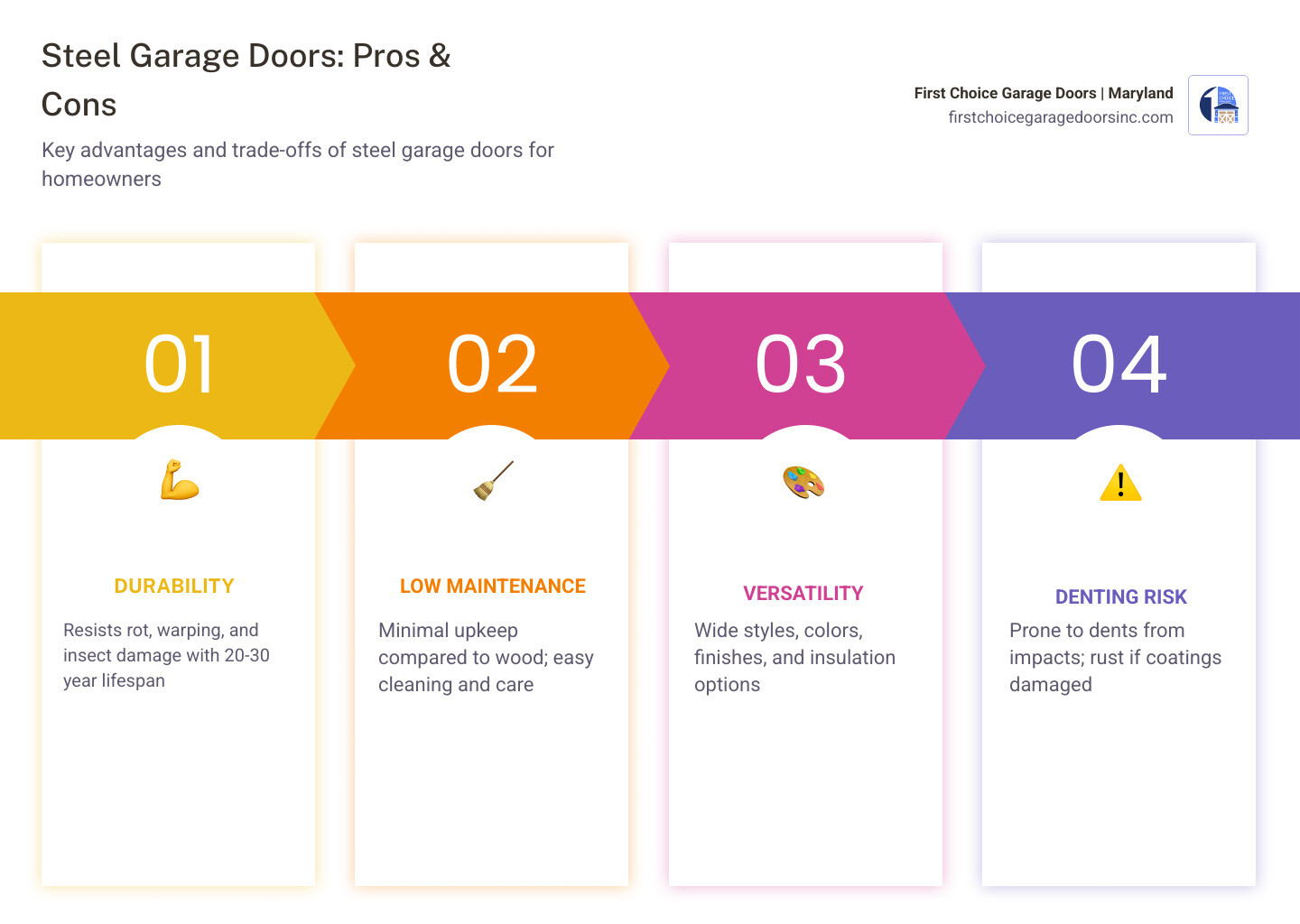
Pros of Steel Garage Doors
- Exceptional durability — resists rot, warping, and insect damage
- Low maintenance compared to wood
- Wide range of styles, colors, and finishes
- Available with insulation for better energy efficiency
- Strong resistance to forced entry
- Can last 20 to 30 years with proper care
Cons of Steel Garage Doors
- Vulnerable to dents and scratches from impacts
- Risk of rust if protective coatings are damaged or neglected
- Steel itself is a poor natural insulator — insulation must be added
- Can transfer heat and noise without proper insulation
- May not fully replicate the warmth and texture of real wood
Steel hits a sweet spot between affordability and long-term performance. That’s why it remains the go-to choice for homeowners and property managers alike, from suburban neighborhoods to commercial properties. But like any major home investment, the details matter — gauge, insulation level, finish, and climate all affect how well your door performs over time.
In this guide, we walk through everything you need to know to decide if steel is the right fit for your home.
Evaluating the Pros and Cons of Steel Garage Doors for Your Home
When we talk about the pros and cons of steel garage doors, we have to start with the sheer versatility of the material. As we head through April 2026, steel continues to dominate the market because it can be engineered to solve almost any problem a homeowner faces. Whether you have a busy household with kids playing basketball in the driveway or you need a sleek, modern look for a new build in Columbia, steel delivers.
One of the Main Reasons to Install a Steel Garage Door is its resistance to the elements. Unlike wood, which can swell with Maryland’s humidity or rot over time, steel remains structurally stable. It doesn’t warp or crack, which means the door continues to fit snugly in its tracks year after year.
However, we always remind our clients that “steel” isn’t just one thing. There are different thicknesses (gauges) and layers to consider. A single-layer door might be budget-friendly, but it’s much easier to dent. A three-layer door, with steel on both sides and insulation in the middle, is incredibly sturdy. Understanding Reasons You Should Have a Steel Garage Door Installation often comes down to this: you get exactly the level of protection you pay for.
Primary Advantages of Steel:
- Versatility: Can mimic wood grain or look ultra-modern.
- Longevity: Often lasts 20–30 years with minimal help.
- Value: Generally offers the best return on investment for curb appeal.
- Eco-Friendly: Steel is highly recyclable, making it a sustainable choice for 2026.
Understanding the Pros and Cons of Steel Garage Doors for Security
Security is a top priority for our customers in Frederick and Easton. When evaluating the pros and cons of steel garage doors, security sits firmly in the “pro” column. Steel is inherently difficult to puncture or break through. Modern galvanized steel is treated to be incredibly tough, providing a reliable barrier against forced entry.
Beyond the material itself, steel doors are designed to work with advanced locking mechanisms and tamper-resistant hardware. Because the panels are rigid, they don’t flex as easily as aluminum or vinyl, making it much harder for an intruder to pry the door away from the tracks. There are many Benefits of Steel Garage Doors, but the peace of mind knowing your family and vehicles are behind a literal wall of metal is at the top of the list. If you’re wondering Why to Use a Steel Garage Door, start with the safety of your home.
How Climate Impacts the Pros and Cons of Steel Garage Doors in Maryland
Maryland weather can be a bit of a rollercoaster. We deal with salty air in coastal areas near Easton, high humidity in Columbia, and significant temperature swings in Frederick. These conditions play a huge role in the pros and cons of steel garage doors.
The biggest concern in our region is rust. While modern doors use a “layered coating system”—including hot-dipped galvanization and baked-on primers—any deep scratch that reaches the raw steel can become a foothold for corrosion. This is especially true if you live near the water where salt air accelerates the process.
To mitigate this, we recommend Why You Should Get a Metal Garage Door that features a high-quality factory finish. If you do get a scratch from a stray bike or a lawnmower, touching it up immediately with matching paint is the best way to prevent a small nick from becoming a big rust spot. Additionally, steel’s low thermal conductivity means that in the heat of a Maryland summer, an uninsulated door can turn your garage into an oven. This makes insulation a necessity rather than an option for most of our local clients.
Comparing Steel to Wood, Aluminum, and Composite Materials
Choosing a material is the hardest part of the process. To help you “steel” yourself for the decision, let’s look at how it stacks up against the competition.
| Feature | Steel | Wood | Aluminum | Composite |
|---|---|---|---|---|
| Durability | High (Dents possible) | Moderate (Rot/Warp) | Moderate (Dents easily) | High |
| Maintenance | Low (Rust checks) | High (Annual sealing) | Low (Corrosion resistant) | Very Low |
| Aesthetics | Versatile | Authentic/Warm | Modern/Sleek | Wood-like |
| Security | Excellent | Good | Moderate | Good |
| Insulation | High (If insulated) | Natural | Low | High |
When Comparing Wood with Steel Garage Doors, the biggest difference is the “homework.” Wood is beautiful but requires sanding and staining every year or two to stay healthy. Steel, on the other hand, just needs a quick wash. For those who love the look of timber but hate the chores, Wood vs Steel Garage Doors comparisons often end with the homeowner choosing a steel door with a “wood-grain” texture.
If you’re Choosing Between Steel and Aluminum Garage Doors, aluminum is lighter and naturally rust-proof, but it’s much softer. A stray basketball that might bounce off a thick-gauge steel door could leave a permanent crater in an aluminum one. That’s why we often suggest steel for families with active kids. You can read more on this in our guide: Should I Install a Steel or Aluminum Garage Door?
Lastly, Comparing Vinyl Garage Doors with Steel Garage Doors shows that while vinyl is “dent-proof,” it lacks the structural strength and design variety that steel offers. Steel remains the most balanced option for most Maryland properties.
The Importance of Insulation and Steel Gauge in 2026
In 2026, energy efficiency isn’t just a buzzword; it’s a requirement. If you are looking at the pros and cons of steel garage doors, you must look at the R-value. Steel is a metal, and metal is a great conductor of heat. Without insulation, a steel door will pull the cold in during the winter and the heat in during the summer.
We recommend looking for doors that comply with the 2015 IECC air infiltration requirements (0.40 cfm/ft2 or less). High-quality insulated steel doors can achieve R-values ranging from 6.3 to 18.4. This is usually achieved through two types of insulation:
- Polystyrene: Rigid foam panels inserted between the steel layers.
- Polyurethane (Intellicore®): A foam that is injected into the door, expanding to fill every crevice. This not only provides better R-values but also makes the door significantly stronger and quieter.
When asking How Many Layers Should Your Steel Garage Door Have?, we generally suggest a three-layer construction for Maryland homes. This creates a “sandwich” of steel-insulation-steel. It’s the gold standard for noise reduction—perfect if you have a bedroom above the garage—and it makes the door feel much more substantial.
Don’t forget the “gauge” of the steel. In metal, a lower number means a thicker door. A 24-gauge door is thicker and more dent-resistant than a 27-gauge door. If your garage faces a busy street or a driveway where kids play, “stepping up” to a thicker gauge is one of the smartest moves you can make. Why Install a Steel Garage Door often comes down to this ability to customize the door’s strength to your specific lifestyle.
Maintenance Strategies for Long-Term Performance
Even though steel is low-maintenance, it’s not “no-maintenance.” To ensure your door lasts 20 to 30 years, you need a simple annual strategy. The pros and cons of steel garage doors are heavily influenced by how well you treat the finish.
First, let’s talk about cleaning. Dirt, salt, and debris can trap moisture against the steel, leading to rust. We recommend washing your door at least twice a year with mild soap and water. Knowing How to Clean Your Steel Garage Door properly—and avoiding harsh chemicals—will keep the factory finish looking new.
Annual Maintenance Checklist:
- Inspect for Scratches: Look for any nicks in the paint. Use a touch-up kit immediately to seal the metal.
- Lubricate Moving Parts: Use a high-quality silicone or lithium spray on the rollers, hinges, and tracks. (Avoid WD-40 as it can actually attract gunk over time).
- Check the Weatherstripping: Make sure the seal at the bottom of the door is intact. This keeps out rain and prevents “standing water” from sitting against the bottom steel panel.
- Tighten Hardware: Garage doors vibrate. Use a wrench to ensure all bolts are snug.
- Test the Balance: Disconnect the opener and lift the door halfway. If it stays put, it’s balanced. If it falls or shoots up, the springs need professional adjustment.
By staying on top of these small tasks, you’ll find that the Why Get a Steel Garage Door argument only gets stronger over time. A well-maintained steel door is one of the most reliable components of your home.
Conclusion
At First Choice Garage Doors, we’ve seen every type of door under the Maryland sun. From the historic streets of Annapolis to the growing neighborhoods of Frederick and Columbia, the pros and cons of steel garage doors remain a central conversation for our customers.
Steel offers an unbeatable combination of strength, style, and value. While it requires a little vigilance against dents and rust, the trade-off is a door that provides superior security and energy efficiency for decades. Whether you’re looking for a contemporary flush panel or a classic carriage house design, we have the expertise to help you choose the right gauge and insulation level for your specific needs.
Our team of experienced professionals is dedicated to safety and quality. We don’t just install doors; we ensure they are a lasting asset to your property. If you’re ready to upgrade your curb appeal and protect your home with a heavy-duty steel door, we’re here to help.
Contact First Choice Garage Doors for a professional garage door estimate today, and let us help you find the perfect fit for your Maryland home!