
Why Your Children Need to Know Garage Door Safety Rules
Teaching children about garage door safety is one of the most important — and most overlooked — steps in keeping your family safe at home.
Here are the core rules to teach your kids right now:
- Never stand, play, or run near a moving garage door
- Keep fingers away from section joints, hinges, and tracks
- Never touch springs, cables, or sensors
- Only adults operate the door opener or keypad
- Never try to walk under a door that is closing
- Keep the access code private — never share it with friends
- Tell a parent immediately if anything looks broken or out of place
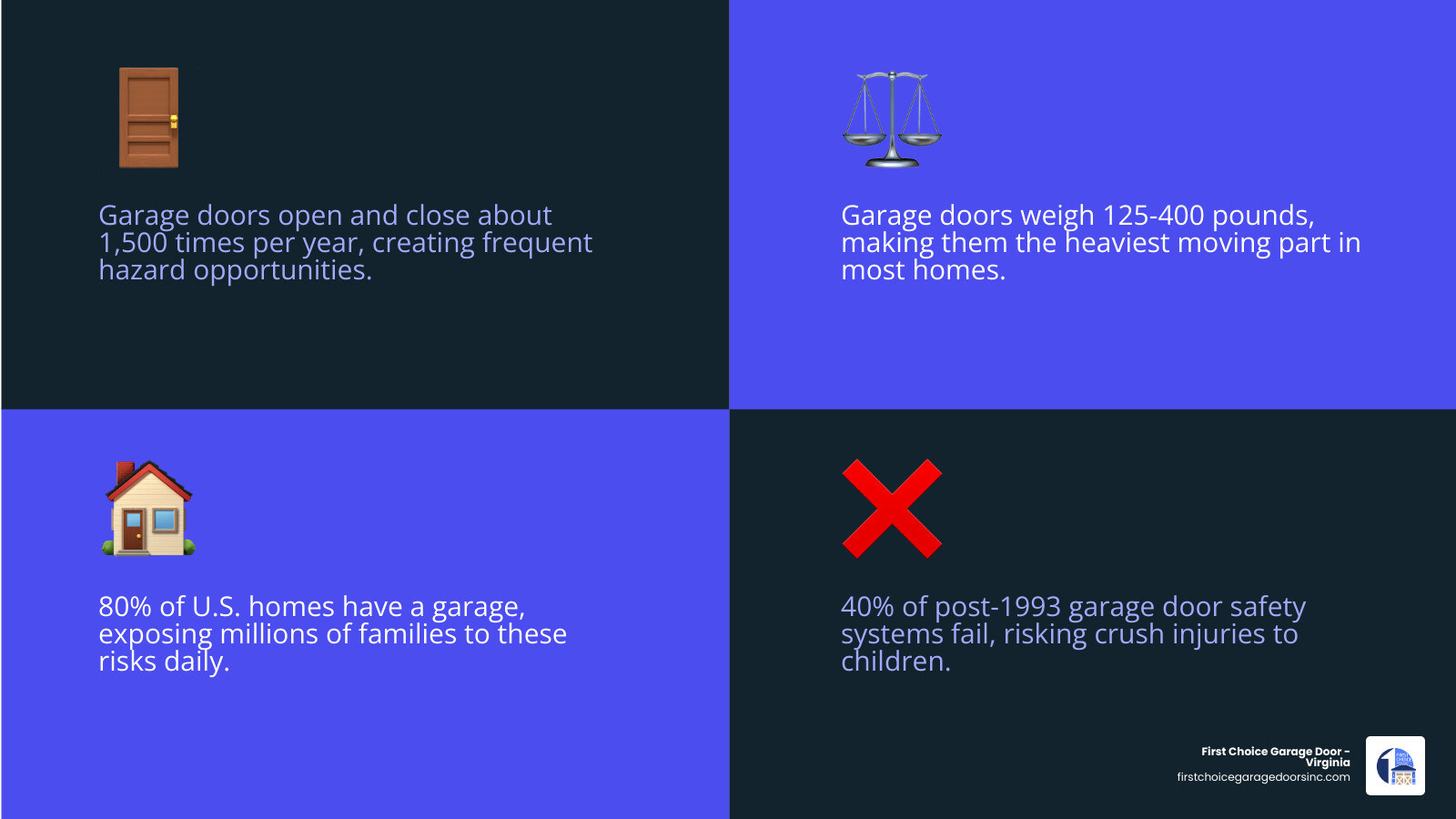
Think about this: your garage door opens and closes roughly 1,500 times a year. That’s a lot of chances for a curious child to get too close. And with 80% of U.S. homes having a garage, this is a hazard most families live with every single day.
The garage door is the largest moving part in your home. It can weigh anywhere from 125 to 400 pounds. Even with built-in safety features, a 2013 Consumer Product Safety Commission study found that 40% of safety systems on garage doors made after 1993 were not working properly — meaning the door could come down with enough force to seriously injure a small child.
The good news? A few simple conversations and rules can go a long way toward preventing accidents.
Why Teaching Children About Garage Door Safety is Essential
In April 2026, we find that the garage has become the primary entry point for many Northern Virginia families. Because we use these doors so frequently, it is easy to forget that they are heavy industrial machines. Children, with their natural curiosity and boundless energy, often view the garage door as a giant toy or a challenge to be raced against.
Unfortunately, the statistics tell a sobering story. As mentioned, a significant percentage of safety reversal systems fail to operate correctly over time. This creates a high risk for crush hazards and entrapment. If a door’s auto-reverse mechanism is out of alignment, it may not detect a small child in its path, coming down with hundreds of pounds of pressure.
Beyond the weight of the door itself, there are mechanical risks. High-tension springs can snap, and cables can fray. By teaching children about garage door safety, you are giving them the tools to recognize these dangers before an accident happens. Education is the first line of defense against the very real risks of entrapment and impact injuries.
Explaining How a Garage Door Works to Kids
The best way to demystify the garage door is to explain how it works in a way a child can understand. We like to tell kids that the garage door is like a giant, heavy wall that “cheats” to move up and down.
While the door can weigh up to 400 lbs, it doesn’t feel that heavy to the motor because of the springs. You can explain that the springs (either torsion springs located above the door or extension springs along the tracks) act like giant rubber bands that do all the heavy lifting. The lifting cables are the “muscles” that pull the door up.
Understanding this helps children realize that if one of those “muscles” or “rubber bands” breaks, the door becomes a very heavy object that can fall quickly. This is a great time to review safety measures to take with an automated garage door so they know that the motor isn’t just magic—it’s a machine that needs to be respected.
Teaching Children About Garage Door Safety Through Demonstration
One of the most effective ways to teach is through a hands-on demonstration. With an adult present, you can perform a “manual lift test.” Disconnect the opener and show the children how, when properly balanced, an adult can lift the door with just one hand.
Explain the “8 to 10 pound rule”: a healthy door should only feel like it weighs about as much as a large bag of flour when moved manually. If it feels heavier, the springs are tired and dangerous. By involving them in this check, you manage their curiosity. Instead of them “exploring” the door when you aren’t looking, they feel like they are part of the “safety team” and understand the mechanics involved.
Identifying the Most Dangerous Garage Door Components
When we visit homes in Manassas or across Northern Virginia, we often see kids playing near the most dangerous parts of the system without even knowing it. It’s vital to point these out specifically.
- Springs and Cables: These are under extreme tension.
- Photo-eye Sensors: These “eyes” near the floor are the door’s brain; if they are bumped, the door might not stop for an obstruction.
- Section Joints: The gaps between the panels where the door folds.
- Tracks and Rollers: The path the door follows.
Reviewing these 5 garage door safety tips with your kids can help them identify these specific zones as “no-touch” areas.
Why Kids Should Never Touch Springs or Cables
The springs and cables are the most dangerous components for anyone, especially children. These parts are under enough tension to cause severe injury or worse if they snap or are tampered with.
Explain to your children that the steel drums and cables are like a tightly wound clock—if you poke it, it can “explode” with force. Instruct them to never put their hands near the cables and to tell you immediately if they see a cable that looks “fuzzy” (frayed) or a spring that has a gap in it. These repairs are strictly for professionals.
The Danger of Fingers in Section Joints and Tracks
Pinch points are a major cause of ER visits related to garage doors. As the door moves, the gaps between the panels (section joints) open and close like a pair of giant scissors.
We recommend teaching children to only use the lift handles if they ever have to touch the door, and to keep their hands completely clear of the tracks. If your door doesn’t have flush-mount hinges or pinch-protection sections, it is even more critical to emphasize a “hands-off” policy for the entire surface of the door while it is in motion.
Essential Rules for Teaching Children About Garage Door Safety
Establishing clear, non-negotiable household rules is the best way to ensure safety. The garage should be treated as a “no-play zone” whenever the door is moving. Children should be taught to “stand back and stay still” until the door has completely finished its cycle.
For more detailed guidelines, you can print out these garage door safety tips to follow and post them in the garage as a reminder.
Teaching Children About Garage Door Safety and Access Codes
A common issue we see in Northern Virginia is children sharing the garage keypad code with friends. Treat the garage code like a “top-secret password.”
- The 5-Foot Rule: Ensure your wall-mounted buttons and exterior keypads are at least five feet off the ground. This prevents toddlers from accidentally opening the door.
- Shielding Hands: Teach older children to shield their hands when entering the code so neighbors or friends can’t see it.
- Remote Storage: Remotes should never be left in a place where a child might think they are a toy, like a low coffee table or a toy box.
Why Climbing on Garage Doors is Prohibited
To a child, the reinforcement struts on the back of a garage door look exactly like the rungs of a ladder. However, climbing on these struts can be disastrous. Not only is there a risk of the child falling if the door is activated, but the extra weight can bend the struts, damaging the door’s structure and causing it to fall out of its tracks. Make it clear: the garage door is not a jungle gym.
The Role of Older Siblings and Regular Safety Checks
If you have older children, enlist them as “Safety Deputies.” Giving them the responsibility to watch over younger siblings near the garage door reinforces their own knowledge of the rules. They can be the ones to make sure the “safety eyes” (photo-eyes) are clear of toys and that everyone is standing at a safe distance.
This is also a great way to talk about keeping pets safe around your garage door, as older kids are often the ones letting the dog in and out through the garage.
Testing the Auto-Reverse System with Your Family
Make safety a family event! Once a month, perform the “Object Test.” Place a 2×4 piece of wood or a sturdy roll of paper towels on the ground in the path of the door. Have the children watch from a safe distance as you close the door.
When the door hits the object, it should immediately reverse. If it doesn’t, it’s time for a professional inspection. This demonstration shows them exactly how the infrared beam and pressure sensors work to keep them safe. You can also show them how to clean the photo-eye lenses with a soft cloth to keep the “eyes” seeing clearly.
Frequently Asked Questions about Garage Safety
How high should the garage door keypad be installed?
To prevent young children from operating the door without supervision, the keypad and the internal wall button should be installed at least five feet (1.5 meters) above the floor. This keeps the controls out of reach of curious toddlers while remaining accessible to adults and older children who have been taught the safety rules.
What is the “8 to 10 pound” rule for garage doors?
This rule refers to the balance of the door. When you disconnect the automatic opener and lift the door manually, a properly balanced door should feel like it weighs only 8 to 10 pounds (about 3.5 to 4.5 kg). It should stay in place if you leave it halfway open. If it’s difficult to lift or slams shut, the springs are not doing their job and need professional attention.
How often should I test the auto-reverse safety feature?
We recommend testing the auto-reverse system and the photo-eye sensors at least once a month. Since garage doors are used so frequently in Northern Virginia, parts can shift or become dirty quickly. Regular testing ensures that the “invisible beam” is aligned and the motor is sensitive enough to reverse if it hits an obstruction.
Conclusion
At First Choice Garage Doors, we believe that a safe home starts with an educated family. Teaching children about garage door safety isn’t just about rules; it’s about giving them the respect for machinery they need to live safely in a modern home. From Manassas to the furthest reaches of Northern Virginia, we are dedicated to helping our neighbors keep their largest moving household part in peak, safe condition.
If you are concerned about your door’s safety features, or if it’s been a while since your last professional check-up, don’t wait for an accident to happen. We offer comprehensive garage door maintenance and safety inspections to ensure your reversal systems, springs, and sensors are working exactly as they should.
Stay safe, keep those “secret codes” private, and remember—the garage door is a tool, not a toy!