
Garage Door Panel Replacement vs Full Door Replacement: Which One Do You Actually Need?
garage door panel replacement vs full door replacement is one of the most common decisions homeowners face after a dent, crack, or storm leaves part of their door damaged.
Here’s the short answer:
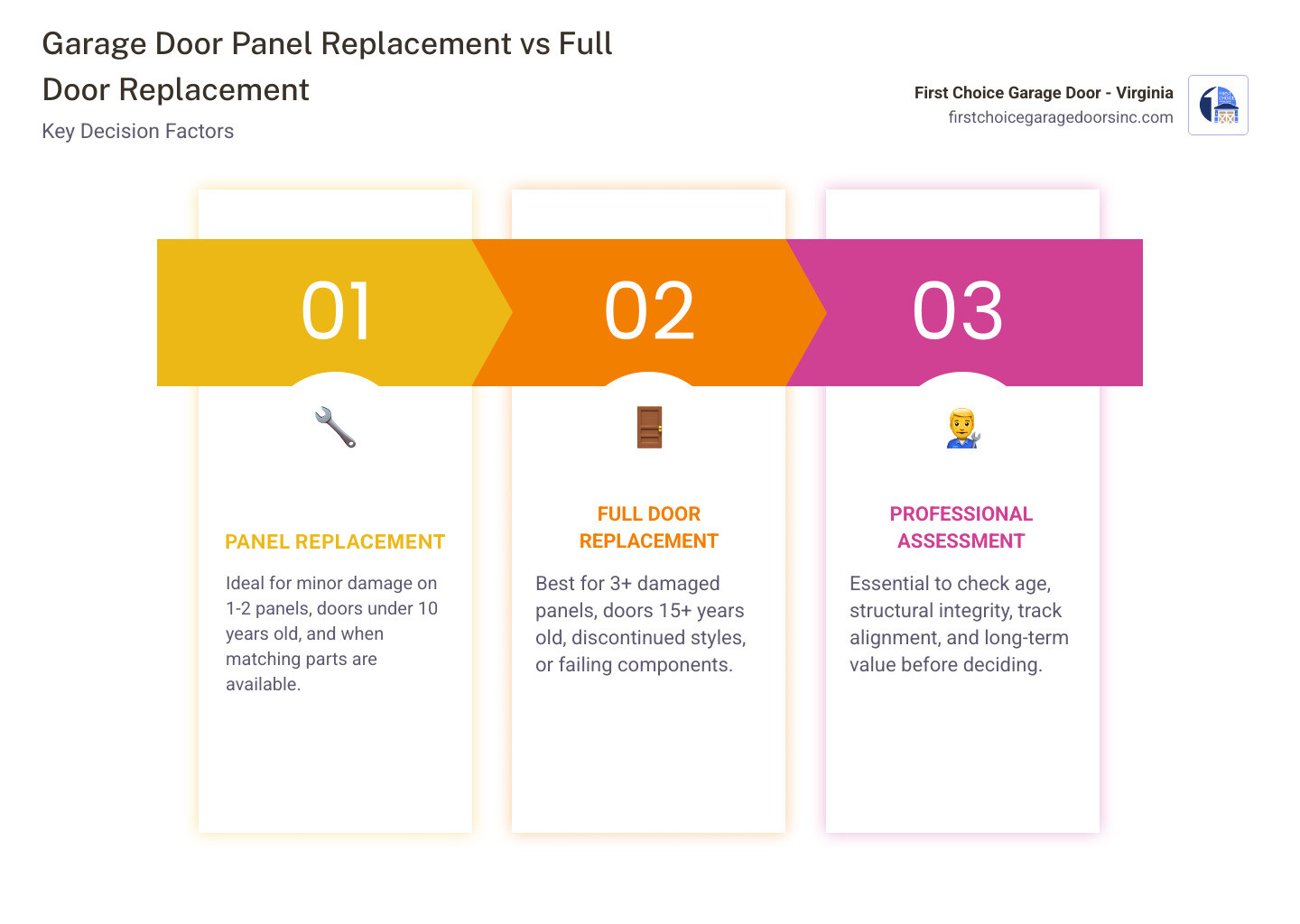
| Situation | Best Option |
|---|---|
| Minor damage on 1-2 panels, door under 10 years old | Panel replacement |
| Damage on 3+ panels, door 15+ years old | Full replacement |
| Discontinued style or poor color match | Full replacement |
| Tight budget, rest of door in good shape | Panel replacement |
| Planning to sell your home | Full replacement |
| Multiple system components failing | Full replacement |
The good news is that sectional garage doors are designed so individual panels can be swapped out — you don’t always need to replace the whole thing. But whether a single-panel fix actually makes sense depends on a few key factors: the age of your door, the extent of the damage, and whether a matching replacement panel is even available.
The tricky part isn’t always the repair itself — it’s figuring out which repair is actually worth it.
Choosing the wrong path can mean spending money on a partial fix that fails quickly, or replacing a door that still had years of life left. This guide walks you through both options clearly, so you can make a confident, informed decision for your home in Northern Virginia.
Is it Possible to Replace Just One Section of a Garage Door?
When a rogue basketball or a slow-speed bumper tap leaves a visible dent in your garage door, your first instinct is likely to look for a localized fix. We often get asked if it is truly possible to replace just one section of a garage door without tearing out the entire system.
The answer is a resounding yes—provided you have a sectional roll-up door. Most modern residential setups in Northern Virginia utilize these doors, which are typically composed of three to four hinged panels. Because these panels are connected by hinges and operate on a track, they can technically be detached and replaced individually.
However, “possible” doesn’t always mean “simple.” The feasibility of a single-section swap depends heavily on panel availability. Manufacturers update their designs every few years. If your door was installed recently, sourcing a matching model is usually straightforward. If your door is older, we might find that the specific style, thickness, or tongue-and-groove locking mechanism has been discontinued.
To determine if your door is a candidate for a single-panel facelift, we recommend looking for the manufacturer’s identification sticker. These are usually located on the interior side of the panels. This label contains crucial codes regarding the style, color, and insulation type. Knowing When You Need A Garage Door Replacement often starts with understanding whether these parts are still in production.
Beyond aesthetics, we also have to consider track alignment and weight distribution. Every garage door is a finely balanced machine. If a new panel has a slightly different weight than the original, it can throw off the spring tension, leading to premature wear on your opener.
When Panel Replacement is the Right Choice for Your Home
There are specific scenarios where replacing a single panel is not just possible, but the smartest financial move. If your garage door is relatively young—typically under 10 years old—and the rest of the system is functioning flawlessly, a panel replacement is often the way to go.
We frequently see “localized” damage that doesn’t compromise the structural integrity of the entire door. Common culprits include:
- Minor vehicle impacts: A bumper tap that dents the bottom panel but leaves the tracks and sensors untouched.
- Storm debris: A fallen branch during a Northern Virginia thunderstorm that punctures a single section.
- Cosmetic wear: A single panel showing early signs of rust or deep scratches while the others remain pristine.
When the damage is purely cosmetic and limited to one or two sections, a replacement can restore your home’s curb appeal quickly. The key is When To Repair Vs Replace Your Garage Door. If the hardware—meaning the rollers, tracks, and springs—is in good condition, there is no need to invest in a full system.
Another factor is the match. For newer doors, we can often achieve a near-perfect match in grain and texture. This makes the repair invisible to the naked eye, maintaining the uniform look of your home’s exterior. If your budget is a primary concern and the door’s overall lifespan hasn’t reached its twilight years, replacing the section is a practical, budget-friendly fix.
Comparing the Value of Garage Door Panel Replacement vs Full Door Replacement
When we look at the long-term value of your home, the choice between a repair and a full replacement becomes a strategic investment. While a panel replacement solves an immediate problem, a full door replacement can fundamentally change the performance and value of your property.
| Feature | Panel Replacement | Full Door Replacement |
|---|---|---|
| Lifespan | Extends the life of the current door | Fresh 20-25 year life expectancy |
| Aesthetics | May have slight color variance | Guaranteed uniform appearance |
| Energy Efficiency | Limited to existing R-values | Opportunity to upgrade insulation |
| Safety Features | Relies on existing technology | Modern pinch-resistant & sensor tech |
| ROI | Restores current value | Exceptional (up to 268% ROI) |
According to the 2025 Cost vs. Value Report, garage door replacement remains one of the highest-returning home improvement projects, with some reports showing an ROI as high as 268%. This is largely because the garage door can make up nearly 40% of your home’s street-facing appearance. A brand-new door doesn’t just look better; it signals to potential buyers that the home has been meticulously maintained.
Beyond resale value, Choosing Between Garage Door Repair Or Replacement involves looking at energy efficiency. Modern “sandwich” steel doors offer significantly higher R-values than older models. In Northern Virginia, where our summers are humid and winters are biting, a well-insulated door can keep your garage 10 to 18 degrees more comfortable, which eventually reflects on your energy bills.
Deciding Between Garage Door Panel Replacement vs Full Door Replacement for Older Models
If your garage door has been serving your home for 15 years or more, the decision-making process changes. We often refer to the “15-year rule.” At this stage in a door’s life, the components are reaching the end of their rated cycles. Torsion springs, for example, are typically rated for 10,000 to 20,000 cycles, which usually translates to 8 to 14 years of normal use.
When you have an older door, finding a matching panel becomes a significant hurdle. Even if we find the exact model, sun fading and paint oxidation mean a brand-new panel will likely stand out like a sore thumb against the weathered sections. This aesthetic mismatch can actually hurt your curb appeal more than a small dent.
Furthermore, structural fatigue is a real concern. When Is It Time To Have A Garage Door Replacement is often answered when we see sagging or warping across multiple panels. If you replace one section on a 20-year-old door, you are essentially putting a new band-aid on a system that may require a full replacement only a year or two later. In these cases, the long-term value lies in a full replacement to avoid “nickel-and-diming” yourself with constant repairs.
Why Professional Assessment Matters for Garage Door Panel Replacement vs Full Door Replacement
It is tempting to look at a dented panel and think of it as a DIY weekend project. However, the U.S. Consumer Product Safety Commission (CPSC) reports between 20,000 and 30,000 injuries every year related to garage doors, many of which stem from DIY repair attempts.
A garage door is the largest moving object in your home, and it is under immense tension. When we perform a 25-point safety inspection, we aren’t just looking at the dent. We are checking the spring tension, the cable integrity, and the track alignment. Replacing a panel requires disconnecting the door from its tension system. If handled improperly, a torsion spring can release its energy with enough force to cause serious injury.
Professional assessment also ensures that your door complies with Northern Virginia building codes and wind-load requirements. Our NATE-certified technicians understand the specific structural needs of homes in Manassas and the surrounding areas. We can identify if a “minor” dent has actually compromised the door’s ability to withstand high winds. Do You Need A Garage Door Replacement Check For These Signs To Find Out before you attempt a repair that could leave your home vulnerable.
Signs Your System Requires a Full Door Replacement
While we always look for the most cost-effective solution for our customers, there are “red flags” that indicate a full replacement is the only safe and logical path forward. If you notice any of the following, a simple panel swap likely won’t suffice:
- Multiple Damaged Sections: If three or more panels are damaged, the cost of individual sections and the labor to install them often approaches the cost of a brand-new door.
- Structural Warping or Sagging: If the door looks “heavy” or bows in the middle when opening, the structural integrity of the frame is likely compromised. This puts massive stress on your opener motor and rollers.
- Obsolete Safety Technology: If your door is over 20 years old, it may lack modern safety features like pinch-resistant technology or high-quality electronic eye sensors. Signs You Need A Garage Door Replacement include a lack of auto-reverse mechanisms that are standard today.
- Excessive Noise and Vibration: While some noise is normal, a door that grinds, squeaks, or vibrates violently often has underlying track and roller issues that a new panel won’t fix.
- Frequent Breakdowns: If you find yourself calling for repairs every few months, you’ve likely reached the end of the door’s 20-25 year life expectancy.
A full replacement offers a “fresh start.” You get a quieter operation, better security, and the peace of mind that every component—from the springs to the weatherstripping—is brand new and under warranty.
Frequently Asked Questions
Is DIY garage door panel replacement safe?
Generally, no. We strongly advise against DIY panel replacement. The process involves manipulating the door’s weight while it is disconnected from the safety cables and torsion springs. These springs are under enough tension to lift a several-hundred-pound door; if they snap or release unexpectedly during your repair, the results can be catastrophic. Professional technicians use specialized tools to “pin” the springs and ensure the door remains stable throughout the process.
How do I find my garage door model for a replacement panel?
The easiest way is to look for the manufacturer’s label. This is typically a white or silver sticker located on the inside of one of the panels (often the end stiles). It will list the model number, serial number, and sometimes the manufacture date. If the sticker is missing, we can often identify the door by measuring the width, height, and thickness of the panels, as well as the unique “design” or “stamp” on the exterior face.
Will a new panel match my existing weathered door?
This is the biggest challenge with panel replacement. Even with the exact same paint code from the factory, your existing door has likely suffered from sun fading and paint oxidation over the years. This is especially true for south-facing garages in Northern Virginia that get direct sunlight all day. While we can sometimes use professional color-matching techniques or suggest painting the entire door after the repair, a full replacement is the only way to guarantee 100% aesthetic uniformity.
Conclusion
Deciding between garage door panel replacement vs full door replacement doesn’t have to be a guessing game. By weighing the age of your door, the availability of parts, and the long-term ROI of a new installation, you can choose the path that best protects your home and your wallet.
Whether you need a quick panel fix for a minor dent or a complete system overhaul to boost your home’s curb appeal, professional guidance is key. A garage door is a complex system of moving parts where safety should always come first. For homeowners in Manassas and throughout Northern Virginia, making the right choice today ensures a reliable, beautiful door for decades to come.
Contact our experts for professional garage door repair and assessment to find out which option is right for your home. We are here to ensure your garage door remains a safe, efficient, and attractive part of your property.