
Why Homeowners Are Switching from Chain to Belt Drive Systems
Garage door chain to belt conversion is a topic many homeowners research when their noisy chain-drive opener becomes too disruptive, especially if bedrooms are located above or near the garage. The constant rattling, clanking, and vibration of a chain drive can disturb your household every time the door opens or closes. While the idea of simply swapping out the chain for a belt sounds appealing, the reality is more complicated than you might expect.
Can you convert a chain drive to a belt drive?
- Direct conversion is rarely feasible: Most chain-drive openers cannot be retrofitted with a belt because the rail, trolley, sprocket, and motor are designed specifically for chain operation.
- Rails are not interchangeable: Chain and belt systems use different rail profiles and dimensions, so the old rail typically won’t work with a new belt assembly.
- Full replacement is recommended: Replacing the entire opener unit with a new belt-drive model is the most practical, safe, and cost-effective solution.
- Professional installation ensures safety: Garage door springs are under extreme tension, and proper alignment of sensors and travel limits is critical for safe operation.
If you’re considering an upgrade, learn more about garage door openers or get a free estimate from a trusted professional.
The good news is that replacing your old chain-drive opener with a modern belt-drive system delivers significant benefits beyond just noise reduction. Belt-drive openers offer smoother operation, less vibration, lower maintenance, and access to smart features like Wi-Fi connectivity and battery backup. Understanding why a full replacement makes more sense than a conversion will help you make an informed decision that improves your home’s comfort and value.
Why Consider a Belt Drive Opener?
We understand that a garage door opener isn’t just about opening and closing a door; it’s about the comfort and convenience of your home. If you’re currently dealing with a noisy chain-drive system, you’re likely dreaming of a quieter existence. That’s where belt-drive openers shine, offering a host of benefits that make them a popular choice for modern homes.
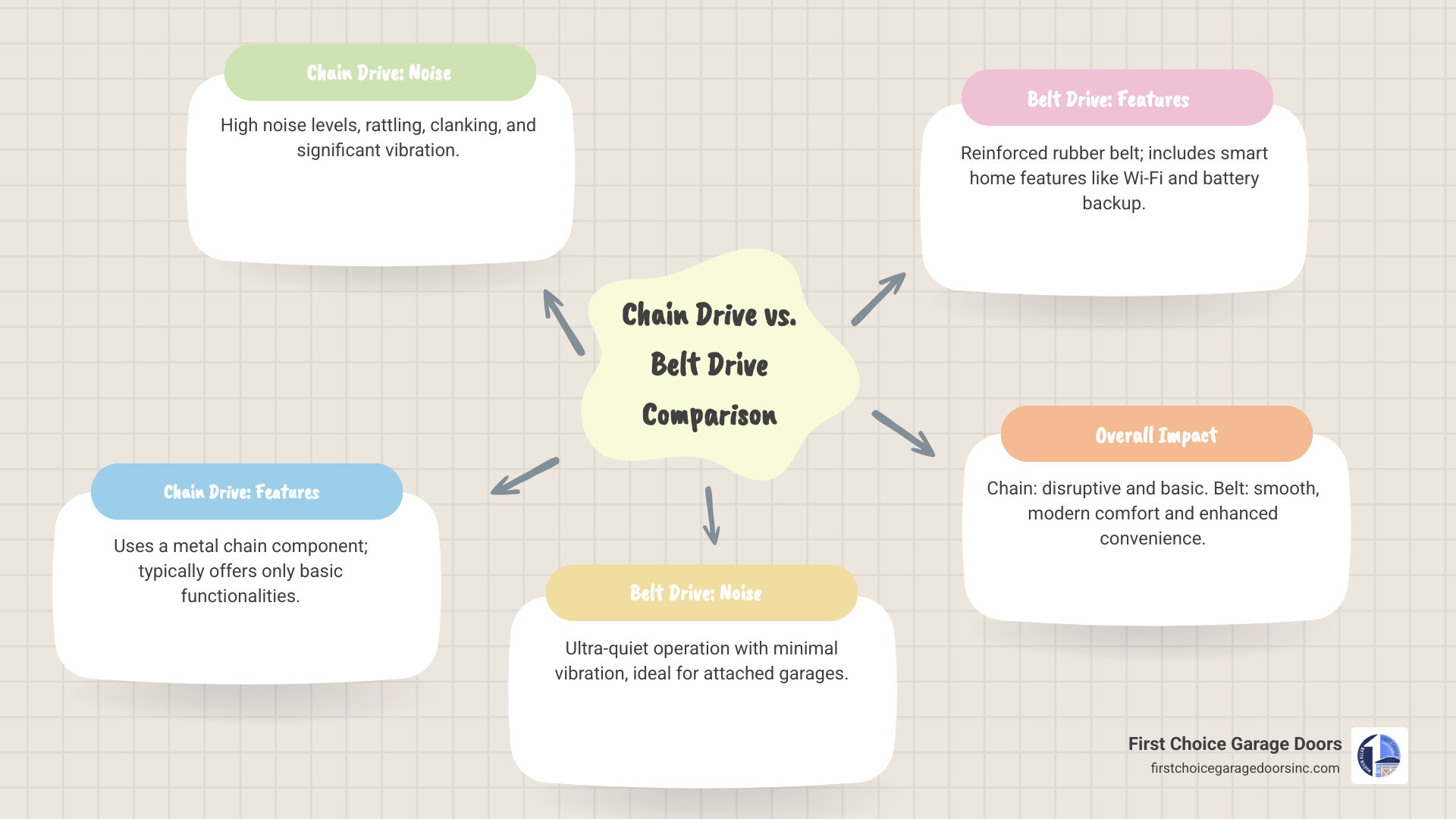
Here’s a quick comparison to highlight the key differences:
| Feature | Chain Drive | Belt Drive |
|---|---|---|
| Noise | Loud, rattling, clanking | Ultra-quiet, smooth operation |
| Maintenance | Requires lubrication, can stretch/sag | Low maintenance, durable |
| Smoothness | More vibration, less smooth | Very smooth, minimal vibration |
| Features | Basic functionality, some modern options | Advanced smart features, battery backup |
The Sound of Silence
One of the most compelling reasons homeowners consider a garage door chain to belt conversion (which, as we’ve established, usually means a full replacement) is noise reduction. Chain-drive garage door openers are notorious for their loud, clanking operation. This metallic symphony can be particularly disruptive if you have living spaces, like a master bedroom, located directly above or adjacent to the garage. Imagine the peace of mind knowing you won’t wake up the whole family when you leave for work early or arrive home late.
Belt-drive openers are generally much quieter than their chain-drive counterparts. This is due to their construction, which uses a reinforced rubber belt instead of a metal chain. This belt glides smoothly along the track, resulting in significantly less noise and vibration. Modern belt-drive openers take this a step further, often incorporating “soft start-and-stop” mechanisms. This feature gently ramps up and down the speed of the door, further minimizing operational noise and making them truly ultra-quiet. For homeowners in Maryland, Delaware, Northern VA, and SE PA, especially those with attached garages, the reduced noise from a belt drive can drastically improve home tranquility. If you’re weighing your options, we’ve put together insights on should you get a belt or chain garage door opener? to help you decide.
Smooth and Steady Performance
Beyond just being quieter, belt-drive garage door openers offer a noticeably smoother and more consistent operation. The rubber belt absorbs more vibration than a metal chain, leading to less jerky movements and a more fluid opening and closing cycle. This smooth performance isn’t just about comfort; it also translates to reduced wear and tear on your garage door’s components. Less vibration means less stress on hinges, rollers, and springs, potentially extending the lifespan of your entire garage door system.
The “soft start-and-stop” technology found in many new belt-drive openers further contributes to this smooth performance. Instead of an abrupt jolt, the door begins and ends its movement gradually. This gentle action not only reduces noise but also minimizes stress on the motor and the door itself, potentially preventing premature wear and costly repairs down the line.
Modern Features and Lifespan
Upgrading to a new belt-drive opener often means gaining access to a suite of modern features that improve convenience, security, and peace of mind. Many new belt-drive units come equipped with Wi-Fi connectivity, allowing you to monitor and control your garage door from anywhere using a smartphone app. Imagine checking if your garage door is closed from your office or letting a delivery person in remotely. Some advanced models even integrate with smart home systems, offering seamless automation.
Battery backup options are another significant benefit, ensuring that your garage door remains operational even during power outages. This can be a lifesaver, preventing you from being locked out (or in!) your garage when the power goes out. Features like built-in cameras and dual LED lighting provide added security and illumination, as seen in models like our Secure View Ultra Quiet Belt Drive Smart Opener with Camera and Dual LED Lighting.
When it comes to lifespan, garage door openers typically last between 10-15 years. While both chain and belt drives are designed for durability, the smoother operation and lower stress on components in a belt drive system can contribute to consistent performance throughout its lifespan. The reinforced rubber belts are built to last, often coming with impressive warranties.
The Feasibility of a Garage Door Chain to Belt Conversion
When homeowners ask about a garage door chain to belt conversion, they often envision a simple swap—take out the chain, put in a belt. If only it were that easy! While the desire for a quieter, smoother system is perfectly understandable, the reality is that directly converting an existing chain-drive opener to a belt-drive system is rarely feasible or recommended.
Direct Swap vs. Full Replacement
The fundamental design differences between chain and belt drive systems mean that their components are not interchangeable. A chain-drive opener’s motor, rail, trolley, and internal mechanisms are all specifically engineered to work with a metal chain. Attempting to force a belt into a system designed for a chain would lead to compatibility issues, poor performance, and potentially unsafe operation.
Many industry experts and manufacturers agree: it’s simply not possible to replace just the chain with a belt. The consensus is that retrofitting an older chain-drive opener with a belt system is not cost-effective or practical. By the time you’d source incompatible parts and attempt a complex, unproven modification, you’d likely spend more time and money than if you had just opted for a full replacement. For this reason, we always recommend replacing the entire opener unit with a new, purpose-built belt-drive model. This ensures optimal performance, safety, and compatibility with modern features.
Understanding the garage door chain to belt conversion process
Since a direct garage door chain to belt conversion isn’t practical, let’s clarify what’s actually involved when you upgrade from a chain to a belt system: it’s a complete replacement of the opener. This means removing your old chain-drive unit entirely and installing a brand-new belt-drive opener.
The key components of any garage door opener system include:
- Motor Unit: This is the housing that contains the motor, logic board, and other electronics. In a chain drive, it powers a sprocket. In a belt drive, it powers a pulley.
- Rail System: This is the long track that extends from the motor unit to the wall above the garage door. The chain or belt runs along this rail.
- Trolley: This component rides along the rail, pulled by the chain or belt, and connects to the garage door arm, moving the door up and down.
- Chain vs. Belt: The crucial difference in the drive mechanism itself. Chains are metal links, while belts are typically reinforced rubber.
- Sprocket vs. Pulley: The motor unit of a chain drive features a sprocket (a toothed wheel) to engage the chain. A belt-drive unit uses a pulley (a smooth or grooved wheel) to move the belt.
Because these components are fundamentally different in their design and interaction, they are not interchangeable. This is why a simple component swap is out of the question, and a full system replacement is the only viable path to enjoying the benefits of a belt drive. We offer both Drive Chain Belt Drive Doors and can guide you to the best option for your home.
Why You Can’t Reuse an Old Rail
One of the most common questions we hear is whether the existing rail from a chain-drive opener can be reused with a new belt-drive system. The short answer, in almost all cases, is no. The rail is a critical component, and its design is specific to the type of drive mechanism it supports.
Here’s why reusing an old rail typically isn’t possible:
- Rail Incompatibility: Garage door opener rails are not standardized. There are different cross-section profiles, such as T-shape and box shape, and these profiles are not universally interchangeable between manufacturers or even different models from the same manufacturer.
- Varying Dimensions: Even if the general shape seems similar, the exact dimensions, internal channels, and mounting points can vary significantly. A belt-drive trolley and belt system simply won’t fit or function correctly within a rail designed for a chain.
- Mismatched Mounting Points: The points where the motor unit attaches to the rail, and where the rail attaches to the header bracket, may differ. Trying to modify an old rail to fit new components could compromise its structural integrity and safety.
- Wear and Tear: Rails, like other components, are subject to wear over time. Reusing a worn rail, even if it could be made compatible, could lead to premature failure of your new opener and potentially unsafe operation.
While you might theoretically be able to drill new holes or make modifications, doing so would likely void warranties, introduce safety risks, and negate any potential time or cost savings. It’s always best to install the new rail that comes with your belt-drive opener to ensure optimal performance and safety.
DIY Replacement: A Step-by-Step Overview
While a direct garage door chain to belt conversion isn’t feasible, replacing an old chain-drive opener with a new belt-drive unit is a project many homeowners in Maryland, Delaware, Northern VA, and SE PA consider tackling themselves. However, it’s crucial to approach this task with a strong emphasis on safety and a clear understanding of the steps involved.
Safety First: Key Considerations
Working with garage door openers and the garage door itself can be dangerous if proper precautions aren’t taken. Garage doors are the largest moving objects in most homes, and an improperly installed or adjusted opener can exert deadly force. We cannot stress enough the importance of safety.
Here are critical safety considerations:
- Disconnecting Power: Always, always disconnect electrical power to the opener before you begin any work. Unplug the unit from the outlet. If it’s hardwired, turn off the corresponding circuit breaker.
- Securing the Door in the Closed Position: Ensure the garage door is fully closed and stable. If your door is unbalanced or has damaged springs, do not proceed; call a professional.
- Spring Tension Warning: Garage door springs (torsion or extension) are under extreme tension and can cause severe injury or even death if mishandled. Never attempt to loosen, move, or adjust garage door springs, cables, pulleys, brackets, or their hardware. This work should only be performed by a trained door systems technician.
- Working with a Partner: Some steps of the installation, especially handling the heavy motor unit and rail, are much safer and easier with two people.
- Clear the Area: Ensure children and pets are away from the work area. Remove any vehicles or obstacles from the garage.
- Read the Manual: Carefully read and understand the installation manual for your new belt-drive opener. Each model may have specific instructions and warnings.
General Steps for Opener Replacement
Once safety precautions are in place, replacing your old opener with a new belt-drive model generally follows these steps. These are general guidelines; always refer to your specific opener’s installation manual.
- Remove the Old Unit:
- Disconnect the garage door from the opener by pulling the emergency release cord.
- Unbolt the door arm from the garage door.
- Carefully remove the old motor unit and rail system from its mounting brackets and the header bracket.
- Remove any old sensors, wall controls, and wiring.
- Assemble the New Rail/Motor:
- Follow the manufacturer’s instructions to assemble the new belt-drive rail system and attach it to the motor unit. This typically involves sliding the belt into the rail and connecting the idler pulley at the far end.
- Install the New Unit:
- Attach the new header bracket above the garage door.
- Lift and secure the assembled rail and motor unit to the header bracket.
- Hang the motor unit securely from the ceiling joists using the provided hanging brackets and hardware. Ensure it’s centered with the garage door.
- Attach Sensors and Wall Control:
- Install the new safety reversing sensors (photoelectric eyes) on either side of the garage door, no higher than 6 inches from the floor. Wire them according to the manual.
- Install the new wall control unit, typically at least 5 feet high and within sight of the garage door, away from moving parts. Wire it to the motor unit.
- Connect Power, Program, and Test:
- Connect the new opener to power.
- Program the travel limits (how far the door opens and closes) and set the automatic force reversal.
- Test the safety reversal system by placing a 1.5-inch object (like a 2×4 laid flat) in the door’s path. The door should reverse upon contact.
- Test the safety reversing sensors by breaking the light beam while the door is closing. The door should stop and reverse.
- Program your remote controls and keypads.
For a wider selection and more detailed specifications on modern units, explore our range of Garage Door Openers.
Challenges in a DIY garage door chain to belt conversion
While replacing an opener can be a rewarding DIY project, it comes with potential challenges, especially for those unfamiliar with garage door systems. These difficulties are why we emphasize professional installation for homeowners in our service areas of Maryland, Delaware, Northern VA, and SE PA.
Some of the potential difficulties you might encounter include:
- Ensuring Proper Door Balance: A crucial step before installing any opener is to ensure your garage door is properly balanced. An unbalanced door will put undue strain on your new opener and can be dangerous. To test, lift the door halfway manually and release it. If it doesn’t stay in place or drifts, it’s unbalanced and needs professional adjustment of the springs. Never attempt to adjust springs yourself.
- Aligning Safety Sensors Correctly: The safety reversing sensors must be perfectly aligned and unobstructed for the door to close safely. Misalignment is a common troubleshooting issue and can prevent your door from closing at all or, worse, compromise its safety features.
- Programming Travel Limits and Force Settings: Accurately setting the up and down travel limits and the force required to open and close the door is vital. Incorrect settings can cause the door to stop short, not close fully, or exert excessive force, posing a safety hazard.
- Electrical Wiring: While many modern openers plug into a standard outlet, some may require basic wiring for the wall control or sensors. If you’re uncomfortable with electrical work, this could be a hurdle.
- Heavy Lifting and Awkward Positions: Handling the motor unit and rail, especially for longer doors, can be cumbersome and require working on a ladder for extended periods.
These challenges, coupled with the critical safety aspects, often make professional installation a more appealing and ultimately safer choice.
When to Call a Professional
While the idea of a DIY garage door chain to belt conversion (or rather, replacement) might seem appealing, there are many situations where calling in the experts is not just convenient, but essential for safety and optimal performance.
Signs You Need an Expert
We often encounter situations where homeowners have attempted a DIY installation only to run into complex issues. Here are clear signs that it’s time to put down the tools and call a professional garage door technician:
- Unbalanced Door: As mentioned, if your garage door doesn’t stay put when manually lifted halfway, it’s unbalanced. This indicates issues with the springs, which are under extreme tension. Adjusting these is highly dangerous and requires specialized training and tools.
- Damaged Springs or Cables: If you notice broken springs, frayed cables, or any damage to your door’s hardware, do not attempt to operate the door or install an opener. This is a critical safety issue that only a trained professional should address.
- Lack of Proper Tools or Experience: If you don’t have the necessary tools (e.g., specialized wrenches, a sturdy ladder, electrical testers) or lack confidence in your mechanical or electrical skills, it’s best to call us.
- Safety Concerns: Any hesitation or discomfort regarding the safety aspects of the installation is a strong indicator to seek professional help. Your safety and the safety of your family are paramount.
- Installation Complexity: If your garage has unusual ceiling structures, limited space, or if the instructions for your specific opener seem overwhelming, a professional can steer these complexities with ease.
- Old or Damaged Door: If your garage door itself is old, warped, or damaged, installing a new opener might not be the complete solution. A professional can assess the entire system and recommend whether door repairs or replacement are also needed.
Benefits of Professional Installation
Choosing professional installation for your new belt-drive garage door opener offers numerous advantages:
- Expertise and Efficiency: Our technicians are highly trained and experienced in installing all types of garage door openers. We can complete the installation quickly and efficiently, ensuring every component is correctly fitted and adjusted.
- Safety Assurance: We prioritize safety above all else. Our professionals are well-versed in all safety protocols, including handling high-tension springs and ensuring all safety features of your new opener (like the safety reversing sensors and auto-reversal) are functioning perfectly. This eliminates the risks associated with DIY attempts.
- Proper Alignment and Tuning: Achieving perfect alignment of the rail, door arm, and safety sensors, along with precise programming of travel limits and force settings, is critical for optimal performance and longevity. Our technicians have the expertise to fine-tune your system for smooth, quiet, and reliable operation.
- Warranty Protection: Professional installation often helps ensure your manufacturer’s warranty remains valid. Incorrect DIY installation can sometimes void warranties.
- Peace of Mind: Knowing that your new belt-drive opener has been installed correctly and safely by certified professionals provides invaluable peace of mind. You can trust that your garage door will operate reliably for years to come.
Our Commitment to Quality
At First Choice Garage Doors, we are proud to serve homeowners in Maryland, Delaware, Northern VA, and SE PA with best expertise. Our unique selling proposition lies in prioritizing quality and safety, delivering prompt and professional service every time. When you choose us for your garage door opener replacement, you’re not just getting an installation; you’re getting the assurance that the job will be done right, safely, and efficiently. Our team is committed to providing you with the best possible experience, from expert advice to flawless execution.
Conclusion: Upgrade Your Garage for a Quieter, Smarter Home
The journey from a noisy chain-drive opener to the quiet efficiency of a belt-drive system is a significant upgrade for any homeowner. While a direct garage door chain to belt conversion isn’t a practical reality, replacing your old unit with a new belt-drive opener is a highly recommended and beneficial investment.
You’ll gain a multitude of advantages, including:
- Quieter Operation: Enjoy the peace and tranquility of an ultra-quiet garage door, especially valuable if living spaces are near the garage.
- Modern Features: Benefit from smart home integration, Wi-Fi connectivity, and battery backup for ultimate convenience and security.
- Improved Reliability: Experience smoother performance, less vibration, and potentially reduced wear on your garage door components, leading to a longer lifespan for your entire system.
Our final recommendation is clear: for a truly successful and safe upgrade, replace the entire opener unit with a new belt-drive system. This approach ensures compatibility, maximizes the benefits, and adheres to the highest safety standards.
For expert advice and professional installation of a new Belt Drive opener, we invite you to explore our wide range of options and find how we can improve the comfort, convenience, and safety of your home. Visit our Products and Services page today to learn more about how First Choice Garage Doors can help you achieve a quieter, smarter garage.